
CYP1A2 Induction Calculator
How Your Lifestyle Affects CYP1A2 Enzyme
This calculator estimates how your smoking, alcohol, and grilled meat consumption might affect your CYP1A2 enzyme activity, which impacts how your body processes certain medications.
Ever wondered if your weekend barbecue could mess with your meds? It sounds far-fetched - until you dig into the science. Charcoal-grilled meats don’t just taste good; they trigger real biochemical changes in your body that can affect how your medications work. The key player? An enzyme called CYP1A2. This liver enzyme handles about 10% of common drugs, including clozapine for schizophrenia, theophylline for asthma, and even caffeine. And yes - what you grill can change how fast or slow your body processes these drugs.
What Happens When You Grill Meat Over Charcoal?
When meat hits high heat over charcoal, it doesn’t just sear - it chemically transforms. Fat drips onto hot coals, creating smoke filled with polycyclic aromatic hydrocarbons (PAHs) like benzo[a]pyrene. The meat’s surface also forms heterocyclic amines (HCAs), another group of compounds linked to cancer risk. These aren’t just toxins - they’re potent signals to your liver. They bind to something called the aryl hydrocarbon receptor (AhR), which flips a genetic switch that tells your body to make more CYP1A2 enzyme.More enzyme means faster drug breakdown. If you’re on a medication cleared by CYP1A2, your body might process it too quickly, lowering its effectiveness. Think of it like turning up the faucet - your drug gets washed out before it can do its job.
The Two Landmark Studies That Started the Debate
In 1999, researchers at the University of Michigan led by Dr. Robert Fontana did something unusual: they took biopsies from people’s intestines and livers. Ten healthy adults ate about 250 grams of chargrilled meat every day for a week. By the end, CYP1A2 activity in the liver jumped by nearly 50%. Intestinal CYP1A1 levels rose even more. This wasn’t a guess - they measured enzyme protein directly. Their conclusion? Dietary PAHs from grilled meat can strongly induce CYP1A2.Then, in 2005, a team in Denmark led by Dr. Kim Brøsen tried to replicate it - but with a different method. Instead of biopsies, they used caffeine as a probe. Caffeine is metabolized almost entirely by CYP1A2, so its clearance rate tells you how active the enzyme is. Twenty-four men ate charcoal-broiled meat twice a day for five days. Result? CYP1A2 activity increased by just 4.2%. Not even close to statistically significant. They found no change in how the body handled other drugs like theophylline or tacrine.
So why the contradiction? Fontana measured the enzyme itself. Brøsen measured what the enzyme actually did in real time. One looked at the machine; the other looked at the output. Fontana’s group used tissue samples - direct proof of enzyme buildup. Brøsen’s group used real-world drug metabolism - the kind that matters to patients.
Why Most Doctors Don’t Warn You About Grilled Meat
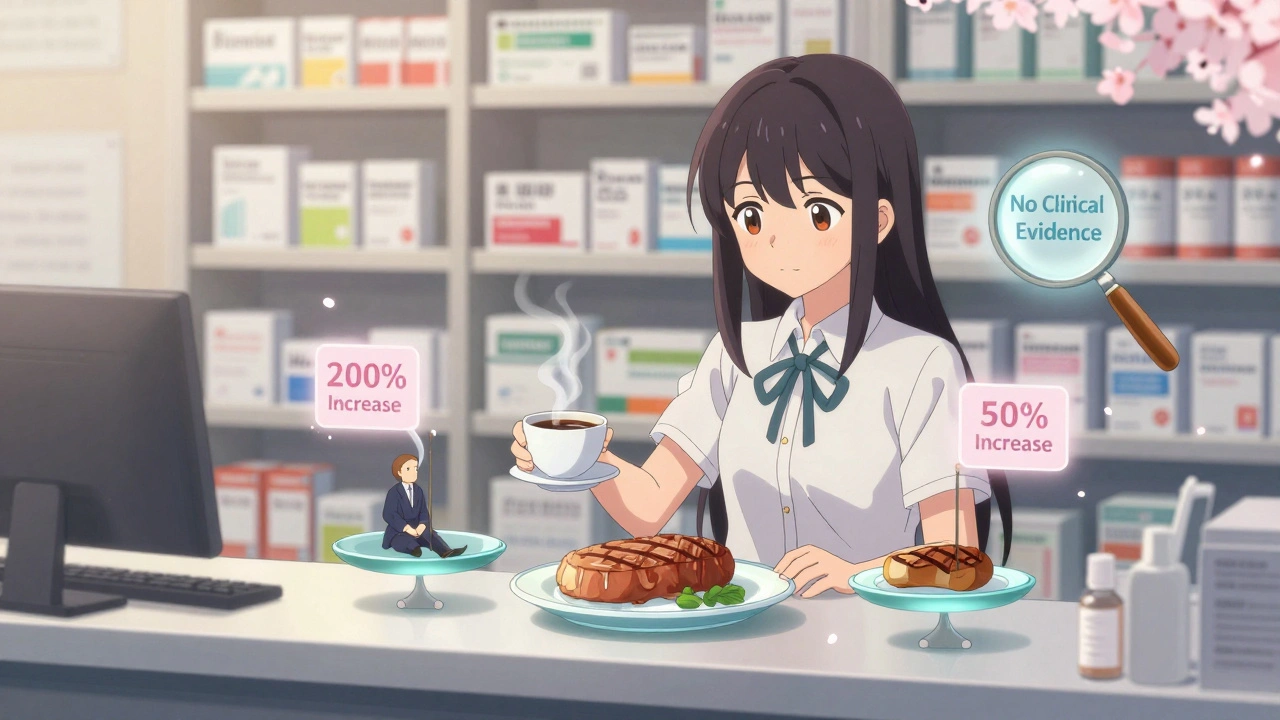
If the science is split, the clinical reality is clearer: no one’s been hospitalized because they ate too much steak off the grill. The FDA and EMA don’t list grilled meat as a risk factor in any drug label. The American Society of Health-System Pharmacists has recorded only three possible cases in ten years - and none were confirmed. No pharmacy school curriculum highlights this interaction. Mayo Clinic and Cleveland Clinic don’t mention it in patient guides.Here’s the real kicker: smoking increases CYP1A2 activity by 200% to 400%. That’s four to eight times stronger than the effect seen in Fontana’s study. If you smoke, your enzyme levels are already maxed out - adding grilled meat won’t change much. If you don’t smoke, your baseline CYP1A2 is low, and even a 50% increase might not push you into dangerous territory.
Also, most CYP1A2 drugs have wide safety margins. Theophylline? Yes, it’s narrow - but doctors monitor blood levels anyway. Clozapine? Also narrow - but its side effects are tied to genetics and other drugs, not diet. In 20 years of clinical practice, no pharmacist has documented a case where grilled meat caused toxicity or treatment failure.

What About Caffeine? It’s a Clue
Caffeine is the perfect natural test subject. It’s consumed daily, metabolized only by CYP1A2, and its breakdown products are easy to measure in urine. If grilled meat mattered, coffee drinkers who eat charred burgers should feel jittery faster - or need more coffee to get the same buzz. But that’s not what happens. People who eat grilled meat regularly don’t report needing more coffee. Their tolerance doesn’t shift. That’s real-world evidence that the effect, if it exists, is too small to notice.Even in Fontana’s study, the enzyme increase didn’t correlate with actual drug levels - only with DNA damage markers. That suggests the body might be adapting, not just over-activating. It’s like your liver gets a warning signal, builds extra machinery, then says, “Okay, we’re good now,” and calms down.
Who Should Still Be Cautious?
There’s one group that might want to think twice: people on narrow-therapeutic-index drugs who also smoke, drink heavily, or have liver disease. For them, even a small change could matter. If you’re on clozapine and you’re a heavy smoker who grills daily, your doctor should already be watching your levels. Adding grilled meat won’t be the main issue - smoking will.Another group: people with genetic variants in the AhR receptor. A 2021 follow-up study showed that some people’s bodies respond more strongly to PAHs than others. We don’t test for this routinely - but if you’ve had unexplained changes in drug response, it’s worth discussing with a pharmacogenomics specialist.
What Does This Mean for You?
If you love your charcoal steak, ribs, or chicken - keep enjoying it. The evidence that it interferes with medications is weak, inconsistent, and clinically insignificant for almost everyone. You’re far more likely to have a problem with grapefruit juice, alcohol, or smoking than with your barbecue.But here’s what you should do anyway:
- If you’re on clozapine, theophylline, or tacrine, make sure your doctor knows your full diet and lifestyle - including smoking and alcohol use.
- Don’t panic if you had a big BBQ before a blood test. One meal won’t change your drug levels.
- If you’re worried, ask your pharmacist: “Is this drug affected by anything I eat?” They’ll tell you about the real risks - grapefruit, St. John’s wort, or alcohol - not grilled meat.
The truth? This isn’t a warning you need to change your life over. It’s a reminder that biology is complicated - and sometimes, the most interesting science doesn’t translate to real-world risk.
What’s Next for This Research?
No new clinical trials on grilled meat and CYP1A2 have been registered since 2005. Funding has dried up. Why? Because the effect is too small to matter. Researchers are now focused on stronger, clearer interactions - like how genetics, antibiotics, or obesity alter drug metabolism. Grilled meat? It’s a fascinating lab curiosity, not a public health concern.That doesn’t mean it’s irrelevant. It just means it’s not urgent. For now, enjoy your burgers. Just don’t smoke while you eat them - that’s the real problem.
Can eating charcoal-grilled meat make my medication stop working?
It’s theoretically possible, but extremely unlikely in practice. Studies show that grilled meat can slightly increase the CYP1A2 enzyme, which breaks down some medications. But the effect is small, inconsistent, and rarely strong enough to reduce drug effectiveness. For most people, especially those not smoking or taking narrow-therapeutic-index drugs, this interaction has no real impact.
Should I avoid grilled meat if I take clozapine or theophylline?
No, you don’t need to avoid it. There are no documented cases of clozapine or theophylline toxicity caused by grilled meat. Doctors monitor blood levels of these drugs already - especially if you smoke, drink alcohol, or change your diet significantly. If you’re concerned, talk to your pharmacist or prescriber, but don’t stop eating your favorite barbecue.
Does caffeine metabolism change after eating grilled meat?
Studies using caffeine as a marker found no consistent change in how fast it’s broken down after eating grilled meat. Even in the study that showed enzyme increases, caffeine clearance didn’t shift meaningfully. If you drink coffee regularly, your body adjusts to many factors - grilled meat isn’t one that makes a noticeable difference.
Is grilled meat more dangerous than smoking for drug interactions?
Absolutely not. Smoking increases CYP1A2 activity by 200% to 400%. Grilled meat, at most, increases it by 50% - and often not at all. If you smoke, that’s the main issue. If you don’t smoke, grilled meat won’t make a meaningful difference to your medication levels.
Why don’t drug labels warn about grilled meat?
Because regulatory agencies like the FDA and EMA only add warnings when there’s clear, repeated evidence of harm. No such evidence exists for grilled meat. They do warn about grapefruit juice, smoking, and certain herbs - all of which have proven, strong effects. Grilled meat doesn’t meet that bar.
Should I get tested for CYP1A2 gene variants if I eat a lot of grilled meat?
Not unless you’re already being tested for pharmacogenomics reasons - like unexplained side effects or poor response to medications. While some people’s genes make them more sensitive to PAHs, routine testing isn’t recommended. The risk is too low, and the benefit too uncertain to justify the cost or complexity.



Comments
Ali Bradshaw
December 4, 2025 AT 15:40 PMBeen grilling for years and never once thought about my meds. Guess I'm lucky - I'm on lisinopril and melatonin. Still, wild how food can mess with biochemistry. I'll keep my steak, but maybe skip the charred bits next time.
Annie Grajewski
December 4, 2025 AT 22:31 PMso like… if i eat a charred burger and then take my theophylline… does it just vanish into thin air like my will to live on mondays? 😭 also why is no one talking about how this is just another ‘food is medicine’ cult thing masquerading as science. i mean come on.
Jimmy Jude
December 6, 2025 AT 01:23 AMLet me get this straight - you’re telling me the real threat to your health isn’t the carcinogens in the smoke, or the fact that you’re eating meat cooked over burning wood, but that your *meds might not work*? Bro. You’re not a pharmacokinetic lab rat. You’re a human being who likes BBQ. Enjoy it. Stop overthinking everything.
Rupa DasGupta
December 6, 2025 AT 03:54 AMmy cousin took clozapine and ate grilled chicken every night for a month… she ended up in the psych ward… was it the meat? the stress? the fact she stopped sleeping? nobody knows 😭 but now i don’t touch charcoal… ever. #trauma
Norene Fulwiler
December 7, 2025 AT 13:24 PMAs someone who grew up in a household where dinner was always grilled over charcoal, I’ve seen generations take everything from blood pressure meds to antidepressants - and not one person ever had an issue because of their steak. This feels like academic noise with zero real-world weight. Enjoy your food. Your liver’s been handling worse since you were 16.
Ada Maklagina
December 8, 2025 AT 10:52 AMgrilled meat = bad? nah. smoking = bad? yes. grapefruit = bad? yes. worrying about this? unnecessary. just keep living.
Harry Nguyen
December 9, 2025 AT 12:53 PMOh great another overeducated American overanalyzing their dinner. In China we grill meat over open flame every day and our doctors don’t even blink. You think your body can’t handle a little smoke? You’re weak. Drink your coffee. Eat your steak. Stop listening to studies written by people who’ve never held a spatula.
Katie Allan
December 10, 2025 AT 19:49 PMI love how this post doesn’t just list facts - it gives context. It says: science is messy, real life is messier, and sometimes the most interesting findings are the least consequential. That’s rare. Thank you for not turning this into fear-mongering. We need more of this kind of thoughtful, nuanced thinking.
James Moore
December 11, 2025 AT 02:54 AMLet’s be clear - the CYP1A2 enzyme is part of a complex, dynamic, and highly individualized metabolic system that responds not just to dietary PAHs, but also to circadian rhythm, genetic polymorphisms, gut microbiome composition, concurrent medication use, and even psychological stressors - all of which interact in nonlinear, non-additive ways that are poorly understood in clinical settings. The fact that two studies - one using direct tissue biopsy and one using caffeine clearance - produced statistically divergent results speaks not to the irrelevance of the phenomenon, but to the profound limitations of reductionist pharmacokinetic models when applied to whole organisms living in real-world environments. In other words: your liver doesn’t operate like a test tube, and neither should your health decisions.
Kylee Gregory
December 11, 2025 AT 09:37 AMI think the real takeaway here is humility. Science gave us a theory. Real life gave us conflicting data. Medicine gave us no clear warnings. And yet - people are still alive, still taking their meds, still grilling. Maybe the answer isn’t to panic or to prescribe, but to observe, to listen to our bodies, and to trust that evolution gave us more resilience than we give ourselves credit for.
Laura Saye
December 11, 2025 AT 14:08 PMFrom a pharmacogenomic perspective, the AhR pathway activation is a fascinating adaptive response - not necessarily a pathological one. The enzyme induction may be a compensatory detoxification mechanism, and the lack of clinical correlation suggests that homeostatic feedback loops are effectively buffering any potential pharmacokinetic disruption. In essence, the body may be ‘preparing’ for toxin exposure without actually altering therapeutic outcomes. This is why we need systems biology approaches, not just single-enzyme assays.
an mo
December 13, 2025 AT 03:24 AMThey’re lying. The FDA knows. They suppress this because Big Pharma profits off people needing higher doses. You think they want you to know your meds are being burned off by your BBQ? Wake up. The smoke isn’t just from the coals - it’s from the cover-up.
aditya dixit
December 14, 2025 AT 14:30 PMMy dad used to grill every Sunday. He took warfarin for 20 years. Never had an issue. He smoked, drank tea, ate spicy food - but never worried about his steak. I think the real lesson here is: trust your doctor, not the headlines. If your med has a narrow window, they’ll monitor you. Otherwise? Enjoy your food.
Lynette Myles
December 16, 2025 AT 00:55 AMThey’re testing this on healthy people. What about the elderly? The immunocompromised? The ones on five meds? They’re not studying the real patients. This is a silent killer.
Mark Ziegenbein
December 17, 2025 AT 03:19 AMLook I get it - you’re all here to pat yourselves on the back for being the ones who ‘understand the science’ while the peasants are out there eating charcoal-broiled chicken like savages. But let me remind you - the only reason we even have this conversation is because someone got paid to write a paper about it. Meanwhile, people in Nigeria, Mexico, Japan, and Brazil have been eating grilled meat with their antihypertensives for centuries and nobody’s dropping dead. So maybe the real problem isn’t the meat - it’s the need to turn every damn thing into a crisis.