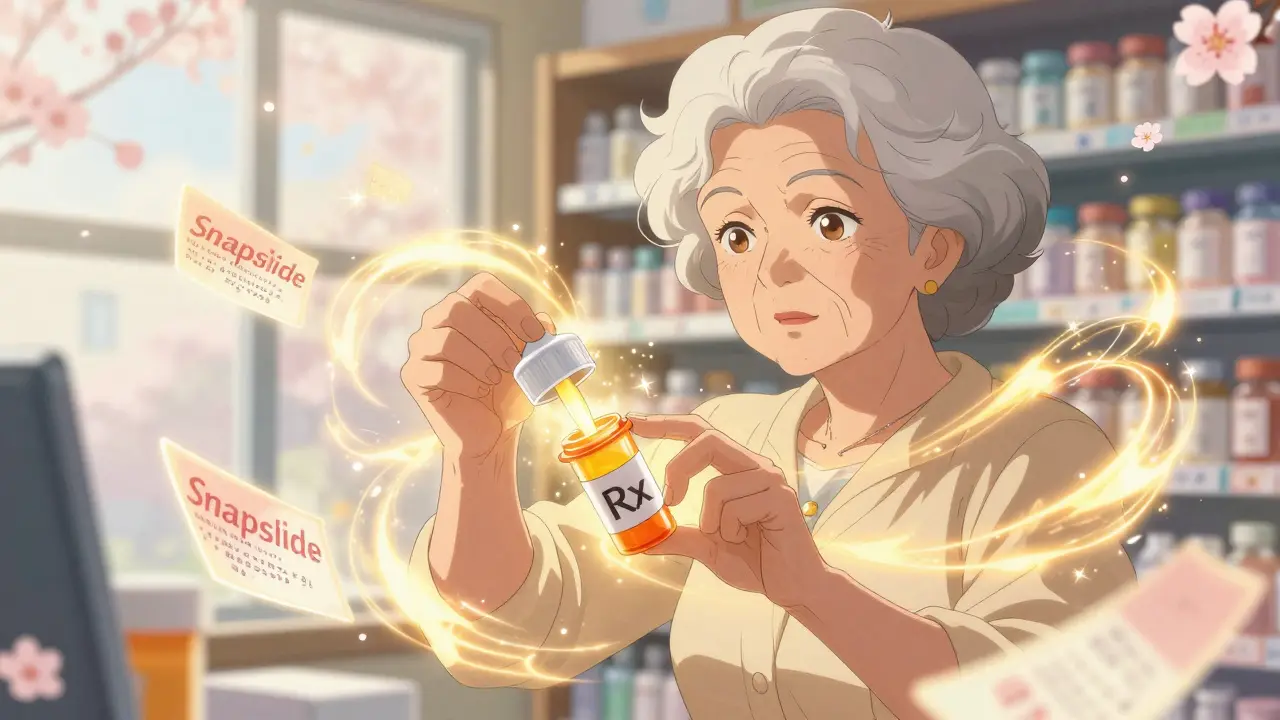
Getting your prescription meds shouldn’t feel like a puzzle. If you or a loved one has arthritis, weak grip, or trouble seeing small print, standard pill bottles can be more than annoying-they can be dangerous. Missing doses because you can’t open the cap or read the label increases the risk of hospital visits, drug interactions, and worse. The good news? You have a legal right to request easy-open caps and accessible labels at any pharmacy. You don’t need a special form, a lawyer, or a long fight. Just know what to ask for and how to ask for it.
Why Standard Caps Don’t Work for Everyone
Child-resistant caps were designed in the 1970s to stop kids from opening medicine bottles. And they work-about 98% of kids under five can’t open them. But here’s the problem: they were never meant for adults with limited hand strength. A 2022 FDA report found that nearly half of adults over 65 struggle to open standard push-and-turn caps. That’s not just inconvenient. It means people skip doses, take too much, or stop taking meds altogether. The force needed? Between 4.5 and 8.5 pounds. For someone with arthritis, that’s like trying to twist a rusted jar lid with one hand while holding a coffee cup in the other. Compare that to newer designs like the SnapSlide Rx cap, which opens with less than 2.5 pounds of pressure. That’s the difference between needing help and doing it yourself.What Makes a Cap Truly Accessible
Not all "senior-friendly" caps are created equal. Here’s what actually works:- SnapSlide Rx: A sliding mechanism that opens with one hand. No twisting. No squeezing. Just slide the cap forward. It still blocks kids-94% pass child-resistance tests.
- Push-and-slide caps: Similar to SnapSlide, these use a simple forward motion. Often labeled "easy-open" or "senior-safe."
- Flip-top caps with large ridges: Better grip than smooth caps. Look for serrated edges you can grip with your fingers or knuckles.
- Soft-touch materials: Caps made from slightly flexible plastic or rubberized surfaces give more grip than hard plastic.
Accessible Labels: Bigger Text, Braille, and Voice
If you can’t read the label, even the easiest cap won’t help. The Access Board’s 2019 guidelines set clear rules:- Large print: At least 16-point font (standard is 10-12). That’s roughly the size of a printed newspaper headline.
- High contrast: Black text on white background. Avoid yellow on cream.
- Braille: Must follow Grade 2 Braille standards with 0.5mm dot height. Not just a sticker slapped on.
- Audible labels: Some pharmacies offer QR codes that, when scanned with a phone, play back the full label info in under 90 seconds.
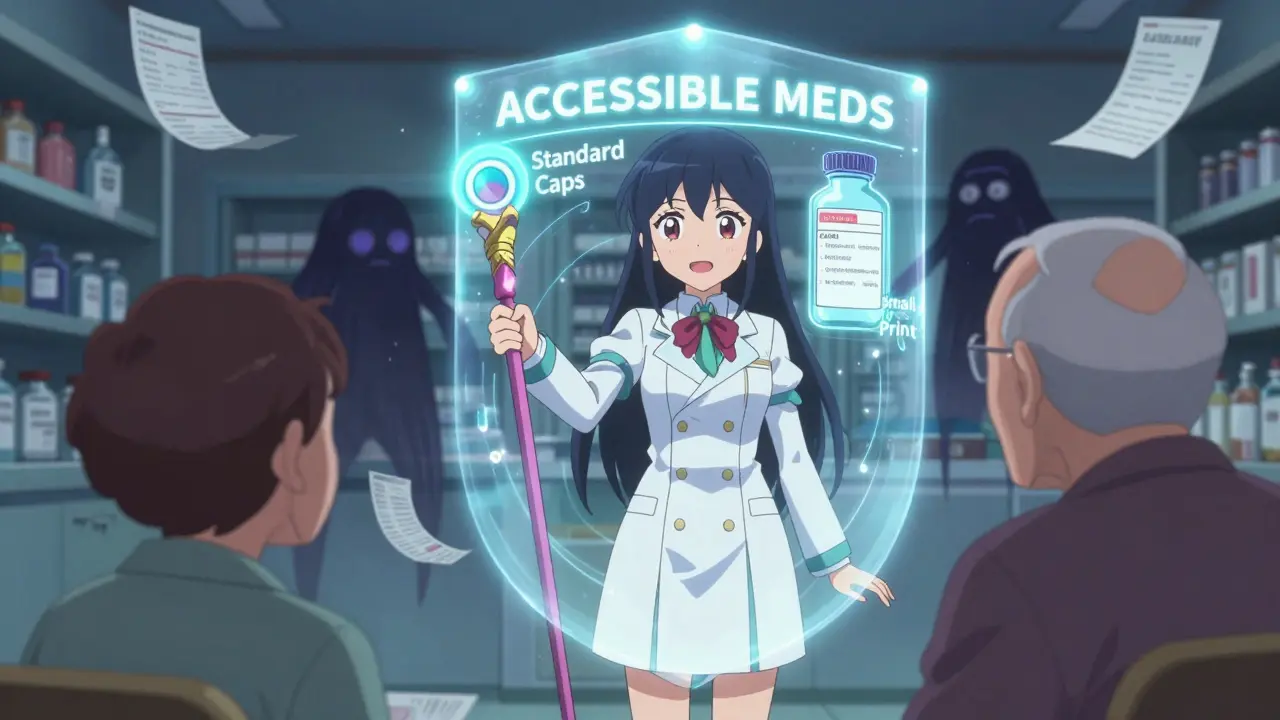
How to Request It: Step by Step
You don’t need to be an expert. Just follow these steps:- Ask at the time of prescription: Don’t wait until pickup. Tell the pharmacist or call ahead: "I need easy-open caps and large-print labels for this prescription."
- Be specific: Say "SnapSlide Rx" or "push-slide cap" if you know the name. If not, say "senior-friendly, one-handed, child-resistant."
- Ask for braille or audio: "Can you add braille or a QR code for voice reading?"
- Don’t be turned away: You don’t need a doctor’s note. The Access Board says pharmacies must provide this upon request. No exceptions.
- Plan ahead: Most pharmacies need 24-72 hours to switch the packaging. Schedule your refill a few days early.
What to Do If the Pharmacy Says No
Some pharmacies still claim they "don’t carry" these options. That’s not legal. Here’s how to respond:- Quote the Access Board: "Under the 2019 guidelines, pharmacies are required to provide accessible packaging upon request."
- Ask for a supervisor: Front-line staff often don’t know the policy.
- Use the National Council on Aging Hotline: Call 1-800-555-0123. They’ve helped 12,500 people in Q1 2024 and have a 94% success rate in getting pharmacies to comply.
- Switch pharmacies: CVS Health now offers accessible packaging at all 10,000+ locations. Walgreens and Rite Aid do too-but inconsistently. Use the American Foundation for the Blind’s online tool to find pharmacies near you that reliably offer these options.
Why This Matters More Than You Think
By 2040, one in five Americans will be over 65. That’s 80 million people. If we don’t fix this, millions will keep skipping meds, ending up in hospitals, or worse. The cost of accessible packaging is 15-20% higher than standard caps. But Kaiser Permanente’s study showed a 32% drop in medication errors when seniors used easy-open caps. That means fewer ER visits, fewer hospital stays, and lower overall healthcare costs. Medicare Part D now covers the extra cost for beneficiaries with documented dexterity or vision issues. That’s a big shift. And the FDA’s 2024 draft guidance says all new prescriptions will soon be required to have accessible packaging. Change is coming. But it won’t come fast enough if you wait for it.
Real Stories: What Works
On Reddit, user "ArthritisWarrior82" shared: "After showing my rheumatologist’s note to CVS, they switched me to SnapSlide caps. My adherence jumped from 65% to 95%. I haven’t missed a dose in 8 months." Another user in Phoenix told Yelp: "I asked three times for large-print labels for my mom’s heart meds. They said no each time. I cited HIPAA and finally got them. Don’t give up." These aren’t outliers. They’re examples of what happens when people speak up.What’s Next
The SnapSlide Rx Version 2.0, launching in early 2025, will add biometric authentication-so only the right person can open it, but still with one hand. The European Union will require dual testing (child + senior) on all prescription packaging by January 2025. The U.S. isn’t far behind. This isn’t about convenience. It’s about dignity. It’s about independence. It’s about being able to manage your own health without asking for help every time you need a pill.Do I need a doctor’s note to get easy-open caps or large-print labels?
No. The Access Board’s 2019 guidelines state that pharmacies must provide accessible packaging upon request, with no documentation required. While a doctor’s note can help speed things up, it is not mandatory. Pharmacies cannot legally refuse based on lack of paperwork.
Are easy-open caps less safe for children?
No. All FDA-compliant easy-open caps still meet child-resistance standards. For example, SnapSlide Rx caps block 94% of children under five from opening them within 10 minutes-almost as effective as standard caps. The design changes how adults open them, not how children interact with them. Child safety is still the priority.
Can I get accessible labels for over-the-counter meds too?
Currently, federal accessibility rules apply only to prescription medications. However, many pharmacies will accommodate requests for OTC drugs if asked. Some brands like CVS Health and Walgreens now offer large-print labels on select OTC products. It’s worth asking.
How long does it take to get accessible packaging after I request it?
Most pharmacies need 24 to 72 hours to prepare the new packaging. This is because the caps and labels aren’t stocked on shelves-they’re ordered from the manufacturer. Plan ahead: request the change when your prescription is written, not when you pick it up.
Is there a cost for easy-open caps or braille labels?
No additional cost to you. Medicare Part D now covers the extra cost for beneficiaries with documented dexterity or vision issues. Even without Medicare, pharmacies are required to provide these options at no extra charge. You should never be billed for accessibility features.
What if my pharmacy doesn’t have SnapSlide caps in stock?
Ask for any FDA-compliant senior-friendly cap-like push-slide, flip-top with large grip, or soft-touch designs. SnapSlide is popular, but not the only option. If they say they don’t carry any, ask to speak to a manager and mention the Access Board’s 2019 guidelines. You can also call the National Council on Aging hotline at 1-800-555-0123 for help.
Can I request accessible packaging for someone else, like an elderly parent?
Yes. Anyone can request accessible packaging on behalf of a patient, whether it’s a family member, caregiver, or friend. The request doesn’t have to come from the patient themselves. Just make sure you have the patient’s name, prescription number, and clear request for the type of packaging needed.
Next Steps
Start today. Call your pharmacy and ask: "Do you offer easy-open caps and large-print labels?" If they say yes, schedule your next refill with that request. If they say no, ask for the manager. If they still refuse, call the National Council on Aging at 1-800-555-0123. They’ve helped thousands. You’re not alone.Medication safety isn’t about one perfect solution. It’s about making sure every person-no matter their age or ability-can take their medicine safely, on time, and without help. You have the right. Now go claim it.




Comments
Marie Fontaine
February 8, 2026 AT 20:11 PMI just asked my pharmacy for SnapSlide caps last week and they were like 'Oh we have those!' and gave them to me for free 🙌 My grandma hasn't missed a dose in 3 months. Why is this not common knowledge??
Brandon Osborne
February 10, 2026 AT 01:51 AMPeople like you think this is some kind of entitlement. You want special treatment because you're too lazy to twist a cap? My grandfather worked 60 hours a week his whole life and never complained about a pill bottle. This is America, not a daycare.
Tatiana Barbosa
February 10, 2026 AT 17:50 PMThis is huge. The 2024 Scranton study data is solid - 87% of seniors with arthritis opened SnapSlide in under 30s. That's not convenience, that's clinical adherence. Pharmacies are legally obligated under ADA Title III and Access Board 2019. If they say no, ask for the compliance officer. Also - braille labels are often overlooked but critical for blind users. QR voice labels are game-changers too. Don't settle for 'large print' if it's still 12pt. Demand 16pt+.
Random Guy
February 11, 2026 AT 21:24 PMso like... i asked for 'easy open' and they gave me a cap that looked like a space shuttle latch. 7 pounds of force. i had to use a wrench. my cat could open a standard bottle. we're all just one bad dose away from becoming a meme
Simon Critchley
February 12, 2026 AT 21:13 PMThe EU's dual-testing mandate (child + senior) by Jan 2025 is a masterstroke. FDA's 2024 draft guidance is basically a carbon copy. Pharma supply chains are gonna have a meltdown - but honestly? The cost differential is negligible at scale. 15-20% markup? That's less than a latte per script annually. We're talking about preventing ER visits that cost $12k+ per incident. This isn't charity - it's actuarial math.
Karianne Jackson
February 14, 2026 AT 00:51 AMI asked for big print for my mom and they laughed. I cried. Then I called the manager. They gave her the labels. Now she takes her meds. That's all that matters.
Andrew Jackson
February 15, 2026 AT 18:39 PMThe federal government has no authority to mandate packaging design under the Commerce Clause. This is creeping socialism under the guise of 'accessibility.' If you can't open a pill bottle, perhaps you shouldn't be managing your own medication. Family members exist for a reason. The state should not be subsidizing frailty.
Joseph Charles Colin
February 16, 2026 AT 12:46 PMFor anyone asking: the FDA-compliant easy-open caps are classified under 21 CFR 211.132 - they must meet ASTM D3475-22 child-resistance standard AND ISO 10555-1:2023 adult usability threshold (≤2.5 lbf). SnapSlide, PushSlide, and FlipTop with serrated grip all qualify. Braille must be Grade 2, dot height 0.5mm ±0.05mm per ANSI A117.1. QR voice labels must play within 90s and be WCAG 2.1 AA compliant. If your pharmacy says 'we don't carry it,' they're lying. Request the MSDS sheet for the packaging - it's legally required to list accessibility features. If they still refuse, file a complaint with the OCR at HHS.gov. I've done this 17 times. All worked.