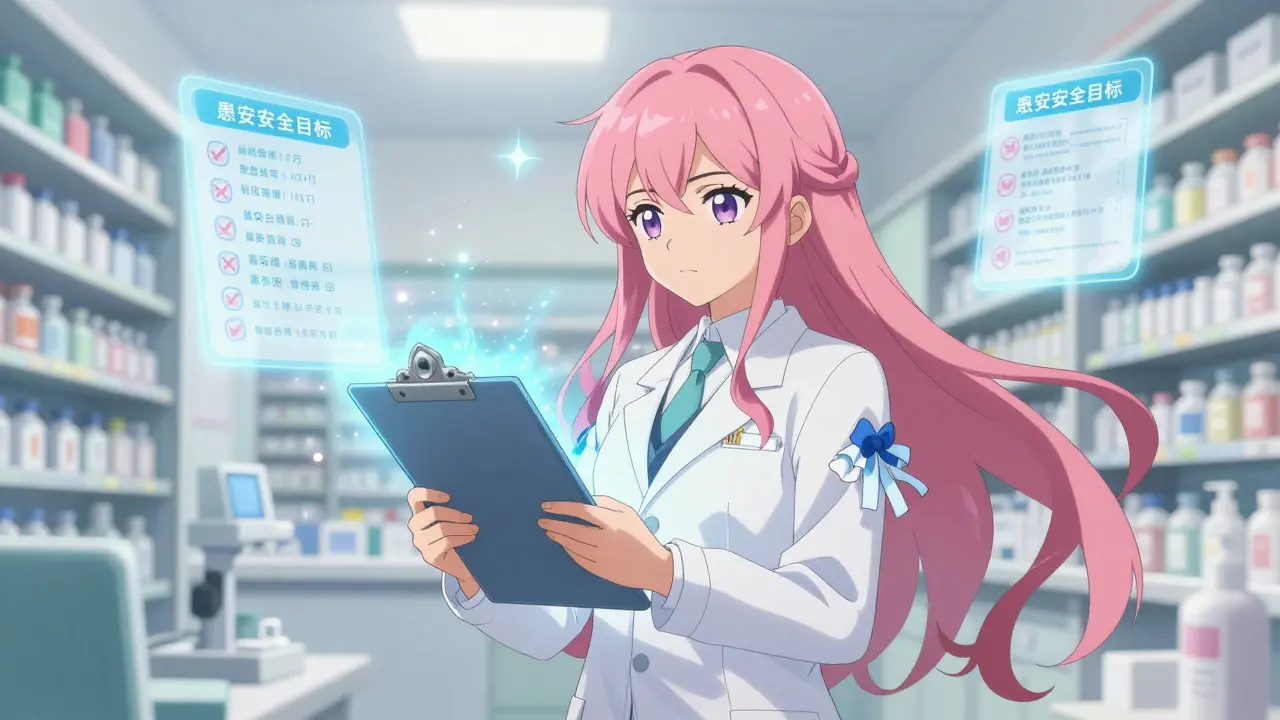
Medication errors are not just statistics; they are preventable tragedies that happen every day in hospitals and clinics. You might think that checking a label is simple, but the reality of high-pressure pharmacy practice tells a different story. According to data from the Agency for Healthcare Research and Quality, medication-related errors contribute to at least 1 out of every 131 outpatient deaths. That number is staggering when you consider how many patients walk through those doors daily.
To combat this, healthcare organizations rely on Patient Safety Goals, specifically defined as annual objectives developed by The Joint Commission to address critical areas of patient safety, with a heavy focus on reducing medication errors during ordering, dispensing, and administration. These goals act as a safety net, ensuring that systems-not just individual vigilance-catch mistakes before they reach the patient.
Understanding the Core Patient Safety Goals
The National Patient Safety Goals (NPSGs) were first introduced in 2003 following the landmark Institute of Medicine report 'To Err is Human,' which highlighted that approximately 250,000 deaths annually in the U.S. were linked to medical errors. Today, these goals cover six primary areas, but three are directly critical to pharmacy practice:
- Identify Patients Correctly: Using two unique identifiers to ensure the right person gets the right drug.
- Improve Staff Communication: Standardizing handoffs and read-backs for verbal orders to prevent misinterpretation.
- Use Medicines Safely: This is the core of pharmacy work, involving proper labeling, reducing anticoagulant harm, and managing high-alert medications.
For pharmacists and technicians, the "Use Medicines Safely" goal is where the rubber meets the road. It requires strict adherence to protocols like NPSG.03.04.01, which mandates that all medications, including those on and off the sterile field in surgery, must be labeled clearly. This means using a minimum 10-point font size for drug names, strengths, and concentrations. It sounds basic, but 27% of operating rooms still struggle with unlabeled syringes, creating a direct risk to patient safety.
The Reality of Dispensing Errors and High-Alert Medications
Dispensing errors often stem from system failures rather than human malice. One major area of concern is High-Alert Medications, defined as drugs that bear a heightened risk of causing significant patient harm when used in error, such as insulin, opioids, and anticoagulants.
The Institute for Safe Medication Practices (ISMP) identifies specific scenarios where these drugs cause the most damage. For example, injectable promethazine has caused 37 documented amputations between 2006 and 2018 due to improper tissue injection. To mitigate this, safety goals require standardized practices, including double-checking doses and verifying patient opioid status before administration.
Another critical component is anticoagulant therapy. NPSG.03.05.01 focuses on reducing harm from these blood thinners. Hospitals must implement standardized protocols for International Normalized Ratio (INR) monitoring and document therapeutic ranges clearly. The target here is 95% compliance, measured quarterly. When these systems fail, patients face life-threatening bleeding or clotting risks.
| Framework | Primary Focus | Enforcement Level | Key Metric/Goal |
|---|---|---|---|
| National Patient Safety Goals (NPSGs) | Mandatory accreditation standards | Required for Joint Commission-accredited facilities | Reduce systemic errors across 6 key areas |
| ISMP Targeted Best Practices | Specific high-risk interventions | Voluntary consensus recommendations | 98% scanning compliance for barcodes |
| Five Rights of Administration | Individual clinician verification | Clinical standard of care | Right patient, drug, dose, route, time |

Technology’s Role: Barcodes and Automated Cabinets
Technology is a double-edged sword in modern pharmacy. On one hand, Barcode-Assisted Medication Administration (BCMA) is a technology system that uses barcode scanners to verify the five rights of medication administration against the electronic health record. Studies show that implementing BCMA can reduce wrong-drug errors by up to 86%. However, it also adds about 7.2 minutes to nurse workflow per dose, which can lead to fatigue and workarounds if staffing isn’t adjusted.
On the other hand, Automated Dispensing Cabinets (ADCs) are secure, computerized cabinets located in clinical areas that store and dispense medications to staff, often requiring override codes for emergency access. While convenient, ADC overrides are a major safety red flag. The recommended override rate is below 5%, yet 34% of pharmacists report rates exceeding this threshold, primarily for "stat" medications during emergencies. Facilities with override rates above 5% see 3.7 times more medication errors. This suggests that ease of access is compromising safety checks.
Beyond the Checklist: Culture and System Design
You might have heard of the "Five Rights" of medication administration: right patient, right drug, right dose, right route, and right time. It’s the gold standard taught in nursing school. But here’s the hard truth: the Institute for Healthcare Improvement (IHI) notes that 83% of medication errors occur even after nurses confirm all five rights. Why? Because the Five Rights place the burden entirely on the individual, ignoring flawed system design.
This is why experts like Dr. Michael Cohen, President Emeritus of ISMP, argue that NPSGs represent minimum standards, not best practices. True safety comes from a culture that prioritizes system-level interventions over blaming individuals. For instance, Australia’s ASHP guidelines emphasize standardized procedures and regular error reviews rather than just telling staff to "be careful."
Pediatric units offer a stark example. Children are not just small adults; their dosing is weight-based and highly complex. Error rates in neonatal and intensive care units are three times higher than in adult units. The Pediatric Medication Safety Model addresses this by mandating specialized training and double-checking for high-risk meds. Children’s Hospital of Philadelphia saw a 91% reduction in weight-based dosing errors after implementing these strict protocols.

Implementation Challenges and Real-World Solutions
Implementing these goals is not a quick fix. The Joint Commission recommends a 12-18 month timeline for full integration. Here is what that looks like in practice:
- Initial Assessment (2-4 weeks): Evaluate current error rates, labeling practices, and ADC override logs.
- Staff Training (8-12 hours per clinician): Move beyond basic theory to scenario-based training on root cause analysis and change management.
- System Integration (6-12 months): Integrate Electronic Health Records (EHR) with Clinical Decision Support Systems (CDSS) to catch interactions automatically.
A major hurdle is insufficient training. A 2023 survey found that 38% of facilities provide less than 4 hours of annual medication safety training per staff member. That is nowhere near enough to build muscle memory for safety protocols. Furthermore, documentation is key. You need to maintain error reports and quarterly performance metrics with at least 90% completeness. If you aren’t measuring it, you aren’t improving it.
Financial incentives also play a role. The Centers for Medicare & Medicaid Services (CMS) links 2% of hospital reimbursement to patient safety outcomes through the Hospital-Acquired Condition Reduction Program. This makes safety not just a moral imperative but a financial one. With the global patient safety software market projected to reach $4.03 billion by 2028, investment in these tools is growing rapidly.
Future Directions: AI and Global Standards
Looking ahead, the landscape of medication safety is evolving. The 2025 NPSGs introduce new requirements for bedside specimen labeling, requiring labels to be applied in the patient’s presence with two-identifier verification. This addresses a gap where mislabeled specimens contribute to 160,000 adverse events annually.
Artificial Intelligence is also entering the mix. Pilot programs at Mayo Clinic show that AI-powered clinical decision support can reduce potential adverse drug events by 47% by predicting errors before they happen. Meanwhile, the World Health Organization’s Global Patient Safety Action Plan 2021-2030 aims for universal adoption of these standards by 2030. Currently, only 22% of low- and middle-income nations have adopted these frameworks, highlighting a significant global disparity.
Ultimately, patient safety in medication dispensing is a continuous journey. It requires robust technology, rigorous training, and a culture that values transparency over blame. By adhering to these goals, pharmacies can significantly reduce the risk of harm and build trust with the patients they serve.
What are the main Patient Safety Goals related to medication?
The primary goals include identifying patients correctly using two identifiers, improving staff communication through standardized handoffs, and using medicines safely. This involves proper labeling (NPSG.03.04.01), reducing harm from anticoagulants (NPSG.03.05.01), and managing high-alert medications with strict protocols.
Why are the "Five Rights" of medication administration considered insufficient?
While the Five Rights (right patient, drug, dose, route, time) are essential, research shows that 83% of errors occur even when they are followed. This indicates that relying solely on individual vigilance is flawed. System-level interventions, such as barcode scanning and standardized workflows, are necessary to catch errors that human attention might miss.
What is the acceptable override rate for Automated Dispensing Cabinets (ADCs)?
The recommended override rate for ADCs is below 5%. Overrides bypass safety checks, so high rates indicate a breakdown in protocol. Facilities exceeding this threshold experience 3.7 times more medication errors. Most overrides occur during emergencies for "stat" medications, suggesting a need for better proactive stocking or rapid-response protocols.
How do Barcode-Assisted Medication Administration (BCMA) systems impact safety?
BCMA systems can reduce wrong-drug errors by up to 86% by verifying medications against the electronic health record at the point of care. However, they can increase workflow time by roughly 7 minutes per dose, which may lead to staff fatigue or workarounds if staffing levels are not adjusted accordingly.
What are high-alert medications, and why are they dangerous?
High-alert medications are drugs that carry a heightened risk of causing significant patient harm if used in error. Examples include insulin, opioids, and anticoagulants. Because the consequences of a mistake are severe, these drugs require extra safeguards such as double-checking doses, specialized storage, and mandatory education for staff.





Comments
Christopher Laver
May 29, 2026 AT 03:07 AMGreat read but honestly this is just common sense stuff that everyone already knows.
Russell Russell
May 30, 2026 AT 01:52 AMWe need to look at the bigger picture here. It's not just about checking labels, it's about building a culture where safety is the foundation of everything we do. When we empower every team member to speak up without fear, we create a system that actually works for everyone. Let's focus on supporting each other through these protocols rather than just following rules blindly. The real change happens when we all commit to being vigilant together.
I've seen how small changes in communication can save lives. We must embrace these standards as opportunities for growth and improvement. By working collaboratively, we can reduce errors and improve patient outcomes significantly. It is time to take ownership of our practice and ensure that no patient goes through what they shouldn't have to endure due to preventable mistakes.
Naresh Chandra
May 30, 2026 AT 15:37 PMThis is such an important topic!!! I really appreciate the detailed breakdown of the NPSGs!! It makes me think about how many times we rush through processes because we are so busy!! We need to slow down and really focus on the details!!! Every single label matters!!! Every single check counts!!!
Cyburg Adeoye
May 31, 2026 AT 11:25 AMYou are absolutely right about the systemic issues!!! It is crucial that we understand the root causes of these errors!!! The data on ADC overrides is particularly alarming!!! We must implement robust training programs that address these specific pain points!!! Furthermore, leveraging technology like BCMA effectively requires proper workflow integration!!! We cannot simply add tools without considering the human factor!!! Let us strive for a holistic approach to medication safety!!! This will undoubtedly lead to better outcomes for our patients!!!
Joseph Teichman
June 1, 2026 AT 13:27 PMthats true but ppl still mess up even with all the tech. its crazy how hard it is to get everyone to follow the rules properly. i think more training would help but idk if thats enough.
Grace Gayle McMullen
June 2, 2026 AT 13:03 PMi totally agree with the part about the five rights being insufficent. its wild that 83% of errors happen after those checks. we really need to rely more on systems than just hoping nurses dont make a mistake. also the bit about pediatric dosing is scary. kids are so vulnerable and we cant afford to slip up there.
Angela Niculescu
June 3, 2026 AT 19:19 PMActually, I disagree with the premise that technology is the savior here. Barcodes add minutes to every dose, which leads to burnout and workarounds. Nurses aren't stupid; they know the system is flawed, so they bypass it to keep up with patient care demands. Blaming 'culture' ignores the reality of understaffing. You can have all the safety goals in the world, but if you don't have enough people to do the job safely, nothing changes. The Joint Commission guidelines are nice on paper, but they ignore the economic pressures forcing hospitals to cut corners.
Victoria Mangiapane
June 5, 2026 AT 07:08 AMOh my god, another article telling us to 'be careful'? Really? Do you think we don't try? We are drowning in paperwork and underpaid while you sit there writing pretty guides. And don't get me started on the AI hype. Machines making decisions about human lives? Please. I'd trust a tired nurse over a glitchy algorithm any day. This whole post feels like corporate spin to avoid hiring more staff. Typical.
Nivetha Narayanan
June 5, 2026 AT 15:12 PMhey guys lets keep it positive!! we are all trying our best here!! i love how diverse our perspectives are!! its great to see everyone engaging with the content!! let's support each other in making healthcare safer!! remember, every small step counts!! keep shining bright!!