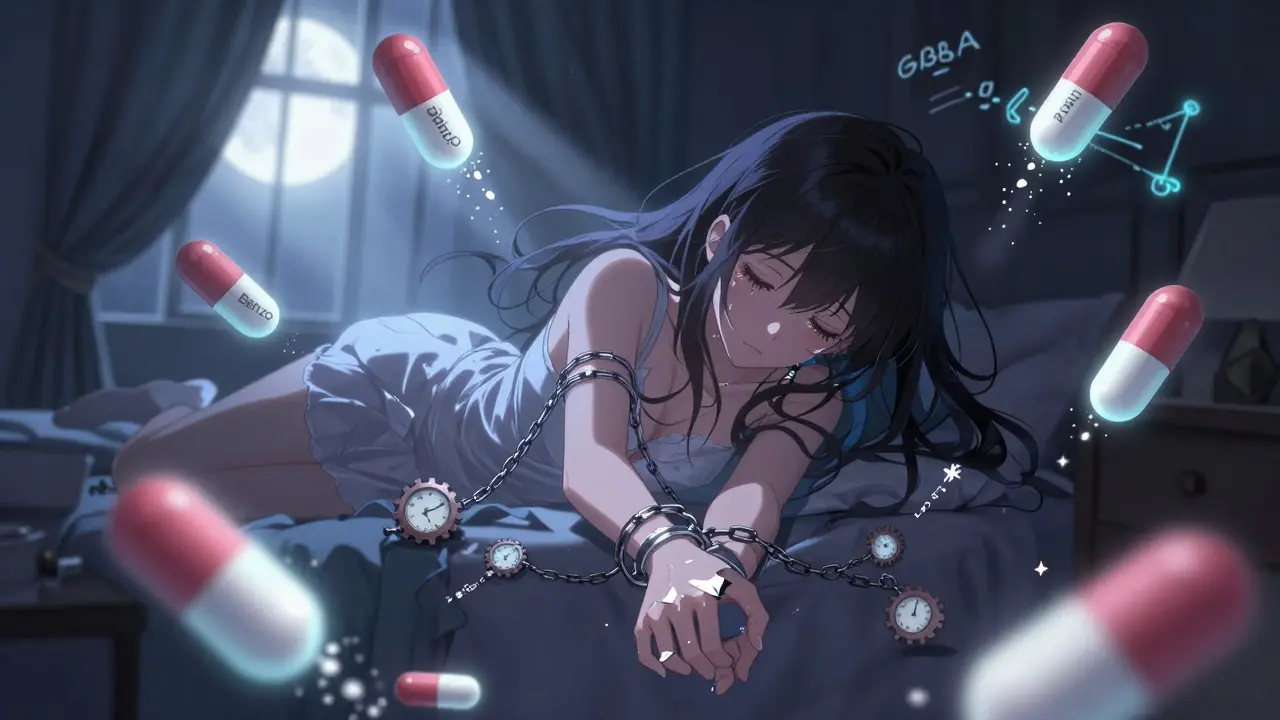
When sleep meds stop working-and start hurting
You’ve tried everything: no caffeine after noon, blackout curtains, white noise, meditation. Still, you lie awake until 3 a.m., then drag through the next day like you’ve been dragged behind a truck. So you fill the prescription. Maybe it’s Ambien. Maybe it’s temazepam. You take it. You sleep. For a while.
But then something changes. You wake up groggy. You forget where you put your keys. You almost ran a red light last week. Your doctor says it’s fine-just a short-term fix. But it’s been six months. And now you’re scared to stop.
You’re not alone. In 2022, over 6 million Americans got prescriptions for non-benzodiazepine sleep pills like zolpidem, eszopiclone, or zaleplon. Another 3.8 million got benzodiazepines like lorazepam or diazepam. These drugs work-fast. But they don’t fix sleep. They mask it. And the cost? It’s higher than most people realize.
How these drugs actually work (and why it matters)
Both benzodiazepines and non-benzodiazepines (also called Z-drugs) boost a brain chemical called GABA. GABA tells your brain to slow down. More GABA = less noise = sleep. Simple, right?
But here’s the catch: benzodiazepines bind to multiple GABA receptor sites across your brain. That means they don’t just help you fall asleep-they also calm anxiety, relax muscles, and blur your memory. That’s why doctors used to prescribe them for panic attacks, muscle spasms, and seizures. But for insomnia? That’s like using a sledgehammer to hang a picture.
Non-benzodiazepines were designed to be more precise. They mostly target just one receptor subtype-the omega-1 site-meant to trigger sleep without the extra effects. That’s why drugs like zolpidem (Ambien) and eszopiclone (Lunesta) were marketed as “safer.” But safety is relative.
Both classes still flood your system with the same basic signal: shut down. And your brain doesn’t care if the drug is called a benzo or a Z-drug. It just knows it’s being forced into sleep, not earning it.
Half-life: Why your morning feels like a fog
Not all sleep pills are created equal when it comes to how long they stick around. This is called half-life-the time it takes for half the drug to leave your body.
Take flurazepam, a long-acting benzodiazepine. Its half-life? Up to 250 hours. That’s over 10 days. By the time you’ve taken it for a week, your system is full of leftover drug. You’re not just sleeping-you’re drugged. Day after day. That’s why people on long-acting benzos report constant fatigue, brain fog, and poor balance. A 2013 study found this kind of accumulation leads to “considerable impairment of daytime performance.”
Now look at zaleplon (Sonata). Half-life? Just 1 to 1.5 hours. It’s designed to help you fall asleep fast, then vanish before morning. Sounds ideal. But here’s the problem: if you wake up at 3 a.m. and take another pill? You’re asking for trouble. The FDA found that doubling the dose of zolpidem increases the risk of sleepwalking, sleep-driving, and even cooking or having sex while unconscious.
Short half-life doesn’t mean safe. It means the drug leaves fast-so your brain wakes up confused. That’s why rebound insomnia is so common. You stop taking it, and your brain doesn’t know how to sleep without it. So you take more. And more. And then you’re hooked.

The hidden dangers no one tells you about
Headache? Dry mouth? Dizziness? Yeah, those are listed. But the real risks? They’re buried in footnotes.
The VA’s 2023 review found that people taking these drugs have a 5-fold higher risk of memory and concentration problems. A 4-fold increase in daytime fatigue. And a 2-fold higher chance of falling and breaking a hip.
For people over 65, that’s not just inconvenient-it’s deadly. A 2012 JAMA study showed benzodiazepines raised hip fracture risk by 2.3 times. Non-benzodiazepines? Still 1.8 times higher. That’s not a side effect. That’s a public health crisis.
And then there’s the behavioral stuff. The FDA tracked 66% of all sleep-driving incidents between 2005 and 2010 to zolpidem. People have driven 20 miles, made a sandwich, or even called their boss-all while asleep. They wake up with no memory of it. No warning. No symptoms before it happens.
One Reddit user wrote: “I woke up in my car at a gas station 15 miles from home. I had no idea how I got there.” Another: “I took Lunesta, and the next day I had a weird metallic taste in my mouth for weeks. My dentist thought I had an infection.”
These aren’t rare. They’re common enough that the American Geriatrics Society lists both classes as “potentially inappropriate” for older adults. Period.
Withdrawal: The silent trap
Most people think, “I’ll just stop when I feel better.” But that’s where things go wrong.
Benzodiazepines? Withdrawal can be brutal. Panic attacks. Seizures. Hallucinations. One person on Reddit described quitting temazepam after eight months: “I had panic attacks for three weeks straight. Felt like my skin was crawling. I thought I was dying.”
Non-benzodiazepines are often seen as “easier” to quit. But that’s misleading. While withdrawal symptoms may be milder, they’re still real. And because these drugs are often taken for months, your brain forgets how to sleep without them.
A 2021 review found that 34% of users reported daytime drowsiness severe enough to hurt their work performance. Another study showed that after just eight weeks of intermittent zolpidem use, there was no improvement in health or daily function. Just dependence.
And here’s the kicker: tolerance builds fast. You start at 5 mg. Then 10 mg. Then you’re taking two pills. Then you’re buying them online. That’s addiction. And it sneaks up on you.
What the guidelines say now (and why you should listen)
The American Academy of Sleep Medicine says this clearly: Cognitive Behavioral Therapy for Insomnia (CBT-I) is the first-line treatment. Not pills.
CBT-I isn’t magic. It’s work. You track your sleep. You limit time in bed. You retrain your brain to associate the bed with sleep-not stress. It takes 4 to 8 weeks. But the results last. For years.
Meanwhile, the VA’s 2023 update says this outright: “It is no longer recommended to take a sedative-hypnotic drug to treat insomnia or anxiety.” That’s not a suggestion. It’s a policy shift.
Why? Because the risks don’t go away. They pile up. Memory loss. Falls. Addiction. Driving accidents. Even worsened sleep apnea. And for every night you sleep on a pill, you’re one night closer to needing more.
There’s no evidence that these drugs improve long-term sleep quality. Only that they make you dependent.

What to do instead
You don’t need a pill to sleep. You need better sleep habits.
- Get sunlight within 30 minutes of waking-this sets your body clock.
- Keep your bedroom cool (around 18°C), dark, and quiet.
- Stop screens 90 minutes before bed. Blue light kills melatonin.
- Write down worries before bed. Get them out of your head.
- If you can’t sleep after 20 minutes, get up. Read under dim light. Don’t lie there stressing.
And if you’re already on these meds? Don’t quit cold turkey. Talk to your doctor about a slow taper. Reducing by 10% every 1-2 weeks is the safest way. For benzodiazepines, that might take months. For Z-drugs, maybe 4-6 weeks.
There are newer options now-like lemborexant (Dayvigo) and suvorexant (Belsomra). These work differently. They block wakefulness signals, not boost sleep ones. Early studies show 30-40% less next-day grogginess. But they’re not magic either. And they’re expensive.
The real solution? Sleep isn’t a problem to be fixed with a pill. It’s a rhythm to be restored.
Final thought: The truth about sleep meds
Sedative-hypnotics aren’t evil. They’re tools. But like any tool, they’re dangerous when used wrong-or for too long.
They work fast. But they don’t fix the root cause. And they leave behind a trail of foggy mornings, shaky balance, and quiet panic when you try to stop.
If you’re on one of these drugs and you’re scared to quit-you’re not weak. You’re trapped by a system that sold you a quick fix.
But you can get out. Slowly. Safely. With support.
Sleep isn’t something you take. It’s something you earn.
Are benzodiazepines more addictive than non-benzodiazepines?
Yes, benzodiazepines carry a higher risk of physical dependence and severe withdrawal, including seizures and rebound anxiety. Non-benzodiazepines (Z-drugs) are less likely to cause life-threatening withdrawal, but they still lead to tolerance and psychological dependence. Both can be hard to quit, but benzodiazepines require slower, medically supervised tapering.
Can I take these drugs with alcohol?
Never. Alcohol and sedative-hypnotics both depress the central nervous system. Together, they can slow your breathing to dangerous levels-sometimes stopping it completely. Even one drink can turn a normal dose into a medical emergency. This combination has caused thousands of overdose deaths.
Why do I feel worse after stopping my sleep pill?
Your brain adapted to the drug. It suppressed its own natural sleep chemicals to compensate. When you stop, those systems are out of balance. That’s called rebound insomnia-and it’s temporary. Most people see improvement within 1-4 weeks. But it’s uncomfortable. That’s why tapering slowly and using CBT-I helps your brain relearn how to sleep on its own.
Are non-benzodiazepines safer for older adults?
No. Both classes increase fall and fracture risk in older adults. The American Geriatrics Society lists all sedative-hypnotics as potentially inappropriate for people over 65. Even short-acting Z-drugs like zolpidem can cause confusion, dizziness, and impaired balance. The risk isn’t about the drug type-it’s about the class effect. Safer alternatives like CBT-I or orexin blockers are preferred.
How long should I take a sleep medication?
Clinical guidelines recommend no more than 2-4 weeks. Most people don’t need them longer. If you’re still taking them after a month, your insomnia likely has other causes-stress, sleep apnea, poor sleep habits. Long-term use increases risks without improving outcomes. Talk to your doctor about switching to CBT-I or checking for underlying conditions.
Next steps if you're on these meds
- Don’t stop suddenly. Talk to your doctor about a taper plan.
- Ask for a sleep study if you snore or wake up gasping. Sleep apnea is common-and worsened by these drugs.
- Look up CBT-I programs. Many are covered by insurance. Some are free through health services.
- Track your sleep for a week. Note when you go to bed, wake up, and how you feel. This helps your doctor see patterns.
- Reduce caffeine after 2 p.m. and avoid screens before bed. Small changes add up.
Sleep isn’t broken. You just need to rebuild it-without pills.





Comments
Steve Hesketh
January 20, 2026 AT 15:42 PMI’ve been there-lying awake at 3 a.m., convinced my brain forgot how to shut off. Took Ambien for 8 months, woke up feeling like I’d been hit by a bus. Then I tried CBT-I. No magic, just work. But now? I sleep like a baby without pills. It’s not easy, but it’s worth it. You’re not broken. You just need to relearn how to rest.
Sangeeta Isaac
January 22, 2026 AT 14:54 PMso like… i took lunesta once bc i was stressed and woke up at 6am making toast in my pajamas while texting my ex. i didn’t even remember it. then i Googled ‘sleep driving’ and cried into my cold toast. also, my cat judged me. 🐱💔
Philip Williams
January 23, 2026 AT 18:55 PMThe clinical data presented here is compelling and aligns with current guidelines from the American Academy of Sleep Medicine. The pharmacological mechanisms of GABAergic modulation, particularly the differential receptor affinity between benzodiazepines and Z-drugs, warrant careful clinical consideration. Long-term use is unequivocally associated with cognitive decline, increased fall risk, and dependence. Non-pharmacological interventions such as CBT-I demonstrate superior long-term efficacy and safety profiles. I strongly recommend clinicians prioritize these evidence-based alternatives before initiating pharmacotherapy.
Melanie Pearson
January 24, 2026 AT 18:24 PMPeople need to stop blaming the medication and take responsibility. If you can't sleep without a pill, maybe you're just lazy. Back in my day, we didn't have all this nonsense. We just went to bed when we were tired. No apps, no white noise, no CBT-I. Just discipline. If you're too weak to sleep naturally, maybe you shouldn't be driving, working, or even living independently.
Rod Wheatley
January 26, 2026 AT 00:00 AMPLEASE-don’t quit cold turkey! I did, and it was hell: heart racing, panic attacks, feeling like my skin was on fire for weeks. I was terrified I was dying. But I found a doctor who helped me taper by 10% every two weeks. Took 4 months. I cried a lot. I slept worse at first. But now? I haven’t taken a pill in 8 months. My brain remembers how to sleep. It’s not perfect-but it’s real. And you can do this too. You’re not weak. You’re healing.
Jerry Rodrigues
January 27, 2026 AT 20:29 PMMy grandma took lorazepam for 12 years. One day she fell in the shower. Broke her hip. Didn’t remember how she got there. We found the bottle under her pillow. She wasn’t even aware she was still taking it. I wish someone had told us earlier. This isn’t about willpower. It’s about systems failing people. CBT-I saved my dad’s life. No pills. Just patience.
Uju Megafu
January 29, 2026 AT 01:58 AMHow is this even still a thing?! People are literally driving while asleep and no one’s shutting this down? The FDA knew about sleep-driving since 2005 and still lets these drugs be prescribed like candy? This is corporate greed wrapped in a white coat. You’re not sick-you’re being exploited. Stop taking pills and start demanding real healthcare. This isn’t a sleep problem. It’s a medical industry crime.
Jarrod Flesch
January 30, 2026 AT 02:23 AMJust wanted to say-CBT-I changed my life. I was skeptical. Thought it was just ‘sleep hygiene’ nonsense. But the therapist made me track my sleep for 2 weeks. Turned out I was in bed 10 hours but sleeping 4. We cut it down to 6.5. Felt awful at first. Then… boom. Better sleep. No pills. No fog. Just me and my brain finally chillin’ 😌💤
Barbara Mahone
January 31, 2026 AT 17:15 PMThank you for this comprehensive and clinically accurate overview. The distinction between receptor subtype specificity and systemic CNS depression is often misunderstood by patients and providers alike. The data on fall risk in older adults is particularly alarming and underscores the urgency of deprescribing. CBT-I remains the gold standard-not as an alternative, but as the foundational intervention. I have shared this with my entire practice.