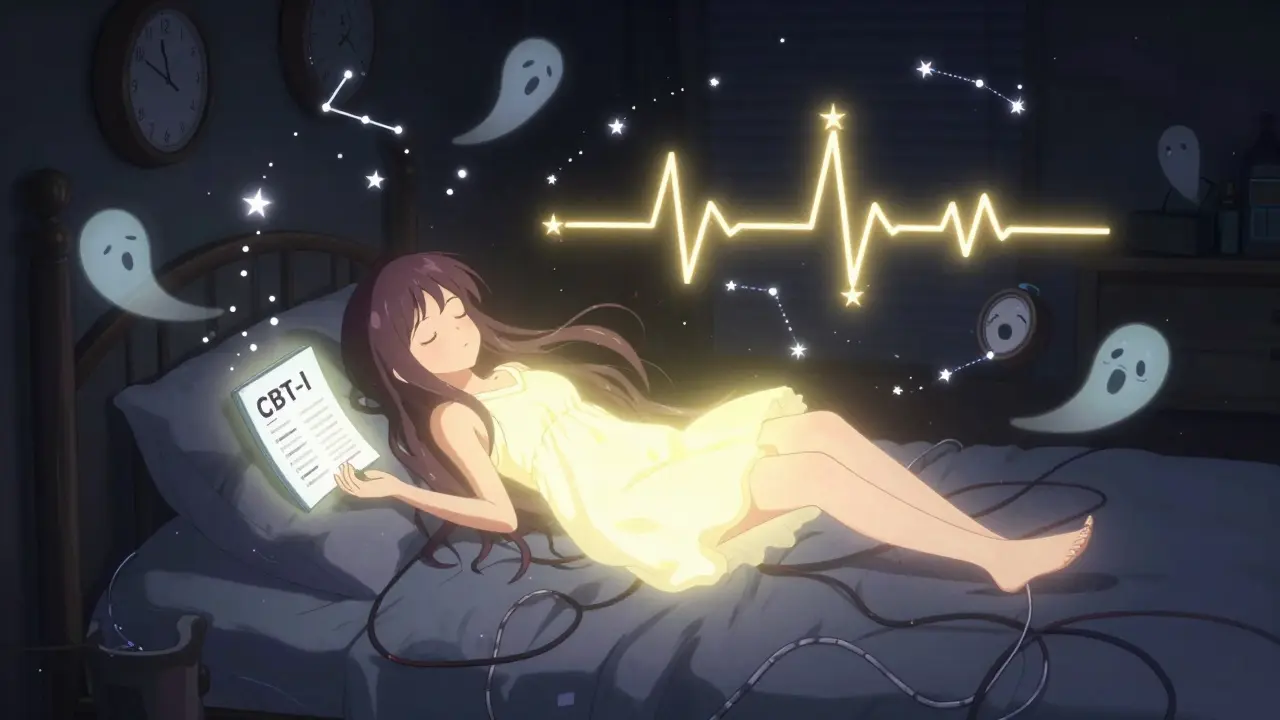
Insomnia isn’t just a bad night’s sleep-it’s a silent driver of depression and anxiety
If you’ve ever lain awake for hours, mind racing with worries, you know how exhausting it is. But what if that sleepless night isn’t just a symptom of your anxiety or depression? What if it’s actually making it worse? For millions of people, insomnia isn’t a side effect-it’s a core part of the problem. Research now shows that treating insomnia directly can reduce depression and anxiety symptoms more effectively than treating mood disorders alone.
Why insomnia and mental health are locked in a cycle
For years, doctors treated insomnia as a side effect of depression or anxiety. If you were depressed, you were told to take antidepressants and your sleep would improve. But that didn’t work for many people. The truth is, chronic insomnia-defined as trouble falling or staying asleep at least three nights a week for three months or more-doesn’t just follow mental illness. It fuels it.
People with long-term insomnia are 40 times more likely to develop severe depression than those who sleep well. That’s not correlation. That’s causation. Studies using genetic data confirm that poor sleep doesn’t just come with depression-it increases your risk of getting it. The same goes for anxiety. When your brain doesn’t get restorative sleep, it stays stuck in high-alert mode. Stress hormones like cortisol, ACTH, and CRH stay elevated. Your nervous system doesn’t reset. And over time, that rewires how you respond to stress, fear, and even everyday situations.
CBT-I: The only insomnia treatment proven to break the cycle
The gold standard for treating insomnia isn’t a pill. It’s CBT-I-Cognitive Behavioral Therapy for Insomnia. Unlike sleep medications like zolpidem, which only mask symptoms and often lead to dependence, CBT-I targets the root causes: the thoughts and habits that keep you awake.
CBT-I isn’t one trick. It’s a structured, six- to eight-week program with four key parts:
- Stimulus control: Your bed is only for sleep and sex. No scrolling, no worrying, no watching TV. If you’re not asleep in 20 minutes, get up and do something quiet until you feel sleepy.
- Sleep restriction: You spend less time in bed than you think you need. If you’re only sleeping 5 hours a night, you’re only allowed to be in bed for 5 hours. It sounds counterintuitive, but it rebuilds your body’s sleep drive.
- Relaxation training: Techniques like diaphragmatic breathing and progressive muscle relaxation calm your nervous system. You’re not trying to force sleep-you’re letting it come.
- Cognitive therapy: You challenge beliefs like “I need 8 hours to function” or “If I don’t sleep tonight, I’ll be ruined tomorrow.” These thoughts create anxiety that keeps you awake.
Studies show that people who complete CBT-I don’t just sleep better-they feel less depressed and anxious. One review of 186 studies found that CBT-I reduced the risk of developing major depression by up to 50% compared to no treatment. Another study showed that people who achieved full insomnia remission were 83% less likely to develop depression than those who still had sleep problems after treatment.

Digital CBT-I is changing access-and it works
One of the biggest barriers to CBT-I has been access. There aren’t enough trained therapists. Insurance often won’t cover it. But digital platforms like Sleepio and SHUTi are changing that.
These apps deliver the same evidence-based CBT-I protocol through guided videos, interactive exercises, and daily check-ins. One large study found that 76% of users saw a clinically meaningful improvement in their insomnia. Another showed a 57% lower chance of developing moderate-to-severe depression after using a digital CBT-I program compared to people who just read sleep education materials.
And the results stick. Unlike sleeping pills, where symptoms bounce back as soon as you stop taking them, the benefits of CBT-I last for years. People who finish the program often keep sleeping well-even if they go through a stressful time later.
Why pills like zolpidem fall short
Many people turn to sleeping pills because they promise quick relief. Zolpidem, eszopiclone, and similar drugs can help you fall asleep faster-sometimes in just 20 minutes. But here’s the catch: they don’t fix the underlying problem.
Research comparing CBT-I to zolpidem found that both improved sleep and mood in the short term. But after six months, the CBT-I group was still sleeping well. The zolpidem group? Their sleep had returned to pre-treatment levels. Worse, many developed tolerance, needed higher doses, or experienced side effects like dizziness, memory issues, or next-day grogginess.
And here’s the biggest problem: sleeping pills don’t reduce your risk of depression relapse. CBT-I does. That’s why major health systems like Kaiser Permanente now screen all depression patients for insomnia-and treat it first.
What if CBT-I doesn’t work for you?
It’s not a magic bullet. About 30-40% of people don’t achieve full remission, even with a full course. Some struggle with the initial sleep restriction phase-being awake more at first feels awful. Others forget to keep sleep diaries or skip sessions.
But here’s the key: it’s not about perfection. Even partial improvement in sleep leads to better mood. If you stick with it for 4-6 weeks, most people see a shift. The biggest predictor of success? Consistency. People who complete daily sleep logs and follow their schedule have 42% better outcomes than those who don’t.
If you’re not seeing results, talk to your provider. Some people benefit from combining CBT-I with antidepressants. A 2024 study found that adding CBT-I to sertraline increased depression remission rates by 40% compared to the drug alone.

The hidden cost of ignoring sleep
Untreated insomnia doesn’t just hurt your mood-it hurts your body, your work, and your wallet. People with chronic insomnia are more likely to take sick days, make mistakes at work, and visit emergency rooms. A 2025 economic analysis found that every dollar spent on CBT-I returns $2.50 to $3.50 in reduced healthcare costs and increased productivity.
And the need is growing. After the pandemic, insomnia rates more than doubled in the U.S. One in three adults now has clinical insomnia symptoms. Yet only 1-2% get evidence-based treatment. That’s not because it doesn’t work. It’s because most people don’t know it exists-or think it’s just about counting sheep.
Where to start
If you’re struggling with sleep and depression or anxiety, here’s what to do:
- Track your sleep for a week. Note when you get into bed, when you fall asleep, how many times you wake up, and how you feel in the morning.
- Ask your doctor or therapist: “Could CBT-I help me?” Don’t assume they’ll bring it up-most still think of sleep as a symptom, not a target.
- If you can’t find a therapist, try a digital CBT-I program. Sleepio, SHUTi, and the CBT-I Coach app (free from the U.S. Department of Veterans Affairs) are all backed by research.
- Give it at least 6 weeks. The hardest part is the first two weeks. Stick with it.
Improving your sleep isn’t about fixing a bad habit. It’s about healing your brain. And when your brain gets the rest it needs, depression and anxiety lose their grip.
What’s next for insomnia treatment
Researchers are now exploring how to personalize CBT-I. Some people respond better to relaxation techniques. Others need more cognitive work. Future tools may use AI to adjust sessions based on your sleep diary, mood logs, and even heart rate variability.
But for now, the clearest path forward is simple: treat insomnia like the medical condition it is-not a nuisance, not a weakness, but a treatable part of mental health recovery.





Comments
Crystel Ann
January 14, 2026 AT 18:01 PMI used to think sleep was just a luxury until I started tracking mine. After 3 months of CBT-I, my panic attacks dropped by 70%. Not because I magically stopped caring, but because my brain finally stopped screaming at 3 a.m. It’s not about willpower. It’s about rewiring.
Still can’t believe doctors don’t screen for this first.
Diane Hendriks
January 16, 2026 AT 17:28 PMThe notion that insomnia is a standalone medical condition is a dangerous delusion propagated by pharmaceutical-adjacent wellness cults. Sleep disturbance is a symptom-always. To treat it as a root cause is to misunderstand neurobiology, history, and human physiology. The body does not malfunction in isolation. The mind does not heal in a vacuum. You are not broken. You are responding.
Dan Mack
January 17, 2026 AT 08:50 AMThey don’t want you to know this but CBT-I is just a cover for the government to monitor your sleep patterns. They’re building a behavioral database under the guise of mental health. The VA app? Totally a backdoor. I know a guy who got flagged after using it. Now he can’t get a security clearance. Sleep is freedom. They’re taking it.
Nilesh Khedekar
January 19, 2026 AT 07:29 AMIn India, we used to say 'jagte raho, zindagi bhar'-stay awake, it’s life. But now I see: staying awake is not strength. It’s exhaustion dressed as discipline. My cousin tried CBT-I after his father died. He didn’t sleep for 11 days. Then he started the program. Six weeks later, he laughed again. Not because he forgot his pain. But because his nervous system finally stopped being on fire.
Jami Reynolds
January 20, 2026 AT 15:16 PMThe data cited here is methodologically flawed. Many studies conflate correlation with causation. The 40x increased risk statistic is drawn from observational cohorts without controlling for comorbidities such as chronic pain, PTSD, or circadian rhythm disorders. Furthermore, digital CBT-I platforms lack standardized therapist oversight, rendering their efficacy claims speculative at best. This is pseudoscience dressed in academic language.
Amy Ehinger
January 21, 2026 AT 02:06 AMI tried CBT-I because I was tired of hating mornings. The first week was brutal-I was awake for 16 hours straight and felt like a zombie. But then, around day 18, something shifted. I didn’t fall asleep faster. I just stopped fighting it. And that’s when the depression started lifting. It wasn’t the sleep that changed me. It was the quiet. The stillness. The fact that I stopped yelling at myself for not being perfect. I still wake up sometimes. But now I just whisper, ‘It’s okay,’ and turn over.
RUTH DE OLIVEIRA ALVES
January 22, 2026 AT 21:34 PMThe integration of evidence-based sleep interventions into primary mental health care represents a paradigmatic shift in clinical practice. The longitudinal efficacy of CBT-I, particularly in reducing depressive relapse rates, is supported by meta-analytic evidence from randomized controlled trials conducted across multiple jurisdictions. It is imperative that healthcare systems prioritize accessibility, reimbursement, and provider training to ensure equitable implementation.
Nat Young
January 24, 2026 AT 17:45 PMCBT-I works for some. But let’s be real-most people who ‘succeed’ are already privileged. They have time, quiet rooms, no kids, no shift work, no landlords who play bass at 2 a.m. Meanwhile, the guy working two jobs and sleeping in his car? They tell him to ‘try sleep restriction.’ Like that’s gonna fix systemic neglect wrapped in a wellness app. This isn’t medicine. It’s a luxury.
Niki Van den Bossche
January 25, 2026 AT 04:05 AMSleep is the last sanctuary of the soul, and we’ve turned it into a productivity metric. CBT-I is just another algorithmic ritual to optimize the human body into a machine that never glitches. But what if the problem isn’t your sleep hygiene? What if it’s your life? What if the quiet you’re chasing isn’t in your bed, but in the silence you’ve been too afraid to sit with? You can’t cognitive-behaviorally therapy away the weight of capitalism, loneliness, and inherited trauma. You can only pretend you’re healing while the world keeps burning.