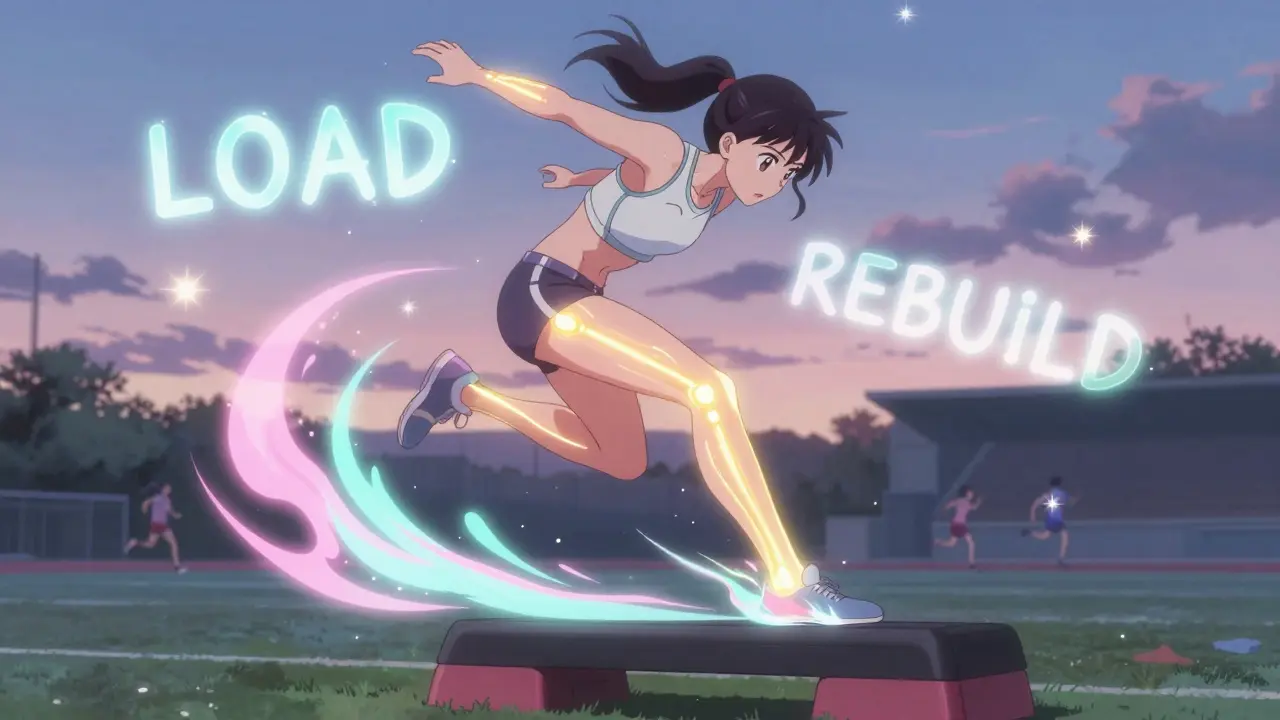
When your tendon hurts-whether it’s the back of your heel, under your kneecap, or in your shoulder-you’re not just dealing with a simple strain. You’re dealing with tendinopathy, a degenerative condition where the tendon’s structure breaks down over time. It’s not inflammation, despite what many still call it. It’s a failed healing response. And the treatment? It’s not about rest. It’s about loading-correctly.
What Tendinopathy Really Is (And Why Rest Doesn’t Work)
Tendinopathy isn’t a sudden injury. It’s a slow collapse. You keep running, jumping, or lifting-even when it hurts-and your tendon can’t repair itself fast enough. Collagen fibers fray, blood flow drops, and pain signals fire even without tissue damage. This is why ice, NSAIDs, and rest often make things worse: they reduce pain temporarily but don’t fix the underlying problem. The tendon needs mechanical stress to heal. Not too much. Not too little. Just enough to rebuild.
Studies show that 30% of all sports medicine visits involve tendinopathy. The Achilles and patellar tendons are the most common targets, but rotator cuff, elbow (tennis elbow), and hamstring tendons aren’t far behind. And here’s the kicker: most people try injections before they try exercise. That’s backwards.
Eccentric Training: The Gold Standard (And Why It Works)
In 1998, Hakan Alfredson published a simple protocol: stand on a step, lift up on both feet, then lower down slowly on one. That’s it. No machines. No drugs. Just controlled lowering. His patients with chronic Achilles pain improved-by 60-70%. Since then, dozens of randomized trials have confirmed it: eccentric training is the most effective non-surgical treatment for midportion tendinopathy.
Here’s how it works: when you lower slowly (3-5 seconds), you create high tension in the tendon. That tension signals cells called tenocytes to start rebuilding collagen. Over time, the tendon thickens, stiffens, and becomes more resilient. Ultrasound scans show real structural changes after 8-12 weeks: collagen fibers straighten out, tendon thickness normalizes, and blood flow increases.
How to Do Eccentric Training Right
Not all eccentric exercises are created equal. The protocol depends on the tendon.
- Achilles tendinopathy: Alfredson’s heel drop. Stand on a step, rise up on both feet, then lower one foot down slowly over 3-5 seconds. Do 3 sets of 15 reps, twice daily. Do one version with the knee straight (targets gastrocnemius) and one with the knee bent (targets soleus). Rest 60-90 seconds between sets.
- Patellar tendinopathy: Single-leg decline squats on a 25-degree board. Lower slowly over 3-5 seconds, keeping your knee aligned over your toes. 3 sets of 15 reps daily. Many patients struggle with form-this is where a physical therapist makes all the difference.
- Rotator cuff tendinopathy: Eccentric shoulder external rotation with a resistance band. Start with arm at 90 degrees, slowly let the band pull your arm inward over 4-5 seconds. 3 sets of 12 reps, every other day.
Progression is key. You don’t stop when it hurts-you adjust. The goal is pain at a 2-5/10 level during exercise. If it spikes to 7+/10 or lingers past 24 hours, you’re overdoing it. A 2022 survey found only 38% of self-managed patients understood this threshold. That’s why 92% of those who worked with a therapist succeeded, compared to 68% who went it alone.
Heavy Slow Resistance (HSR): The Quiet Contender
Here’s something most people don’t know: heavy slow resistance training works just as well as eccentric training-for Achilles and patellar tendinopathy. In a 2015 study, both groups improved by 60-65% on the VISA-A score after 12 weeks. But HSR had better adherence: 87% stuck with it versus 72% for eccentric training.
Why? Less initial pain. HSR uses weights-usually 70% of your one-rep max-performed with a 3-second lift and 3-second lower. No decline boards. No single-leg balancing. Just controlled, loaded movement. For someone who can’t tolerate the pain of heel drops, HSR is a game-changer. It’s also easier to track progress: you add weight. Simple.
Isometrics: The Instant Pain Reliever
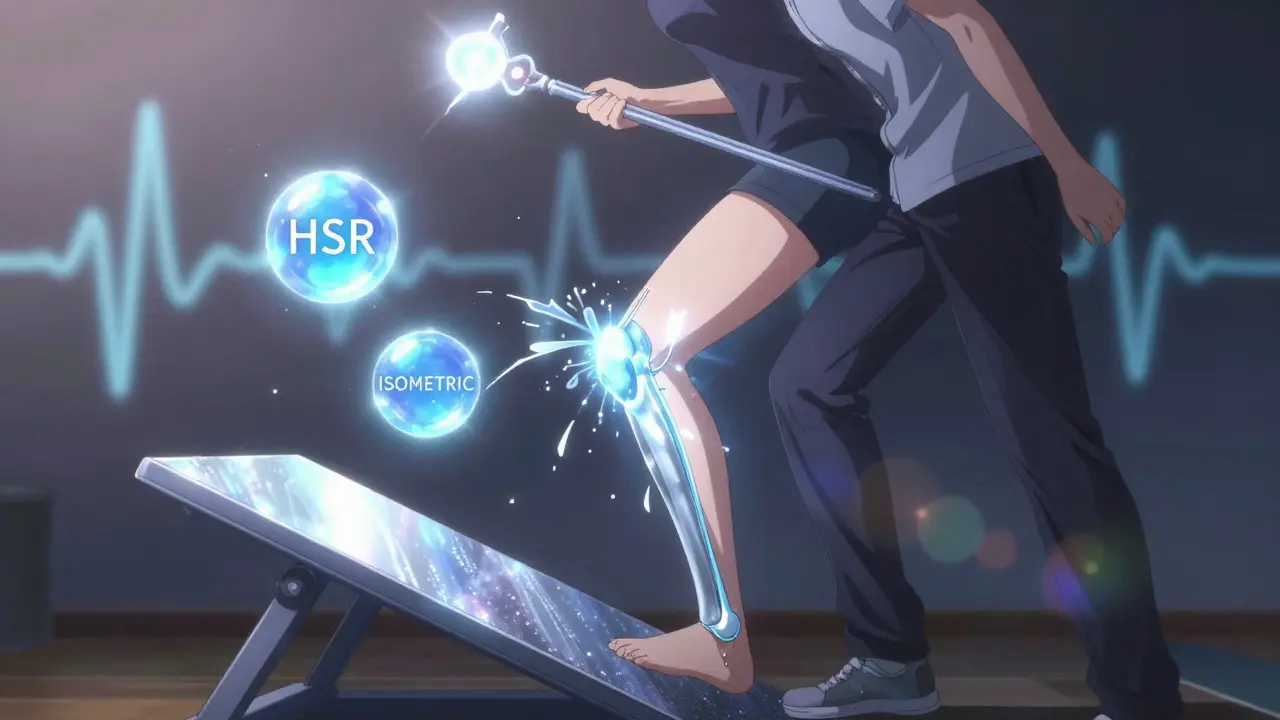
Want to reduce pain before a workout? Try isometrics. Hold a static contraction for 45 seconds. For Achilles: stand on a step and push up hard, holding the top position. For patellar: seated knee extension with a heavy band, holding at 60 degrees. In a 2015 crossover study, isometrics cut pain by 50% within 45 minutes. Eccentric training? Only 20% reduction. Use isometrics as a warm-up. Not a replacement.
Injection Options: What Actually Helps (And What Doesn’t)
Doctors still reach for corticosteroid injections. And yes-they work. For 3-4 weeks, pain drops 30-50%. But here’s the catch: 65% of patients need another treatment within 6 months. Why? Steroids weaken tendon tissue. They silence pain signals, but they don’t rebuild. A 2013 BMJ study found patients who got injections were twice as likely to end up needing surgery compared to those who did eccentric training.
Platelet-rich plasma (PRP) gets a lot of hype. But a 2020 review in the American Journal of Sports Medicine found PRP only beat placebo by 15-20% at 6 months. That’s not clinically meaningful. It’s expensive. And insurance rarely covers it.
What about ultrasound-guided dry needling or sclerosing agents? Some clinics use them for recalcitrant cases. Evidence is thin. A 2023 trial showed no added benefit when combined with eccentric training. Stick to what’s proven.
Why Most People Fail at Eccentric Training
It’s not the exercise. It’s the execution.
- Too fast: If you’re dropping down in 1 second, you’re not doing eccentric training-you’re doing a jump down.
- Too little: 3 sets of 15 reps twice daily is the minimum. Skimping means no structural change.
- No progression: You need to increase load over time. Add weight. Reduce support. Increase reps.
- Ignoring pain signals: Pain at 7+/10 or lasting more than a day? You’re damaging, not healing.
- Going it alone: 40% more errors in self-managed patients. A single session with a physical therapist to check form cuts failure rates in half.
Apps like Tendon Rehab (version 3.2, 2023) help. They give real-time feedback on speed and range. Users who used them had 85% adherence after 12 weeks. Paper protocols? Only 65%.

What the Experts Say
Dr. Jill Cook, a leading tendon researcher, says eccentric training must be tailored to where you are on the tendon continuum. Early stage? More isometrics and low-load. Chronic? High-load eccentric or HSR. Insertional Achilles? Eccentric training can irritate the tendon further-focus on load management instead.
Dr. Hakan Alfredson still stands by his protocol: “It creates the mechanical stimulus tenocytes need.” But he admits: “Not everyone responds.” That’s why 30% of patients are non-responders. That’s why research is shifting toward precision rehabilitation-using biomarkers and load tolerance tests to customize treatment.
Real Results: What Patients Actually Experience
On Reddit’s r/PhysicalTherapy, a 2022 thread with 147 comments revealed a pattern: 78% of users reported major improvement after 8-12 weeks. But 65% said the first 2-3 weeks were “unbearable.” One user wrote: “I cried through the first week. By week 8, I ran a 5K. No pain.”
A 2021 survey of 452 runners with Achilles tendinopathy found 82% who completed 12 weeks of eccentric training returned to their previous running level. Only 58% of those who got corticosteroid injections did. And 67% of successful completers said they hadn’t had a recurrence after 2 years.
Ultrasound images tell the story too. 42% of patients on TendonTalk reported visible tendon thickening after 3 months-proof the tissue was healing.
What’s Next for Tendinopathy Treatment
The future isn’t just about exercise. It’s about personalization. A 2022 study showed that matching load intensity to individual tendon tolerance improved outcomes by 25%. Researchers are now testing peptides that activate tenocytes-phase II trials start in early 2024.
Meanwhile, insurance coverage varies wildly. In the U.S., 78% of private insurers cover 8-12 PT sessions for tendinopathy. In the UK, the NHS offers 6. That’s why self-management is so common there-and why adherence is lower.
At NCAA Division I schools, 92% now use eccentric training as part of prevention. Recreational runners? Only 35%. That’s a gap. Tendinopathy isn’t just for athletes. It’s for anyone who walks, climbs stairs, or stands for long hours.
Bottom Line: What You Should Do
If you have tendinopathy:
- Stop resting. Start loading-correctly.
- Choose eccentric training or heavy slow resistance. Both work. Pick the one you can stick with.
- Use isometrics before activity to manage pain.
- Avoid corticosteroid injections unless it’s a short-term flare-up.
- Work with a physical therapist for at least one session to nail your form.
- Expect 8-12 weeks of daily work. No shortcuts.
- Track your pain. Keep it at 2-5/10 during exercise. No more.
Tendons heal slowly. But they do heal. And when they do, you don’t just get pain relief-you get strength, resilience, and return to the things you love.
Is eccentric training the only effective treatment for tendinopathy?
No. Heavy slow resistance (HSR) training has been shown to be equally effective for Achilles and patellar tendinopathy, with better adherence in some patients. Isometric exercises provide immediate pain relief and are useful for managing symptoms before activity. The key is consistent, progressive loading-not just one type of exercise.
How long does it take to see results from eccentric training?
Structural changes in the tendon take 8-12 weeks of consistent daily training. Pain relief often starts around week 4, but full recovery-returning to prior activity levels-typically takes 3 to 6 months. Rushing the process leads to setbacks.
Can I do eccentric training if my tendon is still painful?
Yes-but only if the pain stays between 2 and 5 on a 10-point scale during and after exercise. Pain above 7/10 or lasting longer than 24 hours means you’re overloading. Adjust the intensity, reduce reps, or add isometric holds before your session. Pain is a guide, not a barrier.
Are corticosteroid injections safe for tendinopathy?
They offer short-term relief but increase long-term risk. Studies show 65% of patients who get steroid injections need additional treatment within 6 months, compared to 35% who use exercise. Steroids weaken tendon tissue and may delay healing. Reserve them for acute flares, not as a primary treatment.
Why do some people not respond to eccentric training?
About 30% of patients are non-responders. Reasons include poor technique, inconsistent adherence, incorrect pain management, or being at the wrong stage of tendon degeneration. Some may need HSR instead. Emerging research suggests future treatments will use biomarkers to match patients with the most effective protocol.
Do I need an ultrasound to diagnose tendinopathy?
Not always. Diagnosis is usually clinical-based on pain location, history, and response to load. But ultrasound can confirm tendon thickening, disorganization, or neovascularization. It’s useful for tracking progress over time, especially if treatment isn’t working.
Can I prevent tendinopathy from coming back?
Yes. After recovery, maintain tendon health with 1-2 sessions per week of controlled loading-like 2 sets of 10 eccentric heel drops or decline squats. Combine that with gradual increases in activity load and avoid sudden spikes in volume. Tendons need consistent, moderate stress to stay strong.




Comments
Arlene Mathison
January 21, 2026 AT 03:37 AMOkay but like, I did the Alfredson heel drops for 10 weeks straight and honestly? My Achilles feels like new rubber. I cried in week 2, I thought I’d never run again, but now I’m training for a half-marathon. No injections. No magic pills. Just slow ass lowers and stubbornness.
Also-do NOT skip the knee-bent version. That soleus work is the secret sauce.
Also also-get a metronome app. Timing matters more than you think.
Renee Stringer
January 22, 2026 AT 12:57 PMPeople still think rest is the answer? How is this even a debate anymore? The science has been clear for over a decade. If you’re not loading your tendon properly, you’re just delaying the inevitable. Rest doesn’t heal tissue-it just lets it atrophy further.
And yes, I’ve seen patients who got cortisone shots and then came back six months later with a ruptured Achilles. It’s heartbreaking.
Crystal August
January 24, 2026 AT 02:22 AMUgh. Another article pretending eccentric training is some holy grail. I’ve seen too many people wreck their knees doing single-leg decline squats because they didn’t have a PT. Form is everything. And if you’re doing it wrong, you’re just grinding your tendon into dust.
Also, why is everyone ignoring the fact that 30% don’t respond? That’s not a niche-it’s a third of patients. This feels like cult behavior.
Nadia Watson
January 26, 2026 AT 01:27 AMAs someone who works with older adults managing tendinopathy daily, I appreciate the clarity here. Many patients are terrified of pain, so they avoid movement entirely-then wonder why they can’t climb stairs. The concept of ‘pain as a guide, not a barrier’ is critical.
That said, accessibility is a real issue. Not everyone can afford PT, or a decline board, or even resistance bands. Community centers should offer guided sessions. This shouldn’t be a privilege.
Also, thank you for mentioning isometrics. I’ve had patients who could barely lift their leg, and a 45-second wall sit with knee extension gave them their first pain-free morning in months. Small wins matter.
And yes, adherence is everything. One woman told me she set a daily alarm labeled ‘Tendon Time’-and now she’s hiking again. That’s the real win.
Ps: Typo in my last sentence? Sorry. I’m typing on a tablet with one hand while holding my cat. You get the idea.
Courtney Carra
January 27, 2026 AT 20:00 PMIt’s funny how we treat tendons like they’re broken machines that need fixing, instead of living, adaptive tissues that respond to context, stress, and meaning.
What if the real issue isn’t just the load-but the meaning behind the load? The athlete who pushes through pain because they fear losing identity. The office worker who ignores discomfort because their job demands stillness.
Eccentric training works because it forces presence. You can’t rush a 5-second lowering. You have to be there. You have to feel it.
Maybe the tendon isn’t broken. Maybe we just stopped listening.
🫡
Jacob Cathro
January 29, 2026 AT 04:28 AMBro, the whole ‘eccentric training is gold standard’ thing is just marketing. I’ve read the studies. The effect sizes are tiny. And don’t get me started on PRP-$1500 for a 15% edge over saline? That’s a scam.
Also, ‘3 sets of 15 twice daily’? Who has time for that? I work two jobs and still manage to run 40 miles a week. You think I’m doing heel drops at 6am? Nah. I stretch, ice, and take a couple of ibuprofen. That’s life.
Also, the author’s like ‘trust the science’ but ignores that most people aren’t athletes. Most people are just trying to walk to the fridge without screaming.
Paul Barnes
January 29, 2026 AT 07:55 AMThe claim that ‘rest makes things worse’ is misleading. In acute tendinopathy, relative rest combined with isometrics is often the first-line intervention. The article conflates chronic degeneration with early-stage overload. This oversimplification risks harm.
Additionally, the assertion that corticosteroid injections ‘weaken tendon tissue’ is based on animal studies and in vitro models. Human longitudinal data is inconclusive. To state it as fact is irresponsible.
Finally, ‘8-12 weeks of daily work’ is not evidence-based-it’s anecdotal. Compliance rates vary widely by population. Generalizing this timeline ignores socioeconomic and biomechanical diversity.
pragya mishra
January 31, 2026 AT 02:36 AMI live in Mumbai, work as a tailor, and my knees have been killing me for 3 years. I tried everything-oil massages, ayurveda, rest. Nothing worked. Then I found this article. I did the decline squats on a wooden ramp I built. First week? I couldn’t sleep. Week 6? I stood for 8 hours straight without pain. Now I teach other tailors how to do it. No doctor needed. Just consistency.
People think this is a Western problem. It’s not. Tendons don’t care about your country. They care about your load.