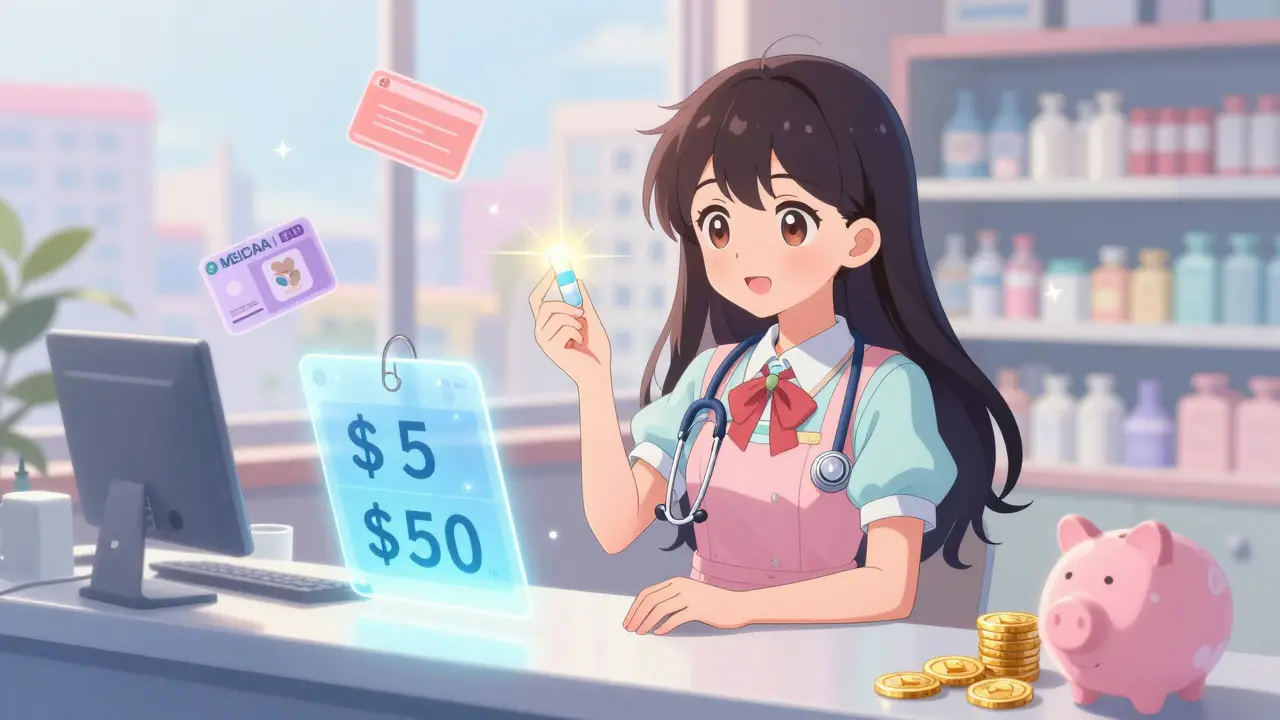
When you pick up a prescription, you might not realize that the decision between a brand-name drug and its generic version isn’t just about your doctor’s preference-it’s often shaped by rules written in state capitals. Across the U.S., states have been quietly building systems to nudge doctors, pharmacists, and patients toward cheaper generic medications. These aren’t bans. They’re incentives. And they’re working-sometimes better than anyone expected.
Why States Care About Generic Drugs
Generic drugs are chemically identical to their brand-name counterparts but cost 80% to 85% less. That’s not marketing. That’s fact. In 2023, generics made up nearly 90% of all prescriptions filled in the U.S., but they accounted for just 20% of total drug spending. That gap is why states are investing so much effort into encouraging their use. Medicaid, the government health program for low-income people, spends billions each year on prescriptions. In 2019, 46 out of 50 states had Preferred Drug Lists (PDLs) to control costs. These lists identify which drugs-mostly generics-are the most cost-effective. If a doctor prescribes a drug not on the list, the patient pays more, or the pharmacy must get special approval. It’s not about restricting care. It’s about making sure the money spent on drugs actually delivers value.How States Push for Generics
States use three main tools to encourage generic use: copay differentials, pharmacist substitution rules, and preferred drug lists. Copay differentials are the most direct. If your brand-name drug costs $50, but the generic is $10, your copay might be $15 for the brand and $5 for the generic. You’re not forced to choose the cheaper option, but the math makes it obvious. A 2000 Kaiser Family Foundation study showed that while pharmacy profits from dispensing generics dropped to just 8 cents more than brand-name drugs, patient copays widened dramatically-making the choice easier for people. Pharmacist substitution is where things get interesting. In some states, pharmacists can swap a brand-name drug for a generic without asking you. That’s called presumed consent. In others, they have to get your permission first-explicit consent. A 2018 NIH study found that states with presumed consent saw a 3.2 percentage point increase in generic dispensing. That’s not a small bump. If all 39 explicit consent states switched, they could save $51 billion a year. Preferred Drug Lists are the most common tool. Forty-six states used them in 2019. But here’s the catch: they’re only as good as the data behind them. If a brand-name drug offers a big rebate to Medicaid, it might still end up on the list-even if a cheaper generic exists. That’s why some states review their lists quarterly. Others do it once a year. The more frequent the review, the more responsive the system.What Doesn’t Work
You’d think mandatory substitution-forcing pharmacists to swap generics-would work best. But research shows it doesn’t. Why? Because pharmacists already have a financial reason to dispense generics. They make more profit on them. So adding a law doesn’t change behavior much. Same goes for paying pharmacists extra to hand out generics. The Department of Health and Human Services found these incentives rarely move the needle. The real leverage is with the patient. When people feel the cost difference at the counter, they change their behavior.
The Hidden Problem: When Generics Disappear
Here’s the twist: the very system meant to save money can sometimes make generics harder to find. The Medicaid Drug Rebate Program requires drug makers to pay rebates to states based on the drug’s price. But in five specific situations-like when input costs rise, or a drug faces a shortage-the rebate can become so high that the manufacturer loses money, even if they don’t raise the price. That’s not a glitch. It’s how the math works. Avalere Health found this leads to drug withdrawals. If a generic becomes unprofitable under Medicaid rules, the maker may stop producing it. That means fewer options. More shortages. And sometimes, patients end up back on expensive brand-name drugs. This isn’t theoretical. It’s happened in multiple states. The system rewards low prices, but doesn’t account for the volatility of generic markets. States are starting to notice.The 340B Program and Its Complications
Another layer comes from the 340B Drug Pricing Program. Created in 1992, it lets safety-net hospitals and clinics buy drugs at steep discounts-often 20% to 50% off. But here’s the problem: when those same clinics serve Medicaid patients, states have to reimburse them based on what they actually paid, not what the drug list says. In 2016, CMS made it clear: states can’t pay more than the 340B ceiling price. That means if a clinic buys a generic for $2, the state can’t reimburse $5 just because that’s what’s on the list. This forces states to track actual acquisition costs, not just wholesale prices. It’s complicated. It’s administrative. But it’s necessary to prevent overpayment.What’s Next? The $2 Drug List
At the federal level, CMS is testing a new idea: the Medicare $2 Drug List. It’s simple. For a handful of low-cost generics, patients pay just $2-no matter what their plan says. No prior authorization. No copay tiers. Just $2. It’s still voluntary and only for Medicare Part D right now. But states are watching closely. If it cuts costs and increases adherence, it could become a model for Medicaid programs. Imagine if every state adopted a similar approach. For drugs like metformin, lisinopril, or levothyroxine, $2 copays could make adherence skyrocket.
Why This Matters to You
Whether you’re on Medicaid, private insurance, or paying out of pocket, these state policies affect your access and your wallet. If your state uses presumed consent, you might get a generic without even asking. If your copay is lower for generics, you’re being financially rewarded for choosing wisely. But it’s not perfect. Some generics vanish because the rebate system breaks. Some patients still pay too much because the system isn’t updated fast enough. And not every state has the same rules. The goal isn’t to eliminate brand-name drugs. It’s to make sure generics-the safe, effective, cheaper alternatives-are the default choice. Because when they are, everyone wins: patients pay less, insurers spend less, and the system becomes more sustainable.What You Can Do
Ask your pharmacist: “Is there a generic version of this?” If there is, and you’re paying more than $10 for it, ask why. Check your plan’s formulary. See if your state has a Preferred Drug List. You might be surprised how much you can save. Don’t assume your doctor knows the cost differences. Many don’t. But you do. And that gives you power.Frequently Asked Questions
What’s the difference between a generic and a brand-name drug?
Generics contain the same active ingredients, dosage, and strength as brand-name drugs. They’re required by the FDA to work the same way in your body. The only differences are in inactive ingredients, packaging, and price-generics cost far less.
Can my pharmacist switch my brand-name drug to a generic without asking me?
It depends on your state. In 11 states, pharmacists can substitute generics without your permission (presumed consent). In the rest, they must ask you first (explicit consent). Check your state’s pharmacy board website for the exact rule.
Why do some generics cost more than others?
Not all generics are made by the same company. Some manufacturers charge more due to supply issues, lower production volume, or limited competition. Also, if a drug has few generic makers, prices can stay higher. That’s why some states use Maximum Allowable Cost (MAC) lists to cap what they’ll pay for a generic.
Do these policies reduce the quality of care?
No. The FDA requires generics to meet the same safety and effectiveness standards as brand-name drugs. Studies consistently show no difference in clinical outcomes. The goal isn’t to cut corners-it’s to cut waste.
Why do some generic drugs disappear from shelves?
Sometimes, the rebate system makes it unprofitable for manufacturers to sell generics to Medicaid. If the rebate exceeds the profit margin-even if the drug’s price hasn’t changed-the company may stop making it. This leads to shortages and forces patients back onto more expensive brands.


Comments
calanha nevin
January 30, 2026 AT 10:58 AMGeneric drug incentives aren't just about savings-they're about equity. Low-income patients are the ones who benefit most when copays drop from $50 to $5. States that implement presumed consent aren't overreaching-they're removing barriers to affordable care. The data is clear: when you make the cheaper option the default, people choose it. No coercion needed.
What's frustrating is how slowly some states update their Preferred Drug Lists. A rebate loophole shouldn't override clinical effectiveness. If a generic is FDA-approved and cheaper, it should be prioritized-period.
Pharmacists are already incentivized to dispense generics. Adding more financial nudges doesn't help. The real leverage is at the point of sale. Make the math obvious. Patients aren't stupid. They'll pick the $5 option every time if they understand the difference.
owori patrick
January 31, 2026 AT 05:21 AMThis is exactly the kind of policy I wish we had back home in Nigeria. Here, even basic generics like paracetamol or amoxicillin are priced like luxury items because of import taxes and middlemen. The idea of state-led incentives to push cheaper alternatives sounds revolutionary. No one talks about this in global health circles enough.
It's not just about money-it's about dignity. When you can afford your meds, you take them. When you can't, you skip doses. That's how chronic conditions turn into emergencies. These systems work because they respect people's reality, not just their choices.
Russ Kelemen
February 2, 2026 AT 01:14 AMThere's a deeper philosophical question here: should healthcare be designed around what people *should* do, or what they *will* do? These incentive structures assume people respond to cost signals-and they do. That’s not paternalism. That’s behavioral realism.
We’ve spent decades trying to educate patients into making 'rational' choices. It didn’t work. Then someone realized: make the rational choice the easy one. That’s what these policies do. They don’t force. They guide. And that’s how change actually happens in complex systems.
The real tragedy isn’t the occasional generic shortage-it’s that we still treat medicine like a market commodity instead of a public good. But at least these policies are a step toward aligning incentives with human needs, not corporate profits.
Niamh Trihy
February 3, 2026 AT 03:47 AMThe 340B program complication is real but often misunderstood. Hospitals using 340B drugs to serve Medicaid patients shouldn’t get reimbursed at inflated rates. That’s not fraud-it’s accounting. But states need better systems to track actual acquisition costs, not just wholesale price lists. Otherwise, you get perverse incentives where clinics stockpile cheap generics just to cash in on reimbursements.
And yes, the $2 drug list is promising. But it’s a Band-Aid. We need structural reform: cap rebates at reasonable levels, enforce regular PDL reviews, and penalize manufacturers who pull generics just to game the system.
Sarah Blevins
February 4, 2026 AT 04:05 AMLet’s be honest-this whole system is a house of cards. Generics disappear because the rebate formula is broken. States are playing whack-a-mole with drug shortages while pretending they’re saving money. The truth? The system rewards low prices but punishes reliability. That’s not efficiency-it’s instability.
And don’t get me started on the 340B loophole. Safety-net providers are being used as conduits for state reimbursement arbitrage. This isn’t healthcare policy. It’s financial engineering disguised as public good.
Marc Bains
February 4, 2026 AT 10:26 AMAs someone who grew up in a rural town where the nearest pharmacy was 40 miles away, I can tell you: if your copay for a generic is $15, you’re not taking it. Period. These policies work because they meet people where they are. No lectures. No moralizing. Just lower prices.
And yes, pharmacists should be able to substitute without asking. Why? Because in 99% of cases, the patient doesn’t care. They just want to feel better. The idea that they need to be ‘consulted’ every time is paternalistic nonsense. If they want the brand, they’ll say so. Don’t treat adults like children.
Eliana Botelho
February 5, 2026 AT 05:43 AMOkay but have you thought about how this affects people who actually need the brand name? Like, what if the generic doesn’t work for you? I have a friend with epilepsy and the generic version gave her seizures-literally. So now she’s stuck paying $200 a month for the brand because her insurance won’t cover it unless she jumps through 17 hoops. And the state says ‘oh we’re just nudging’ but really they’re punishing people who are medically different. This isn’t innovation-it’s exclusion disguised as cost-cutting. And the fact that nobody talks about the people who get left behind because they don’t fit the statistical average is the real problem here. We’re not building a system for humans-we’re building one for spreadsheets. And that’s terrifying.
Also, why do pharmacists even get to decide what I take? Shouldn’t my doctor have the final say? I don’t trust a pharmacist to make clinical decisions. They’re not doctors. They’re cashiers with a pharmacy degree. And now they’re making life-or-death choices because the state said so? No thanks. I’ll keep paying more if it means my meds don’t kill me.
Lisa McCluskey
February 7, 2026 AT 04:43 AMGenerics save lives. Not just money. I’ve seen patients skip doses because they couldn’t afford their meds. When copays dropped to $5, adherence jumped. That’s not theory. That’s clinic data.
The rebate issue is real. Manufacturers pull drugs when the math doesn’t work. States need to adjust rebate caps or offer stability payments for essential generics. Otherwise, we trade short-term savings for long-term crises.
Simple fix: create a protected list of high-use generics that can’t be pulled unless there’s a verified shortage. Metformin. Lisinopril. Levothyroxine. These aren’t luxuries. They’re lifelines.
Sazzy De
February 7, 2026 AT 10:26 AMJust got my metformin for $2. No drama. No paperwork. Just took it. Good system.