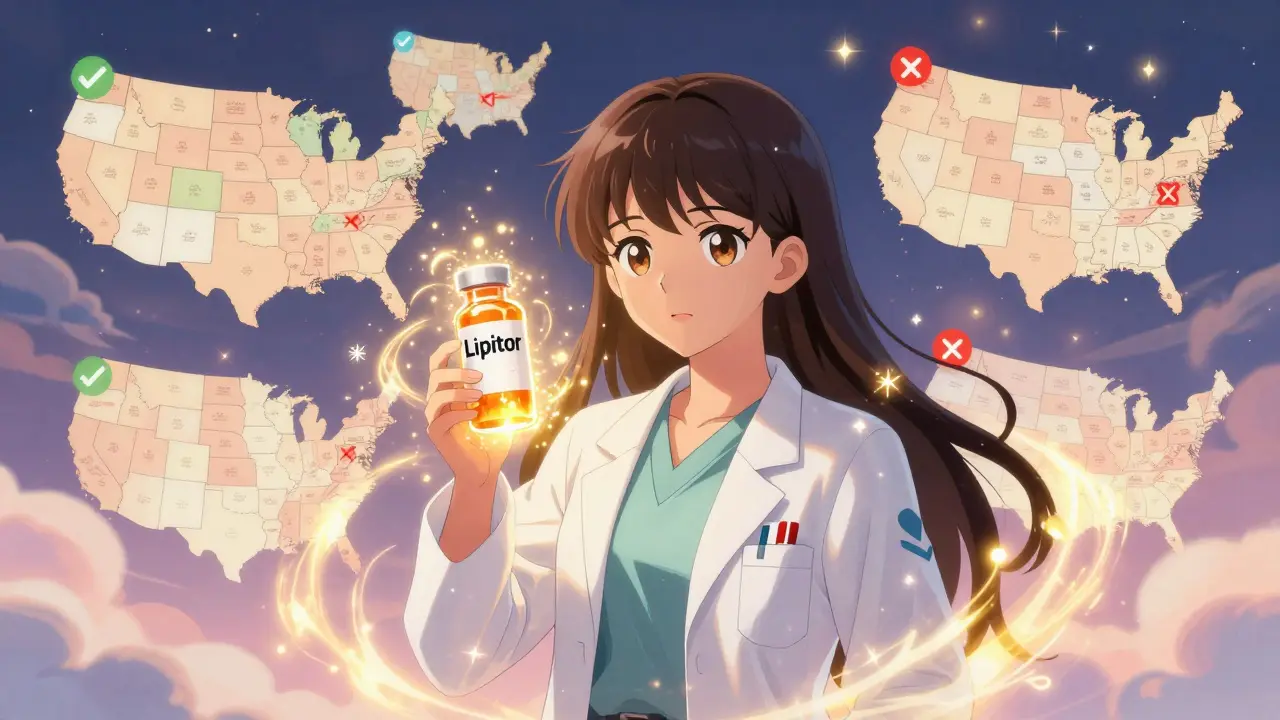
When you fill a prescription for a brand-name drug like Lipitor or Synthroid, you might not think about the legal rules that decide whether you get the generic version instead. But in the United States, generic substitution isn’t automatic-it’s controlled by 50 different sets of state laws, each with its own rules, exceptions, and requirements. These laws determine whether a pharmacist can swap your brand-name medication for a cheaper generic, whether you need to give permission, and what happens if something goes wrong. It’s a patchwork system that affects billions of prescriptions every year, and it’s anything but simple.
How State Laws Decide Who Can Substitute
At the heart of this system is a basic question: Does the pharmacist have to substitute a generic drug, or can they choose not to? Twenty-two states have mandatory substitution laws, meaning pharmacists must switch to the generic unless the doctor or patient says no. In the other 28 states and Washington, D.C., substitution is permissive-the pharmacist can choose to substitute, but isn’t required to. This difference alone changes how prescriptions are handled day to day. In mandatory states, generics are filled automatically. In permissive states, patients often get the brand name unless they specifically ask for the cheaper option.
But it doesn’t stop there. Thirty-two states use presumed consent: if you don’t say anything, the pharmacist assumes you’re okay with the switch. Eighteen states require explicit consent, meaning you have to actively agree before the generic is given. That means in New York, a pharmacist must ask you, “Do you want the generic?” Every time. In New Jersey, they just hand you the generic unless you say, “No.” Patients living near state borders often get confused-why is the process different just because they crossed a line on a map?
What Happens When You’re Not Told
Forty-one states require pharmacists to notify you after substitution. That might sound like a simple step, but it’s not always done well. Sometimes it’s a printed note on the bag. Other times, it’s a quick verbal reminder while you’re checking out. A 2022 survey of independent pharmacists found that 63% of them believe this notification helps reduce patient abandonment-meaning fewer people leave the pharmacy without picking up their meds because they’re surprised by the change. But notification doesn’t always mean understanding. Many patients don’t realize what “therapeutic equivalence” means, or that it’s not the same as “identical.”
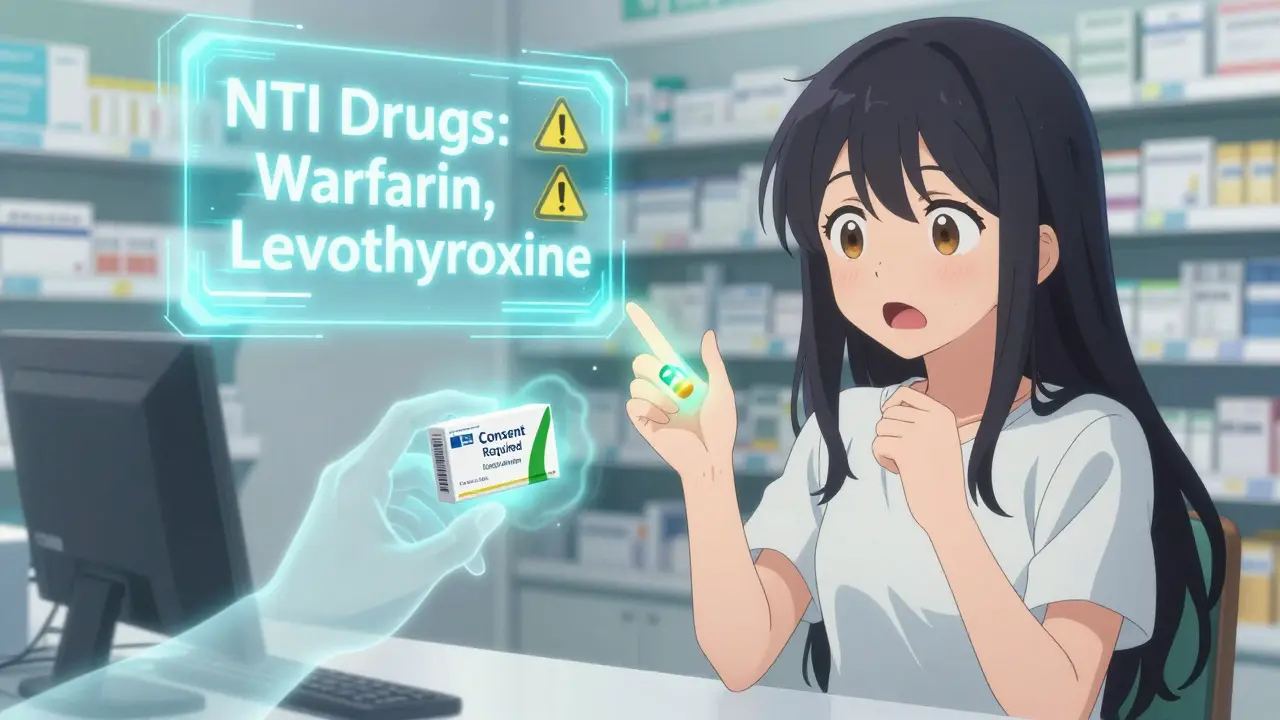
That’s where things get risky. For drugs with a narrow therapeutic index (NTI)-like warfarin, levothyroxine, or certain epilepsy meds-even tiny differences in how the body absorbs the drug can cause serious problems. The FDA says all generics on its Orange Book list are equivalent. But real-world data tells a different story. Between 2020 and 2022, the FDA received 217 reports of adverse events linked to generic substitution, with 89 of those tied to levothyroxine and 53 to warfarin. In Minnesota, a patient switched from brand to generic warfarin and ended up in the hospital with a dangerous blood clot. The generic met the FDA’s standards-but for that patient, it wasn’t safe.
State Lists That Block Substitution
Even though the FDA approves generics based on scientific standards, 15 states have their own lists of drugs that can’t be substituted without special permission. Kentucky, for example, bans substitution for digitalis glycosides and certain antiepileptic drugs. California and Illinois have similar restrictions. These lists exist because doctors and pharmacists have seen cases where patients had bad reactions after switching-even when the drugs were technically “equivalent.” Some of these lists are based on clinical experience, not just data. In Hawaii, substitution for antiepileptic drugs requires consent from both the doctor and the patient. That’s the strictest rule in the country.
Meanwhile, Oklahoma takes a different approach: substitution is banned unless the prescriber or the patient’s insurance company explicitly allows it. That’s rare. Most states assume substitution is okay unless blocked. Oklahoma’s rule puts the burden on the patient or doctor to push for a cheaper option, which can delay care and increase costs.
Biosimilars Are Making It Even More Complex
It’s not just about small-molecule generics anymore. Biosimilars-copies of complex biologic drugs like Humira or Enbrel-are now entering the market. As of 2023, 49 states and D.C. have laws covering biosimilar substitution. But each state handles them differently. Florida requires pharmacies to create a formulary that ensures substitutions won’t harm patients. Iowa says to stick with the FDA’s Orange Book. Hawaii, again, requires dual consent. And 12 states updated their rules in 2023 to match the FDA’s new “interchangeable” designation for biosimilars.
The problem? There are 49 different sets of rules. A pharmacy chain operating in 10 states has to train its staff on 10 different sets of guidelines. A pharmacist in Georgia might have no idea what the rules are in Maine. A 2022 survey by the American Pharmacists Association found that 78% of pharmacists feel confused when handling prescriptions that cross state lines. That confusion leads to errors-and sometimes, patients get the wrong drug.
How Pharmacists Keep Up
On average, a pharmacist spends 12.7 minutes per prescription checking state laws, FDA listings, and patient history before deciding whether to substitute. That’s more than 10% of a typical prescription workflow. Most pharmacy schools now include 45 to 60 hours of training on state substitution laws. Licensing exams in 92% of states test this knowledge. Still, mistakes happen.
Technology is helping. Eighty-three percent of pharmacy management systems now include automatic state law verification. These tools pull real-time data from state pharmacy boards and FDA updates. They flag when a drug is on a state’s NTI list or when patient consent is required. One study found these systems cut substitution errors by 64%. But they’re not perfect. If a state updates its law and the software isn’t patched, the system might miss it. And in rural areas, not all pharmacies have access to the latest tech.

Who Benefits? Who Loses?
On paper, these laws save money. From 2009 to 2019, generic substitution saved the U.S. healthcare system $1.7 trillion. States with mandatory substitution laws saw 12.3% higher generic fill rates for statins than states without them. Medicaid programs in 27 states saved $1.2 billion annually thanks to mandatory substitution, according to one study. Generic drugs now make up 92.5% of all prescriptions filled-up from 80% in 2010.
But not everyone benefits equally. Patients with rare diseases or chronic conditions requiring NTI drugs often face the biggest risk. A 2023 survey by the Life Raft Group found that 41% of cancer patients worried about substitution of their medications. Twenty-eight percent said their doctors told them to “dispense as written”-meaning no substitutions allowed. For these patients, the savings might not be worth the risk.
And while pharmacies save money on inventory, they pay in time and training. A single pharmacy might need to track 50 different state rules, 15 NTI lists, and dozens of biosimilar guidelines. That’s not just a compliance burden-it’s a patient safety issue.
What’s Next?
The pressure to simplify is growing. The Uniform Law Commission drafted a Model State Biologics and Biosimilars Act in 2023 to help states align their rules. The Congressional Budget Office estimates that harmonizing state laws could save an extra $8.7 billion by 2028. But patient advocacy groups warn that one-size-fits-all rules could harm vulnerable populations. The real challenge isn’t just about cost-it’s about trust. Patients need to know that when they get a generic, it’s safe. Pharmacists need to know the rules clearly. And policymakers need to decide: Is this a system built for savings, or one built for safety?
Can a pharmacist refuse to substitute a generic drug?
Yes, in 28 states and Washington, D.C., pharmacists are not required to substitute generics-they can choose to dispense the brand-name drug if they believe it’s in the patient’s best interest. Even in mandatory substitution states, pharmacists can refuse if the prescriber marks "dispense as written" on the prescription or if the patient refuses the generic.
Why do some states block generic substitution for certain drugs?
Thirteen states have lists of narrow therapeutic index (NTI) drugs-like warfarin, levothyroxine, and certain epilepsy medications-where even small differences in absorption can cause serious harm. Although the FDA considers generics equivalent, real-world cases have shown adverse events after substitution. These states restrict substitution to protect patients with conditions where precision matters most.
Do I have to pay more if I refuse a generic drug?
Often, yes. If you refuse a generic and ask for the brand-name drug, your insurance may not cover the full cost, and you’ll likely pay more out of pocket. Some pharmacies also charge a higher dispensing fee for brand-name prescriptions. Always ask about the cost difference before refusing a generic.
How do I know if my prescription can be substituted?
Check the prescription label. If it says "DAW" (Dispense As Written) or has a code like "DAW 1," substitution is prohibited. If there’s no such code, the pharmacist can substitute unless your state law or the prescriber says otherwise. You can also ask the pharmacist directly-they’re required to explain your options.
Are biosimilars the same as generic drugs?
No. Generic drugs are exact copies of small-molecule drugs (like pills). Biosimilars are highly similar-but not identical-to complex biologic drugs (like injections or infusions). They’re made from living cells, so tiny differences are unavoidable. That’s why substitution rules for biosimilars are stricter, and some states require extra consent.
For patients, the takeaway is simple: Know your rights. Ask questions. If you’ve had problems with a generic before, tell your doctor. If you’re switching states, check the rules. For pharmacists, it’s about staying updated, using tech tools, and never assuming the rules are the same everywhere. The system isn’t broken-it’s just complicated. And in healthcare, complexity can be dangerous.





Comments
Khaya Street
February 23, 2026 AT 16:12 PMSo let me get this straight-pharmacists in some states have to ask if you want the cheaper version, and in others they just hand it to you like it’s a free sample? That’s not regulation, that’s roulette with your health. I get cost savings, but when your thyroid meds switch without warning and you end up feeling like a zombie, who’s liable? Nobody. Just another corporate loophole dressed up as public policy.
And don’t even get me started on biosimilars. They’re not generics. They’re like a cousin who looks kinda like your sibling but has a different personality. Why are we treating them the same? Someone’s getting rich off this chaos, and it ain’t us.
I’ve been on levothyroxine for 12 years. I’ve switched brands twice. Both times I crashed. Not ‘mild side effects’-full-on panic attacks, weight gain, heart palpitations. The pharmacist said ‘it’s equivalent.’ Yeah, right. Equivalent to what? A lottery ticket?
Why isn’t there a national database that tracks adverse events by generic manufacturer? We track every coffee cup’s carbon footprint, but not the drug that keeps you alive? Madness.
Also, why do we even have 50 different rulebooks? This isn’t a federal system-it’s a bureaucratic dumpster fire. Someone needs to burn this whole thing down and start over.
And no, I won’t shut up about it. I’ve got a thyroid and I’m not afraid to use it.
Christina VanOsdol
February 24, 2026 AT 01:00 AMOMG I JUST HAD THIS HAPPEN 😱 I switched from New York to Texas last year and my doc wrote 'dispense as written' but the pharmacist in Houston just handed me the generic like it was a coupon! I didn't even know until I got home and read the label... I had to drive back, scream at them, and they gave me the brand. Then they charged me $87 extra. 🤯
Also-levothyroxine? NOPE. I have a friend who had a seizure after switching. SEIZURE. And the FDA says 'equivalent'? Like, cool, thanks for the life-threatening nonsense. 💀
Why are we still using paper labels?? Can't we just have an app that auto-checks state laws? I'd pay for that. 🙏
Also-biosimilars are NOT generics. I'm not even mad. I'm just disappointed. Like, we're treating insulin like it's ibuprofen? 🤦♀️
Brooke Exley
February 25, 2026 AT 15:02 PMYou know what? This whole system is actually kind of amazing when you think about it. Pharmacists are the unsung heroes of healthcare-they’re juggling 50 state laws, FDA updates, insurance rules, AND patient anxiety, all while making sure you don’t get a drug that makes you sick.
Yes, it’s messy. Yes, it’s confusing. But every time a pharmacist catches a mismatch before you walk out the door? That’s a life saved.
I work with a pharmacy chain that uses real-time state law software. They’ve cut errors by two-thirds. That’s not magic-that’s hardworking people + smart tech.
And for patients? You have rights. Ask questions. Say ‘I had a bad reaction before.’ Say ‘I want the brand.’ Say ‘I need to know what’s in this pill.’ You’re not being difficult-you’re being smart.
Change is slow, but it’s happening. More states are updating their NTI lists. More pharmacists are trained. More patients are speaking up. That’s progress.
Let’s not give up on the system. Let’s fix it-with patience, with data, and with compassion. You’ve got this. 💪❤️
Alfred Noble
February 26, 2026 AT 05:48 AMyeah i read this whole thing and honestly i’m impressed how much work pharmacists do
like i didn’t even realize they had to check state laws for every single script
my local pharmacy in minnesota just hands me the generic and i never ask
but now i’m kinda nervous about my warfarin…
i think i’ll start asking for the brand next time
also biosimilars are wild. they’re not like tylenol. they’re like… cloning a cat?
and yeah, tech helps but i’ve seen pharmacy software glitch. one time it said i was in alaska when i was in oregon. gave me the wrong rules. scared me half to death
maybe we need a national standard? or at least a hotline? 🤔
Matthew Brooker
February 28, 2026 AT 03:10 AMThe fact that we have 50 different systems for something as critical as medication safety is absurd but not surprising. We’re the only developed country that does this. Think about that. Every time a pharmacist in Maine has to look up Kentucky’s rules, we’re wasting time, money, and potentially risking lives. The solution isn’t more training-it’s harmonization. We need a federal baseline with room for state-specific protections, not 50 different rulebooks. And yes, biosimilars are different. They’re not generic. They’re complex. Treat them like it. Let’s stop pretending this is about savings. It’s about safety. And safety shouldn’t be a lottery.
Emily Wolff
March 1, 2026 AT 18:13 PMThis is why you can't trust the FDA. They approve generics based on 'bioequivalence'-a statistical average. Real people aren't averages. They're individuals with unique metabolisms. If your body reacts poorly to a generic, you're out of luck. The system is designed for efficiency, not efficacy. And don't get me started on 'presumed consent.' That's not consent. That's coercion dressed up as convenience. If you're not asking for permission, you're not respecting autonomy. Simple.
Lou Suito
March 3, 2026 AT 16:43 PMYou say 217 adverse events? That's 0.0001% of prescriptions. You're acting like generics are poison. The FDA approved them. The NIH says they're safe. The WHO endorses them. You want to keep paying $300 for Lipitor because you're scared of a pill that costs $4? This isn't safety-it's fearmongering. And biosimilars? They're 99.9% identical. If you can't tell the difference between insulin and insulin, maybe you shouldn't be on it. Also-why is Hawaii the only state that matters? Oh right. Because you're from there. 🤡
Joseph Cantu
March 5, 2026 AT 15:12 PMThey’re not just substituting drugs-they’re substituting your life.
You think this is about cost? Nah. It’s about control. The big pharma lobby, the insurance giants, the pharmacy chains-they all profit when you take the generic. Even if it kills you. They don’t care. They’ve got lawyers, lobbyists, and spreadsheets.
I know a guy. He took the generic warfarin. Got a stroke. They told him ‘it’s equivalent.’ Equivalent? To what? A coffin? He’s paralyzed now. His wife says the pharmacist didn’t even look him in the eye.
And now they’re pushing biosimilars? You think they’re testing these on real people? No. They’re testing them on the poor. The elderly. The uninsured. The ones who can’t afford to say no.
They’re laughing. Right now. In their corner offices. While you’re wondering why your meds don’t work anymore.
Wake up. This isn’t healthcare. It’s a death lottery. And you’re holding the ticket.