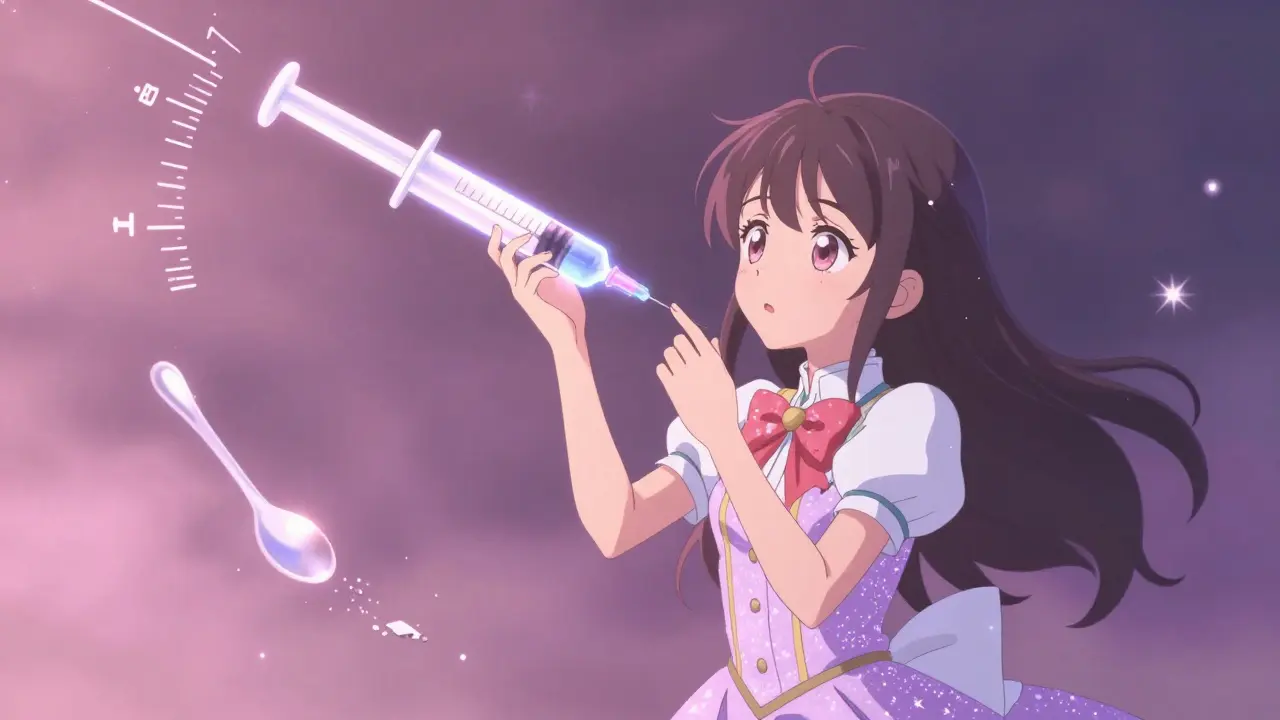
Getting the right amount of liquid medicine isn’t just about following the label-it’s about avoiding dangerous mistakes. Every year, thousands of children and adults receive too much or too little medication because the wrong tool was used to measure it. A teaspoon from the kitchen isn’t the same as a teaspoon on a prescription. That’s why accurate dosing devices aren’t optional-they’re lifesaving.
Why Household Spoons Are Dangerous
Many people still reach for a kitchen spoon when giving liquid medicine to a child. It feels natural. It’s what they’ve always done. But a tablespoon from your cabinet can hold anywhere from 10 to 20 milliliters. The standard dose for many pediatric medications is 5 mL. That’s a 50% error waiting to happen.The Institute for Safe Medication Practices found that household spoons are responsible for about 40% of all liquid medication errors in children. That’s not a small risk-it’s a pattern. Parents aren’t being careless. They’re using what’s available and what feels familiar. But when a label says “give 5 mL,” and the only tool nearby is a spoon, the chance of overdose or underdose skyrockets.
The FDA, the American Academy of Pediatrics, and the World Health Organization all agree: stop using teaspoons and tablespoons for medicine. Ever. The only unit that should appear on labels or devices is milliliters (mL). No exceptions. No abbreviations like “tsp” or “tbsp.” Just mL.
The Right Tools for the Job
Not all dosing devices are created equal. There are three main types: oral syringes, dosing cups, and dosing spoons. Here’s how they stack up in real-world use.Oral syringes are the gold standard for doses under 10 mL. They’re precise, easy to control, and eliminate parallax error-the mistake you make when you look at a cup from an angle and misread the level. Studies show that when measuring a 5 mL dose, 67% of users get it right with a syringe. With a cup? Only 15% do. Syringes also allow for measurements as small as 0.1 mL, which is critical for infants and newborns. A 2023 study in PubMed found syringes had only a 4% error rate for 2.5 mL doses. Cups? 43%.
Dosing cups are common, but flawed. They’re often too big. Many hold 15 or 30 mL, even when the maximum dose is just 5 mL. That means the cup is covered in unnecessary lines, making it harder to read. And because they’re wide, the liquid forms a curve (meniscus). If you don’t look at it straight on, you’ll misread it. That’s why 81% of dosing cups have too many markings-most of them useless and confusing.
Dosing spoons are a middle ground. Better than kitchen spoons, but worse than syringes. Their volume varies depending on how full you fill them. One study found they had a ±15% error rate. That’s unacceptable for a medication meant to be exact.
Bottom line: for doses under 10 mL, use an oral syringe. For doses over 10 mL, a dosing cup with clear, minimal markings (only the doses you need) is acceptable-but only if it’s marked in mL and nothing else.
How to Read a Dosing Device Correctly
Even the best tool won’t help if you don’t use it right. Here’s how to get it accurate every time:- Place the syringe or cup on a flat surface. Don’t hold it in the air.
- Draw the liquid slowly. Let it settle. Tap the side gently to pop any bubbles.
- Hold the device at eye level. Don’t look down. Don’t tilt it.
- Read the measurement at the bottom of the meniscus (the curved surface of the liquid). That’s the true level.
- For syringes, make sure the top edge of the plunger lines up with the correct mark. Not the bottom of the plunger.
Practice with water first. Fill the syringe to the right dose, then pour it into a small cup. Check it with a kitchen scale if you can. Five milliliters of water weighs exactly 5 grams. If it doesn’t match, you’re reading it wrong.

Label and Device Must Match
One of the biggest problems? The label says 5 mL, but the cup that comes with the medicine has markings for 1 tsp, 2 tsp, and 1 tbsp. That’s a recipe for confusion. The FDA’s 2022 guidance made it clear: the unit on the label must match the unit on the device. Always. No mixing mL with teaspoons.A 2013 JAMA Network study found that 89% of liquid medications had mismatched labels and devices. That’s not a glitch-it’s a systemic failure. Pharmacies still hand out cups with household units because it’s easier than ordering the right ones. But when caregivers see “1 tsp” on the label and “5 mL” on the cup, they guess. And guessing with medicine is never safe.
Always check: if the label says 5 mL, the device should have a 5 mL mark. No other numbers. If it doesn’t, ask for a different device. Demand an oral syringe. It’s your right.
What Pharmacies Should Be Doing
Pharmacists are on the front line. They’re the last person to catch this before the medicine leaves the store. But too often, they don’t.The American Pharmacists Association recommends that all liquid prescriptions under 10 mL come with an oral syringe. In a multicenter trial, this simple change cut dosing errors by 28%. Yet, only 35% of pediatric prescriptions include one. Most still get a cup.
Good pharmacies now do more than hand out devices. They show you how to use them. The “teach-back” method works: ask the caregiver to demonstrate the dose with water. If they can do it correctly, they’re far less likely to make a mistake later. Studies show this reduces errors by 35%.
Some chains are going further. CVS’s “DoseRight” system gives you a QR code on the label. Scan it, and a video shows you exactly how to use the syringe. Walgreens now offers Bluetooth-enabled syringes that connect to an app and confirm the dose before you give it. These aren’t sci-fi-they’re practical, proven solutions.

What to Do If You’re Given the Wrong Device
You walk out of the pharmacy with a bottle of medicine and a dosing cup marked in teaspoons. You know it’s wrong. What now?Don’t assume it’s fine. Don’t guess. Go back. Ask for an oral syringe. Most pharmacies keep them in stock. If they don’t, call another one. Or order one online. They cost less than $2 and ship fast.
Don’t wait until the next dose. If you’re giving medicine to a child with a fever or infection, every milliliter matters. An overdose can cause liver damage. An underdose can let an infection spread.
And if you’re given a syringe but you’re not sure how to use it? Watch a video. Search “how to use oral syringe for liquid medicine” on YouTube. There are dozens of short, clear tutorials. Watch one before you give the first dose.
The Bigger Picture: Why This Matters
Liquid medication errors aren’t rare. They’re common. And they’re preventable. The CDC found that between 2015 and 2022, pediatric liquid medication errors dropped by 37%-because more people started using syringes and stopped using spoons.But progress is uneven. Low-income families are 63% more likely to get poorly designed, inaccurate devices. Older medications still use teaspoon labels. Some states have strict rules. Others don’t enforce them at all.
This isn’t just about following guidelines. It’s about protecting the people you love. A child with an ear infection doesn’t need a 10% overdose. A senior with high blood pressure doesn’t need half the dose because they misread a cup.
Accurate dosing isn’t complicated. It’s simple: use mL. Use a syringe. Read at eye level. Match the label to the device. And never, ever use a kitchen spoon.
If you’re a caregiver, a nurse, a pharmacist, or just someone who cares about safety-speak up. Ask for the right tool. Demand better. Because in medicine, precision isn’t optional. It’s the only thing that keeps people safe.




Comments
Bob Cohen
February 2, 2026 AT 11:44 AMSo let me get this straight - we’re still having this conversation in 2025? 🙄 I gave my kid amoxicillin last week with a syringe, and my mom screamed like I was injecting him with alien goo. 'But we always used a spoon!' Yeah, and we also used to smoke in hospitals and drive without seatbelts. Progress, folks.
Also, why do pharmacies still hand out those 30mL cups with 12 useless markings? It’s like giving someone a Swiss Army knife to butter toast. Just give me the damn syringe.
I’ve started printing out the FDA guidelines and taping them to the medicine cabinet. My sister still uses a teaspoon. I’ve stopped visiting. No regrets.
Aditya Gupta
February 3, 2026 AT 11:05 AMbro i used spoon for my son’s fever medicine last month 😅
then i saw a video how 1 tsp = 15ml not 5ml
my heart stopped
got a syringe from local chemist next day
cost me 50 rupees
life changed
Angel Fitzpatrick
February 3, 2026 AT 18:39 PMLet’s be real - this isn’t about dosing errors. This is a Big Pharma psyop. They don’t want you using kitchen spoons because then you’d realize how little actual medicine is in those bottles. The syringes? They’re designed to make you feel like you need their proprietary tools. The meniscus? A distraction. The ‘mL only’ mandate? So they can charge $12 for a plastic syringe that costs 3 cents to produce.
And don’t get me started on the Bluetooth syringes. That’s not healthcare - that’s surveillance with a side of Tylenol. Your kid’s dose is being logged. Who’s accessing that data? Who’s selling it?
The real danger isn’t the spoon. It’s the system that profits from your fear.
PS: I use a calibrated eyedropper from my old aquarium kit. 5.2 mL. Perfect. FDA doesn’t know what’s best. I do.
Donna Macaranas
February 3, 2026 AT 22:53 PMI’m a nurse and I can’t tell you how many times I’ve seen parents stress over this. The worst part? They feel guilty. Like they’re bad caregivers because they used a spoon. But honestly? Most of them just didn’t know. No one ever showed them. No one handed them a syringe and said, ‘Here, this is how you do it.’
My hospital started giving out free syringes with every liquid script under 10mL. The drop in ER visits for dosing errors? Crazy. Parents are way calmer too. It’s not about blame. It’s about access.
Also - yes, the ‘teach-back’ method works. Just ask them to show you with water. If they can do it, they’ll remember. Simple.
Lisa Rodriguez
February 4, 2026 AT 13:46 PMMy aunt gave her grandkid cough syrup with a soup spoon last week and now she’s convinced she almost killed him
she cried for an hour
then bought 3 syringes from Amazon
and now she’s handing them out to everyone in her book club
like it’s a new yoga mat
but honestly
thank you for this post
it’s the kind of thing that should be on every pharmacy counter
not buried in a 20-page pamphlet
just a big sign
NO SPOONS
USE SYRINGE
simple
done
Lilliana Lowe
February 5, 2026 AT 19:20 PMThe fact that this even needs to be written in 2025 is a national disgrace. The WHO, CDC, AAP - all of them have issued unequivocal guidelines for over a decade. Yet we still have pharmacists handing out ‘tsp’-marked cups because ‘that’s what patients expect.’
Expectation is not a valid medical standard. If patients expected to use a ruler to measure insulin, would you comply? Of course not. But when it’s liquid medicine, suddenly ‘they’re used to it’ becomes a justification for negligence.
And the ‘dosing spoons’? A marketing scam. They’re not even standardized. One brand’s ‘teaspoon’ is 4.8 mL, another’s is 6.1 mL. That’s not a tool - it’s a gamble.
Until the FDA enforces labeling compliance with penalties, this will keep happening. And the children will keep paying the price.
vivian papadatu
February 6, 2026 AT 15:57 PMMy mom’s from India and she used to say ‘one spoon’ for everything - medicine, curry, tea.
When my daughter was born, I was terrified.
So I bought a syringe, wrote ‘5 mL’ on it in Sharpie, and taped a picture of a syringe next to the medicine cabinet.
My mom still says ‘just a spoon’ - but now she watches me measure it first.
She’s learning.
It’s slow.
But it’s happening.
❤️
Melissa Melville
February 8, 2026 AT 00:39 AMmy grandma still uses a spoon
she says 'i've been doing this since 1952' and i'm like...
yeah grandma
but back then
you didn't have to worry about acetaminophen poisoning
and you didn't have to measure
because you just gave 'a little' and hoped for the best
we can do better now
and we should
she doesn't get it
but i keep the syringe on her counter anyway
just in case
Deep Rank
February 8, 2026 AT 08:55 AMOkay but let’s be honest - this whole thing is just another way for rich white doctors to guilt-trip working-class parents who can’t afford fancy syringes or don’t have time to go back to the pharmacy. You think I’m gonna drive 20 miles because the pharmacist gave me a cup with 'tsp' on it? My kid’s fever isn’t going to wait while I chase down a $2 plastic tool. And don’t even get me started on the ‘teach-back’ method - like I’m supposed to sit there and perform a demo like I’m in a medical school exam while my toddler screams because he’s sick and I’m exhausted?
Also, the fact that you’re quoting PubMed studies like they’re scripture? Cute. Most of us don’t even know what PubMed is. We just want our kid to feel better. And if that means using a damn spoon because it’s the only thing in the house? Then that’s what we do. You wanna fix this? Don’t lecture us. Give us the tools. For free. At every pharmacy. Without asking. That’s the solution. Not more judgment.
Naomi Walsh
February 9, 2026 AT 11:22 AMIt’s astonishing how casually American caregivers treat pharmacological precision. In Europe, we have standardized dosing devices mandated by EU Regulation 2021/883. No exceptions. No ‘it’s easier this way.’ No ‘but my grandmother used a spoon.’ The metric system isn’t a suggestion - it’s law. And yet here you are, debating whether a 15mL cup with ‘tsp’ markings is ‘acceptable.’
Frankly, it’s embarrassing. This isn’t culture. It’s negligence dressed up as tradition. The fact that you’re even asking whether to ‘demand’ a syringe means your healthcare infrastructure has failed. A child’s life isn’t a negotiation. It’s a right.
Sami Sahil
February 9, 2026 AT 12:36 PMi used to think syringes were for shots
then my nephew got sick
pharmacist gave me one
i thought it was a joke
but then i tried it
so easy
so clear
no guessing
no spill
now i carry one in my bag
for everyone
my sister
my mom
my neighbor’s kid
just ask for it
they’ll give it
no big deal
just a little plastic tool
that saves lives
Nancy Nino
February 11, 2026 AT 10:41 AMLet me just say - I’m a pediatrician. I’ve seen kids admitted for liver failure from a single overdose. One teaspoon. One. And you know what the parents said? ‘I thought it was the same.’
So yes. This post is necessary. And yes - I will continue to hand out syringes, even if I have to buy them myself. Because if I don’t, who will?
And to the people who say ‘it’s not that big of a deal’ - you’re not wrong. It’s not a big deal. Until it is. And then it’s too late.
Jaden Green
February 12, 2026 AT 02:48 AMLet’s be honest - this entire post reads like a pharmaceutical industry whitepaper. Syringes cost more. They’re harder to produce. They’re harder to distribute. And yet here we are, pretending this is just about ‘accuracy’ and not about profit margins. Why don’t we just give everyone a digital dosing scale that auto-calibrates? Oh wait - because it costs $80 and the insurance won’t cover it.
Meanwhile, the real problem? Most parents don’t have time to ‘practice with water’ or ‘scan QR codes.’ They’re working two jobs. Their kid is vomiting. They’re exhausted. And now you want them to read a 2000-word essay on meniscus angles?
Stop blaming caregivers. Fix the system. Mandate syringes. Fund distribution. Stop hiding behind ‘education’ when what’s needed is infrastructure.
This isn’t about spoon usage. It’s about healthcare inequality dressed up as a parenting tip.
Donna Macaranas
February 13, 2026 AT 10:03 AMJust wanted to reply to Jaden Green - you’re right about the system failing. But I’ve seen pharmacies in rural areas where the only thing they have is a cup. No syringes. No budget. No support. So I started donating syringes to community clinics. I buy them in bulk. I leave them at the front desk with a sticky note: ‘Ask for this. It’s safer.’
It’s not perfect. But it’s something.
And honestly? If we all did one small thing - like handing out a syringe to a stranger at the pharmacy - we’d cut these errors in half. No need for legislation. Just compassion.
One syringe at a time.