Why Insulin Storage Matters More Than You Think
Insulin isn’t like other medications. If it gets too hot, too cold, or sits out too long, it stops working - and you won’t always know until your blood sugar goes wild. People with diabetes rely on insulin to stay alive. When it degrades, blood sugar control falls apart. That’s not a minor inconvenience. It’s dangerous. The American Diabetes Association says 23.1 million Americans use insulin. Many of them don’t realize their insulin might be bad - until it’s too late.
Insulin is a protein. Proteins break down when exposed to extreme temperatures. Frozen insulin forms crystals. Hot insulin loses its shape. Either way, your body doesn’t get the right dose. You might think you’re injecting the same strength, but you’re not. That’s why unexplained high blood sugars often trace back to spoiled insulin.
Unopened Insulin: Keep It Cold, But Not Frozen
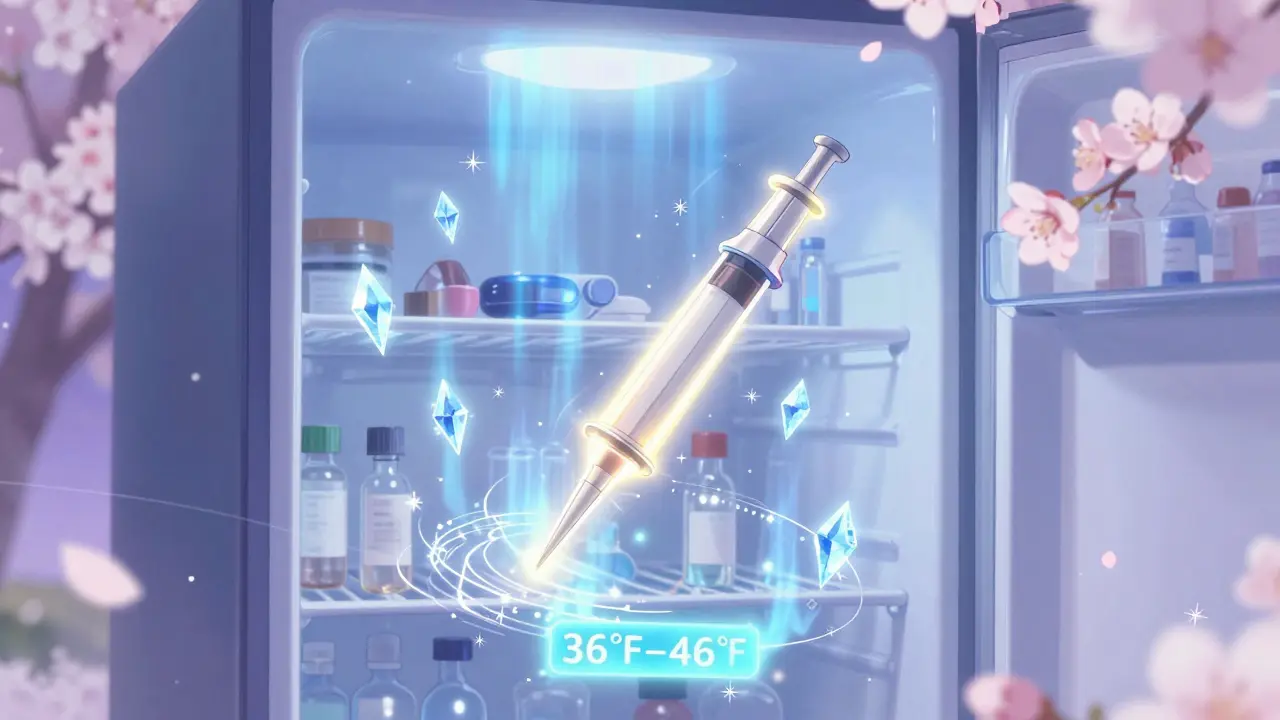
Before you open a new vial, pen, or cartridge, store it in the fridge. The sweet spot is between 36°F and 46°F (2°C to 8°C). That’s standard across all major brands - Eli Lilly, Novo Nordisk, Sanofi. This keeps insulin stable until its printed expiration date.
But here’s the trap: don’t put it in the back of the fridge or near the freezer. Many fridges have cold spots that dip below 32°F. If insulin freezes, it’s ruined. You’ll see clumps or crystals. Never use it. Even if it looks okay after thawing, the damage is permanent. The Wisconsin Department of Health Services found 12% of home fridges have zones that freeze insulin accidentally.
Store insulin on a middle shelf, away from walls. Use a small insulated bag or container if you’re worried about temperature swings. Keep it in its original box too - light can degrade it. Don’t leave it on the fridge door. Every time you open it, the temperature jumps.
Opened Insulin: Room Temperature Is Okay - For a While
Once you start using insulin, you don’t need to keep it cold. In fact, injecting cold insulin hurts. Most people prefer letting it warm up for 30 minutes before use.
After opening, insulin can stay at room temperature (59°F to 86°F / 15°C to 30°C) for a set number of days. But it’s not the same for every type:
- Most insulins (like Humalog, NovoLog, Lantus): 28 days
- Isophane (NPH): Only 14 days
- Tresiba (Insulin Degludec): Up to 8 weeks
- Toujeo (insulin glargine U300): 56 days (approved in early 2023)
Always check the package insert. Manufacturers now include these details clearly - more than ever before. In 2010, only 65% of insulin boxes had room temperature guidelines. Today, it’s 100%.
Mark the Date - Don’t Guess
How do you know when your insulin was opened? If you don’t write it down, you won’t remember. And that’s how people end up using insulin for 45 days when it should be gone after 28.
The CDC recommends marking the opening date on the pen or vial with a permanent marker. A University of Michigan study found this simple habit reduced expired insulin use by 68%. Write the day, month, and year. Do it right after you first use it. Don’t wait.
Also, check the expiration date on the box. Even if you opened it yesterday, if it’s past the printed date, throw it out. The two dates are separate. The expiration date is the manufacturer’s guarantee. The opened date is your responsibility.

What to Do If Insulin Looks Weird
Normal insulin should look clear or slightly cloudy - depending on the type. If you see clumps, flakes, or particles that won’t mix, toss it. Same if it’s discolored - yellow, brown, or has any unusual tint.
Insulin that should be clear (like rapid-acting or long-acting analogs) turning cloudy is a red flag. That means the protein structure broke down. It’s not just less effective - it’s unpredictable. You could get a low blood sugar one hour and a spike the next.
And don’t rely on how you feel. Some people think, “I’ve used this for 30 days and I’m okay.” That’s risky. Degraded insulin doesn’t always cause obvious symptoms right away. It just makes control harder - slowly, over days.
Insulin Pumps: A Different Rulebook
If you use an insulin pump, the rules change. Once you fill the reservoir from a vial, that insulin must be thrown out after 14 days - no exceptions. Even if it’s still within the 28-day window for pens or vials.
And the infusion set? Replace it every 72 hours. That’s not about the insulin. It’s about the tubing and needle. Bacteria can grow, and the flow can clog. But temperature still matters. If your pump gets too hot - say, left in a car on a sunny day - discard the insulin immediately, even if it’s only been 24 hours.
Studies show pump users are more likely to experience complications from degraded insulin because they’re exposed to it longer. One 2022 survey found 31% of pump users didn’t know they had to replace reservoir insulin every 14 days.
Traveling With Insulin: No More Guesswork
Traveling? You need a plan. Airplane cargo holds can drop below freezing. Checked luggage is risky. Carry insulin in your hand luggage. Use an insulated case with a phase-change gel pack. Brands like Frio Wallet, CoolerPak, and ViviCap keep insulin between 59°F and 86°F for 45+ hours.
These cost $25 to $50 - cheaper than one spoiled vial. Amazon reviews show 4.3 out of 5 stars from over 2,800 users. People who travel often say these cases are non-negotiable.
And if you’re flying, carry a doctor’s note. TSA allows insulin through security, but having proof helps avoid delays. Never check insulin. Never leave it in a hot car. Even on a 75°F day, a car’s interior can hit 110°F in 30 minutes. That’s enough to ruin insulin fast.

Emergency Situations: What If You Lose Power?
Power outage? No fridge? Don’t panic. The FDA’s 2023 emergency guidelines say most insulin stays safe for up to 28 days at temperatures up to 86°F. That’s longer than most people think.
But if it hits 95°F or higher, potency drops fast - 35% after just 7 days. If you’re stuck without refrigeration and your insulin is over 86°F for more than a few hours, keep it in a cool, dark place. A basement, a cooler with a wet towel, or even buried in the ground (if you’re camping) can help.
Don’t use ice packs directly against the insulin. Condensation can damage the label or pen. Wrap it in a cloth first.
What Not to Do
- Don’t leave insulin in the car. Even on a mild day.
- Don’t store it near the stove, window, or radiator. Heat rises.
- Don’t reuse pens or vials beyond their time limit. It’s not worth the risk.
- Don’t ignore expiration dates. 41% of users don’t check them regularly.
- Don’t assume “it still looks fine” means it’s safe. Degradation isn’t always visible.
Waste Is Costly - And Preventable
Improper storage isn’t just a health issue. It’s a financial one. In the U.S. alone, wasted insulin due to poor storage costs $1.2 billion a year. That’s $380 lost for one person after a fridge fails - like one Reddit user experienced. That’s not rare.
And it’s not just money. It’s stress. It’s missed work. It’s ER visits from uncontrolled blood sugar. A 2019 IDF Europe report found 8.2% of diabetic ketoacidosis cases in summer were linked to spoiled insulin.
Using the right storage habits cuts that risk. Mark dates. Keep it cool. Know your type. Check for changes. It’s simple - but it saves lives.
What’s Changing in Insulin Storage?
The good news? Insulin is getting more stable. Sanofi’s Toujeo now lasts 56 days at room temperature. New formulations in development can survive 14 days at 104°F. By 2027, 60% of new insulins will offer 35+ days of room temperature stability.
This isn’t just science fiction. It’s real progress. Manufacturers are responding to patient needs. But until then, the rules still apply. Don’t assume your new insulin is heat-resistant unless the label says so.





Comments
Edith Brederode
January 20, 2026 AT 04:58 AMI literally cry every time I see someone waste insulin 💔 I had to go to the ER last year because I didn’t realize my pen had been sitting in the car for a day. Now I keep it in a little insulated pouch in my purse. Life-changing. 🥺
clifford hoang
January 20, 2026 AT 11:06 AMLet me guess - Big Pharma wants you to buy new pens every 28 days so they can profit off your fear. 🤡 I’ve been using my Lantus for 4 months and my A1C is LOWER than ever. They’re lying about degradation. Proteins don’t just ‘break down’ like that - it’s all a scam to keep you hooked.
Arlene Mathison
January 21, 2026 AT 22:09 PMY’all. I used to be the person who left insulin on the counter. Then I got a Frio wallet. Now I travel with it everywhere - even to the grocery store. It’s $30. It’s not a luxury. It’s a lifeline. 💪 Don’t wait until you’re in crisis to start caring. You got this!
Emily Leigh
January 22, 2026 AT 23:44 PMOkay, but… why are we treating insulin like it’s a fragile flower? It’s a drug. Not a sacred artifact. People have been using it since the 1920s. Why are we suddenly so scared of heat? And why does everyone act like 28 days is some kind of divine law? 🙄
Carolyn Rose Meszaros
January 24, 2026 AT 00:05 AMI love how this post breaks it down so clearly. I just started insulin last year and I was terrified I’d mess up. Now I mark every pen with a sticky note and a Sharpie. It’s such a small thing, but it makes me feel so much more in control. 🌸
Greg Robertson
January 24, 2026 AT 12:53 PMJust wanted to say thanks for writing this. I’ve been sharing it with my cousin who just got diagnosed. He didn’t know any of this. It’s scary how little people are taught about their own meds. Small details save lives.
Renee Stringer
January 26, 2026 AT 09:36 AMI don’t understand how anyone can be so careless. Insulin isn’t a suggestion. It’s a requirement for survival. If you don’t treat it with the respect it deserves, you’re not just risking your health - you’re being selfish.
Courtney Carra
January 27, 2026 AT 04:28 AMThere’s a philosophical layer here, isn’t there? We treat insulin as both a biological necessity and a symbol of modern medical authority. We fear its degradation because it reminds us how fragile our control really is. The pen is a proxy for autonomy - and when it fails, we feel powerless. 🤔
Thomas Varner
January 27, 2026 AT 22:53 PMI used to think the fridge door was fine… until I found a frozen vial in the back. The ice crystals were like little needles. I threw it out immediately. Now I use a little plastic container with a note: 'DO NOT TOUCH THIS, IT’S NOT A DRINK'.
Manoj Kumar Billigunta
January 29, 2026 AT 08:13 AMIn India, many people reuse insulin pens because they can’t afford new ones. This article is helpful, but we need better access, not just better habits. I’ve seen people use insulin for 60+ days. They’re not lazy - they’re surviving. We need systems, not just reminders.
Nadia Watson
January 29, 2026 AT 16:45 PMThe information presented herein is both comprehensive and commendable. It is imperative that individuals with insulin-dependent diabetes mellitus adhere to the prescribed storage protocols, as deviations may result in significant clinical consequences. One must also consider the socioeconomic disparities that impede adherence, particularly in underserved communities.
thomas wall
January 31, 2026 AT 13:03 PMI’m appalled that anyone would even consider leaving insulin in a car. This isn’t ‘carelessness’ - it’s negligence. And yet, the medical establishment lets people get away with it. Someone should be held accountable. This isn’t just about diabetes. It’s about responsibility.
Jacob Cathro
February 2, 2026 AT 05:03 AMSo basically, the whole thing is a giant corporate trap? You gotta buy new pens every 28 days, even if it’s still ‘good’? And now they’re making Tresiba last 8 weeks so you feel guilty for using it longer? I call BS. I’ve used the same vial for 5 months. My glucose monitor doesn’t lie - and mine says I’m fine.
Paul Barnes
February 3, 2026 AT 22:20 PMThe article correctly identifies that insulin degradation is often asymptomatic until blood glucose levels become erratic. This is a well-documented phenomenon in endocrinology literature, with multiple peer-reviewed studies confirming reduced bioavailability following thermal stress. Proper storage is non-negotiable.
pragya mishra
February 5, 2026 AT 04:47 AMWhy are you all making this so complicated? Just keep it cold. Always. Even if the label says room temp. I’ve seen people die because they trusted the ‘28-day rule’. My uncle did. So I don’t take chances. I refrigerate everything. Always. Even if it hurts. Better safe than sorry.