Switching from brand-name to generic immunosuppressants like cyclosporine and tacrolimus can save thousands of dollars a year. But for transplant patients, that savings comes with a hidden risk: even tiny changes in drug levels can trigger rejection or toxicity. This isn’t theoretical-it’s happened in real hospitals, in real lives.
Why These Drugs Are Different
Cyclosporine and tacrolimus are both calcineurin inhibitors. They stop your immune system from attacking a transplanted organ. Sounds simple, right? But here’s the catch: they work at extremely low doses, and the difference between a safe level and a dangerous one is razor-thin. That’s what makes them narrow therapeutic index (NTI) drugs.Tacrolimus is about 20 to 100 times more potent than cyclosporine. A typical daily dose? Around 5 mg twice a day for tacrolimus. For cyclosporine? Up to 150 mg twice a day. But even a 10% change in absorption can push levels out of the safe zone.
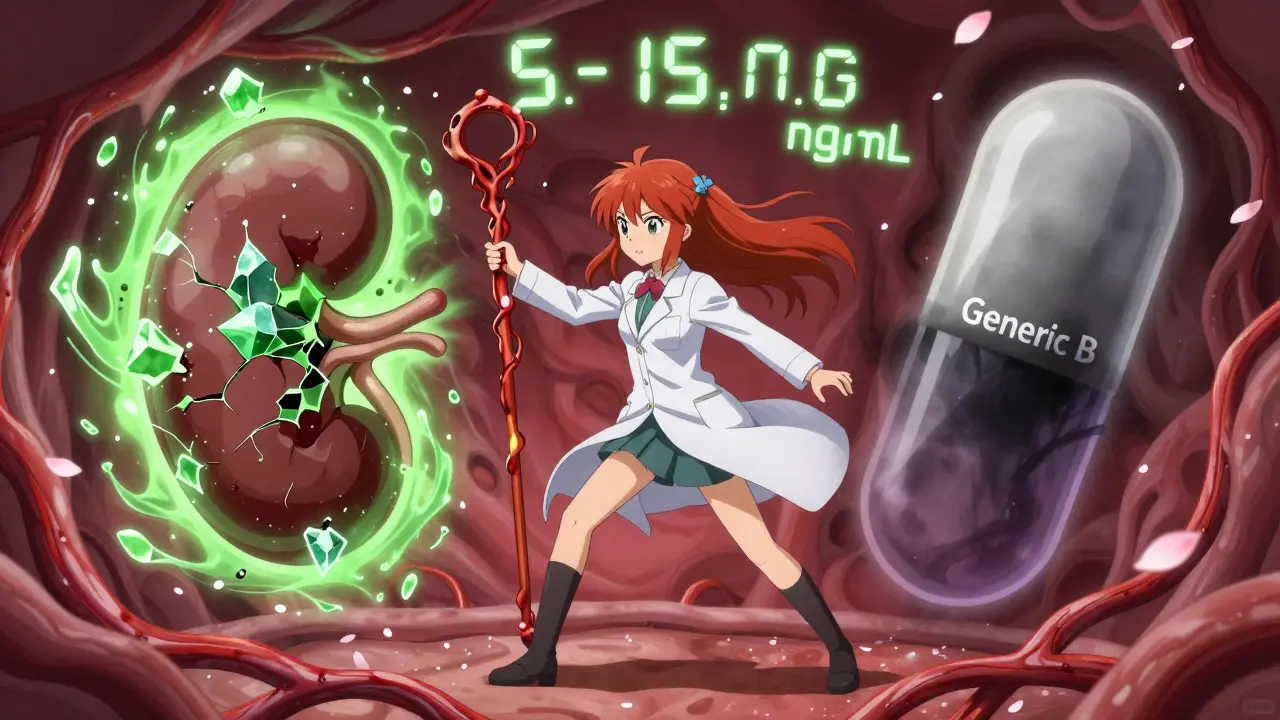
Therapeutic ranges are strict. For tacrolimus, blood levels should stay between 5-15 ng/mL in the first six months after transplant. Go below 5? Risk of rejection. Above 15? Risk of kidney damage, tremors, or even diabetes. Cyclosporine’s range is wider-100-200 ng/mL-but still unforgiving. A drop from 180 to 140 ng/mL might seem small. But for someone with a new kidney, it’s enough to trigger an immune attack.
Generic Versions Aren’t All the Same
There are now over 14 FDA-approved generic versions of tacrolimus and 11 of cyclosporine. Companies like Teva, Mylan, Sandoz, and Apotex make them. On paper, they’re all “bioequivalent.” But bioequivalence doesn’t mean identical.The FDA allows generics to differ by up to 20% in absorption compared to the brand. That’s legal. But for a drug like tacrolimus, a 20% drop in absorption could mean your level falls from 10 ng/mL to 8 ng/mL-still within the “normal” range, but now dangerously close to rejection territory. A 20% increase? You could hit 12 ng/mL and start developing neurological side effects.
Cyclosporine is even trickier. Older versions were oil-based and absorbed unpredictably. Even the newer microemulsion versions vary between manufacturers. One generic might use a different emulsifier, another a different particle size. These small changes affect how much drug gets into your bloodstream. One patient might switch from Generic A to Generic B and see their cyclosporine level drop by 30%-no warning, no symptoms-until their biopsy shows rejection.
Real Stories, Real Consequences
Online transplant forums are full of posts like this:- “Switched to generic tacrolimus. My level went from 8.5 to 5.2 in two weeks. Had to be hospitalized for rejection.”
- “My insurance forced me to switch from Prograf to a generic. I started getting tremors and couldn’t hold a coffee cup. My doctor said it was the drug.”
- “I’ve been on the same generic for 18 months. Stable. No issues. Saved $900/month.”
These aren’t outliers. A 2022 survey of 1,247 transplant patients found that 42.7% noticed side effects after switching to a generic. Nearly 1 in 5 needed a dose adjustment. The United States Renal Data System showed medication non-adherence jumped 15.3% among those on generics-not because they forgot, but because they feared the changes.
One patient, u/KidneyWarrior on Reddit, didn’t know his levels had dropped until his new kidney started failing. He didn’t feel sick. No fever. No pain. Just a slow, silent rejection. By the time he got to the hospital, he needed IV steroids and a second biopsy.
Doctors Know the Risks
Transplant teams aren’t blind to this. Dr. Michelle A. Josephson from the University of Chicago warned in the American Journal of Transplantation that switching between generic brands without monitoring can lead to “clinically significant fluctuations.” The European Medicines Agency echoed this in 2020: “Switching between different generic tacrolimus products without appropriate monitoring may result in subtherapeutic or supratherapeutic concentrations.”Many transplant centers now have strict rules:
- No switching between generic brands without prior approval.
- Weekly blood tests for the first month after any switch.
- Only one generic manufacturer used per patient-once you’re on it, you stay on it.
By 2023, 67% of major transplant programs had signed contracts with a single generic supplier to avoid constant switching. That’s not because they dislike generics. It’s because they’ve seen what happens when patients get shuffled between different versions.
What You Can Do
If you’re on cyclosporine or tacrolimus, here’s what matters:- Know your brand. If your pharmacy switches your generic without telling you, ask. Write down the name on the pill bottle. Keep a list.
- Never switch without talking to your transplant team. Even if your insurance forces it, push back. Ask for a letter of medical necessity.
- Monitor closely after any switch. Expect blood tests every week for at least four weeks. Don’t wait for symptoms.
- Be consistent. Take your dose at the same time every day. Avoid grapefruit. Don’t mix supplements without checking with your pharmacist.
- Ask about extended-release options. In December 2023, the FDA approved a new extended-release tacrolimus (LCP-tacrolimus) that smooths out blood level spikes. It’s not generic yet-but it may reduce substitution risks in the future.

The Bigger Picture
Generic drugs saved the U.S. healthcare system over $400 billion in 2023. That’s huge. But for transplant patients, the cost of a rejection episode-hospitalization, extra biopsies, new immunosuppressants, even re-transplantation-can exceed $100,000. The savings from a $300 generic aren’t worth risking a $100,000 crisis.The industry is moving toward personalized dosing. A 2023 study in JAMA Internal Medicine showed that tailoring tacrolimus doses based on a patient’s CYP3A5 gene type reduced the time to reach stable levels by 63%. That’s the future. But until then, the best protection is awareness.
Generic immunosuppressants are not the enemy. They’re necessary. But they’re not interchangeable. Treat them like insulin or warfarin-not as commodities, but as precision tools. One pill can mean the difference between survival and loss.
Can I switch between different generic versions of tacrolimus safely?
No, not without close monitoring. Even though generics are approved as bioequivalent, small differences in absorption can cause your blood levels to drop or spike. Many transplant centers forbid switching between generic brands because it increases the risk of rejection or toxicity. Always consult your transplant team before changing manufacturers.
Why is tacrolimus more dangerous than cyclosporine when switching generics?
Tacrolimus works at much lower doses-20 to 100 times less than cyclosporine. A 10% change in absorption for tacrolimus can shift your level from 8 ng/mL to 9 ng/mL, which might still be in range, but if you’re already near the edge, that small change can tip you into rejection territory. Cyclosporine’s range is wider, so small fluctuations are less likely to cause immediate harm.
How often should I get blood tests after switching to a generic immunosuppressant?
You should have blood tests every week for the first four weeks after switching. Some centers extend this to six weeks. After that, if your levels are stable, you may return to monthly checks. Never assume stability-always confirm with lab results.
Is there a difference between generic cyclosporine and generic tacrolimus in terms of switching risks?
Yes. Generic cyclosporine has more variability due to formulation differences-oil-based versus microemulsion-and absorption is more affected by food and gut health. Tacrolimus is more consistent in absorption but far more sensitive to small changes because of its narrow therapeutic window. Both require caution, but tacrolimus demands tighter monitoring.
What should I do if my insurance forces me to switch to a cheaper generic?
Ask your transplant team for a letter of medical necessity explaining that switching could risk organ rejection. Many insurers will approve a brand-name or single-source generic if you provide documentation. You can also contact the National Transplant Insurance Assistance Fund-they helped over 1,800 patients in 2023 navigate these issues.
Are there any new formulations that reduce generic switching risks?
Yes. In December 2023, the FDA approved a new extended-release tacrolimus (LCP-tacrolimus) that provides steadier blood levels and reduces peak-trough fluctuations. While it’s not yet available as a generic, it’s designed to minimize the impact of switching. Ask your doctor if you’re a candidate.
What Comes Next
The future of immunosuppression is moving toward genetic testing and personalized dosing. If your doctor hasn’t mentioned CYP3A5 gene testing, ask. It can predict how fast your body breaks down tacrolimus-and help avoid dangerous fluctuations from the start.Until then, the best defense is knowledge. Know your drug. Know your level. Know your manufacturer. And never let cost be the only factor when your organ’s survival is on the line.





Comments
Lauren Warner
January 10, 2026 AT 13:01 PMThe FDA’s 20% bioequivalence allowance is a joke when you’re talking about drugs that can kill your transplanted organ. This isn’t about cost-it’s about negligence. I’ve seen patients get rejected because a pharmacist switched their generic without a word. No one gets held accountable. The system is broken.
Craig Wright
January 12, 2026 AT 07:31 AMIt’s absurd that American healthcare allows such reckless substitution. In the UK, we don’t play roulette with immunosuppressants. If a drug has a narrow therapeutic index, it’s kept under strict control. This is why I’m skeptical of American pharmaceutical deregulation-it’s not innovation, it’s cost-cutting at the expense of human life.
Lelia Battle
January 12, 2026 AT 17:02 PMThere’s a deeper philosophical question here: when does cost-saving become moral compromise? We treat insulin like a commodity, warfarin like a commodity, and now tacrolimus like a commodity. But these aren’t aspirin. They’re lifelines. The moment we start treating life-sustaining drugs as interchangeable goods, we’ve lost something fundamental about medicine.
steve ker
January 13, 2026 AT 21:36 PMgeneric = bad. brand = good. why is this even a debate
George Bridges
January 14, 2026 AT 22:22 PMI’ve had a kidney transplant for 12 years. I’ve been on the same generic tacrolimus since 2018. My levels are stable. I’m alive. That doesn’t mean everyone’s experience is the same-but it also means blanket fear isn’t helpful. The real issue is inconsistent monitoring, not generics themselves.
Faith Wright
January 15, 2026 AT 11:09 AMSo let me get this straight-you’re telling me the same pill, made by a different company, costs $300 instead of $1,200, but now I might lose my kidney because of it? And the solution is… more paperwork? More bureaucracy? Wow. Just wow. I’m starting to think the real villain isn’t the generic-it’s the insurance companies playing god with people’s organs.
Prachi Chauhan
January 17, 2026 AT 02:36 AMMy cousin in India got a kidney transplant and uses a cheap generic. He checks his levels every week. He doesn’t eat grapefruit. He takes his pill at 7am sharp. He’s fine. It’s not the generic. It’s the lack of discipline. If you don’t monitor, you’re asking for trouble. No magic pill fixes laziness.
Katherine Carlock
January 18, 2026 AT 22:33 PMI’m a transplant nurse. I’ve seen both sides. Some patients do fine switching. Others crash. The key? Communication. If your doctor knows you switched, they can adjust. If you don’t tell anyone? That’s when things go wrong. Also-please, please, please don’t skip your blood tests. I’ve lost count of how many patients say ‘I felt fine’-and then their creatinine spikes.
Sona Chandra
January 20, 2026 AT 18:09 PMMy brother died because his insurance switched his tacrolimus. He didn’t even know until his legs swelled up. They told him it was ‘just a generic’-like it was a different brand of shampoo. He was 34. I’m not crying. I’m not mad. I’m just done with this system. Someone needs to burn it down.
beth cordell
January 22, 2026 AT 14:51 PM❤️🩹 This post saved my life. I switched generics last month and didn’t get tested. I had a tremor and thought it was stress. After reading this, I called my transplant team-my level was 4.8. They gave me IV steroids and switched me back. I’m alive because of this. Thank you. 🙏