
Bleeding Risk Assessment Tool
Assess Your Bleeding Risk
This tool estimates your bleeding risk when taking blood thinners based on key factors identified in medical research. Results should be discussed with your healthcare provider.
When you take a blood thinner to prevent a stroke or clot, you’re trading one risk for another. These medications save lives - but they can also cause severe bleeding without warning. For millions of people on drugs like apixaban, rivaroxaban, or warfarin, the biggest fear isn’t the condition they’re treating - it’s the bleeding they might not even notice until it’s too late.
Why Blood Thinners Cause Bleeding
Blood thinners don’t actually make your blood thinner. They slow down the clotting process. Warfarin blocks vitamin K, while DOACs like dabigatran and apixaban block specific proteins that help clots form. This is great if you have atrial fibrillation or a replaced heart valve - it cuts stroke risk by 60-70%. But it also means that when you cut yourself, bruise, or develop an internal bleed, your body can’t stop it as easily.According to the Mayo Clinic, about 3.1% of patients on direct oral anticoagulants (DOACs) experience a bleeding event in their first year. That might sound low, but consider this: 58% of those events happen in people on low-dose regimens. That’s not a mistake - it’s a pattern. Even when doctors reduce the dose to protect older or sicker patients, the risk doesn’t disappear. It shifts.
Who’s at Highest Risk?
Not everyone on blood thinners bleeds. But some people are far more likely to. The data shows clear patterns:- Age 80+: People over 80 have more than 3 times the bleeding risk of those under 60. A Swedish study found 4.33 major bleeds per 100 treatment years for seniors versus 1.25 for younger adults.
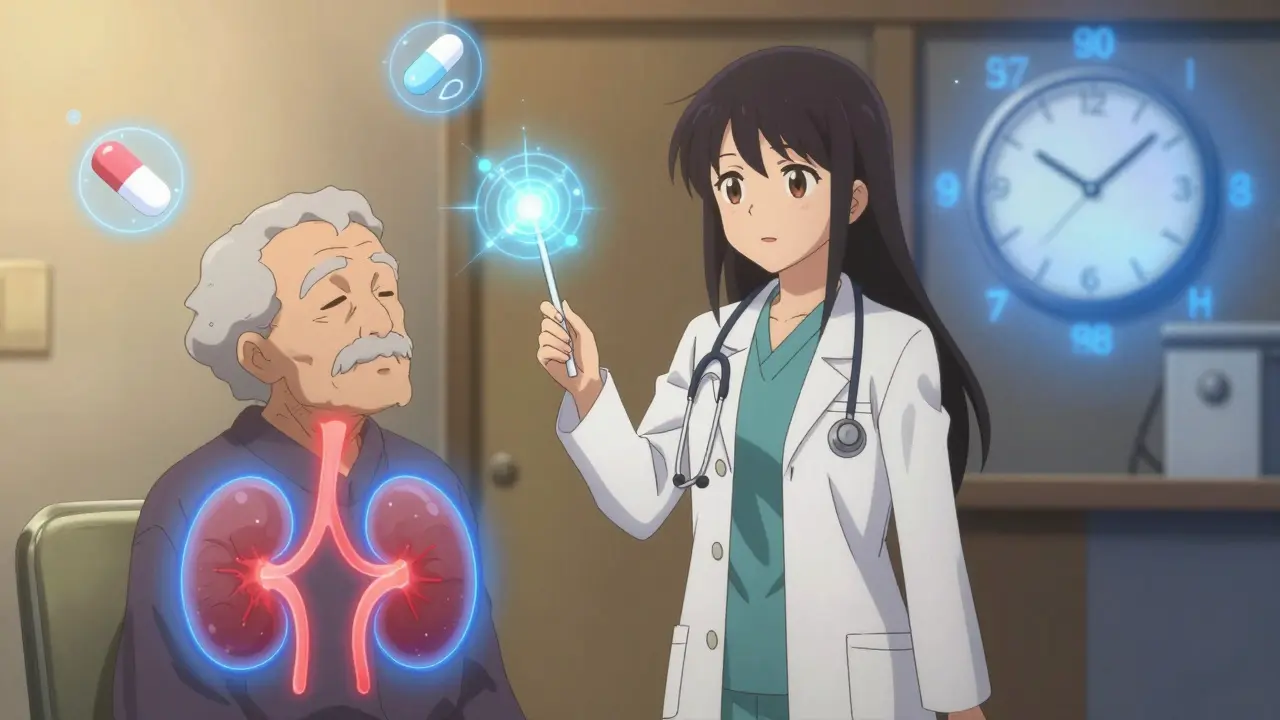
- Kidney problems: If your kidneys can’t clear the drug, it builds up. Renal insufficiency triples your bleeding risk.
- Previous bleeding: If you’ve had a GI bleed, nosebleed, or brain hemorrhage before, your chance of another is 4.2 times higher. History isn’t just a factor - it’s a red flag.
- Combining medications: Taking aspirin, ibuprofen, or clopidogrel with a DOAC doubles your bleeding risk. Many patients don’t realize their OTC painkiller is dangerous.
The strongest predictor? A past bleed. If you’ve been hospitalized for bleeding before, your next episode is more likely - and more dangerous.
The Most Dangerous Time: First 90 Days
You might think the risk goes down over time. It doesn’t. The first three months are the deadliest. The MAS study from April 2024 found that 60.8% of all bleeding events happen within 90 days of starting a new anticoagulant. Why?- Doctors often start with standard doses, even for elderly or frail patients.
- Patients don’t know what symptoms to watch for.
- Drug levels haven’t stabilized - especially with DOACs, which vary wildly between individuals.
One patient on Reddit described it perfectly: "I took apixaban for six months. Then I noticed black, tarry stools. I thought it was just my diet. By the time I went to the ER, I’d lost enough blood to need two transfusions. I had a bleeding ulcer. I almost didn’t make it."
That’s not rare. A 2023 Mayo Clinic survey found 28% of patients didn’t recognize early bleeding symptoms as serious. Another 37% waited over two hours before seeking help.
What Severe Bleeding Looks Like
You need to know the signs - and act fast. The American Heart Association lists 12 critical symptoms:- Nosebleeds lasting more than 10 minutes
- Red or brown urine
- Black, sticky, tar-like stools
- Unexplained bruising (especially large, spreading patches)
- Coughing or vomiting blood
- Severe, sudden headache (could mean brain bleed)
- Dizziness, fainting, or feeling like you’re going to pass out
- Weakness on one side of the body
- Blurry or double vision
- Unusually heavy menstrual bleeding
- Joint pain or swelling after minor injury
- A cut that won’t stop bleeding after 10 minutes of pressure
None of these are "normal." If you’re on a blood thinner and any of these happen - go to the ER. Don’t wait. Don’t call your doctor tomorrow. Don’t Google it. Go now.
Emergency Response: What Happens at the Hospital
When you arrive with suspected severe bleeding, the hospital moves fast. First, they check your vital signs - blood pressure, heart rate, oxygen. Then they run tests: hemoglobin level (to see how much blood you’ve lost), kidney function, and a clotting panel.If you’re on warfarin, they’ll give you vitamin K and possibly fresh frozen plasma. If you’re on dabigatran (Pradaxa), they’ll use idarucizumab (a reversal agent that binds to dabigatran and neutralizes it within minutes). For rivaroxaban or apixaban, they’ll use andexanet alfa (a protein that reverses factor Xa inhibitors like these DOACs). These drugs work fast - but they’re expensive. Idarucizumab costs about $3,500 per vial. Andexanet alfa runs over $12,500 per treatment.
For GI bleeds, they might do an endoscopy. For brain bleeds, a CT scan. In extreme cases, surgery. The average cost of a major bleeding episode in the U.S. is $18,500. A brain bleed? Over $52,000.

Why Some Patients Bleed Even on "Low Dose"
This is the biggest surprise in recent data. In 2024, the MAS study tracked 1,657 patients on DOACs. Half of all bleeding events happened in people taking low-dose regimens - not because their dose was too high, but because their body processed the drug too slowly. Some patients have naturally slow metabolism. Others have kidney changes that aren’t caught by standard tests. Their drug levels were in the top quartile - meaning they had more medication in their blood than intended.That’s why new guidelines now recommend checking DOAC levels 2-4 weeks after starting. The FDA approved the first point-of-care test for this in January 2024. Now, clinics can test blood levels in minutes - no lab needed. This is especially important for patients over 75, those with kidney disease, or anyone who’s had a prior bleed.
What You Can Do to Stay Safe
You can’t control everything - but you can control these five things:- Know your bleeding risk score. Ask your doctor for your HAS-BLED score. If it’s 3 or higher, you need a safety plan - not just a prescription.
- Get educated. A 2023 JAMA study showed that patients who spent 15-20 minutes with their doctor learning symptoms had 34% fewer emergency visits.
- Don’t take NSAIDs. No ibuprofen. No naproxen. Even aspirin. Talk to your doctor about safer pain relief.
- Check your kidney function. Get a creatinine clearance test at least once a year - more often if you’re over 70.
- Ask about level testing. If you’re on a DOAC and you’re elderly, have kidney issues, or have bled before - ask if you should have a drug level check.
The Future: Safer Blood Thinners
Scientists aren’t giving up. Two new drugs - milvexian and asundexian - are in late-stage trials. Both target clotting proteins differently, and early results show 20-25% fewer bleeding events than current DOACs. A universal reversal agent called ciraparantag is also in Phase III trials. If it works, it could reverse all types of anticoagulants with one injection.But for now, the best defense is awareness. Bleeding on blood thinners isn’t rare. It’s predictable. And it’s preventable - if you know the signs, know your risks, and act fast.
Can you die from bleeding caused by blood thinners?
Yes. Major bleeding events carry a 5-15% mortality rate, depending on where the bleeding occurs. Brain bleeds and internal GI bleeds are the most deadly. The NIH found that nearly one in seven people who suffer a major bleed from anticoagulants don’t survive. Many of these deaths happen because symptoms were ignored or misinterpreted.
Is it safe to stop taking blood thinners if you’re worried about bleeding?
Never stop without talking to your doctor. Stopping blood thinners suddenly can cause a stroke or heart attack - often more dangerous than the bleeding risk. If you’re concerned, ask about switching to a different medication, checking your drug levels, or adjusting your dose. Your risk of stroke is usually much higher than your risk of bleeding.
Which blood thinner has the lowest bleeding risk?
Apixaban (Eliquis) has the lowest major bleeding rate among DOACs. In the ARISTOTLE trial, it caused 2.13% major bleeding per year compared to 3.09% for warfarin. For patients with prior GI bleeding, apixaban carries a 31% lower risk of recurrence than rivaroxaban. But no blood thinner is risk-free - individual factors like kidney function and age matter more than the drug name.
How often should you get blood tests on warfarin?
For the first month, weekly INR tests are standard. After that, if your levels are stable, you can switch to every two weeks, then monthly. Some patients on stable doses can go every 6-8 weeks. But if you’re over 70, have kidney disease, or are taking other medications, you may need testing every 1-2 weeks. The goal is to keep your INR between 2.0 and 3.0.
Do all blood thinners require reversal agents?
No. Warfarin can be reversed with vitamin K and plasma. DOACs like apixaban and rivaroxaban need specific reversal drugs - andesexanet alfa. Dabigatran requires idarucizumab. These drugs are expensive and not always available in small hospitals. That’s why prevention and early detection are more important than waiting for a crisis.




Comments
Shivam Pawa
March 3, 2026 AT 13:15 PMBeen on apixaban for 3 years. No issues. But I do check my kidney numbers every 6 months. Doctor didn’t push it but I asked. Smart move. Low dose doesn’t mean low risk if your clearance is slow. Saw a guy in the clinic last month with a GI bleed. He was on rivaroxaban. Didn’t know NSAIDs were a no-go. Simple stuff. Missed.
Lebogang kekana
March 4, 2026 AT 22:19 PMTHIS IS LIFE OR DEATH PEOPLE. I lost my uncle to a brain bleed on warfarin. He thought the headache was stress. TWO DAYS LATER he was gone. Don’t wait. Don’t Google. Don’t hope it goes away. If you’re on these meds and something feels off - GO. NOW. I don’t care if it’s 2am. Call an ambulance. Your life is worth more than your pride.
Jessica Chaloux
March 6, 2026 AT 08:33 AMOMG I’m crying 😭 I had a nosebleed that wouldn’t stop and I thought I was just dehydrated… then I saw the bruise on my thigh the size of a dinner plate… I went to the ER and they said I was 0.5 away from a transfusion. I’m on apixaban. I didn’t know ANY of this. Thank you for posting this. I’m printing it out and taping it to my fridge. 💔🩹
Raman Kapri
March 6, 2026 AT 22:39 PMThe data presented here is statistically sound but lacks context. The 3.1% bleeding rate is misleading without stratification by comorbidities. Furthermore, the assertion that low-dose regimens are inherently dangerous is inaccurate - it’s pharmacokinetic variability, not dosing, that drives risk. The article conflates correlation with causation. A more rigorous approach would include CYP3A4/ABCB1 polymorphism analysis. This is popular science, not clinical guidance.
Tildi Fletes
March 8, 2026 AT 20:10 PMAs a clinical pharmacist, I can confirm the 90-day risk window is underrecognized. We now routinely schedule a follow-up at 30 days for all new DOAC patients - not just to check INR, but to review symptom recognition, medication reconciliation, and renal function. We also provide printed symptom checklists. Compliance improves by 40% when patients have tangible tools. This isn’t theoretical - it’s protocol. And yes, point-of-care DOAC testing is changing the game. Ask for it.
Siri Elena
March 10, 2026 AT 17:28 PMOh honey, you’re telling me that people on blood thinners don’t know they can’t take Advil? 🤦♀️ I mean, I get it - the internet is full of people thinking "natural pain relief" means ibuprofen. But really? You need a 2000-word essay to explain that NSAIDs + anticoagulants = bad news? Next you’ll tell us not to drink bleach. 🙄
Divya Mallick
March 12, 2026 AT 06:19 AMIndia has the lowest bleeding rates in the world because we don’t overmedicate. You Americans are obsessed with pills. We use turmeric. We use ginger. We use lifestyle. And guess what? Our elderly live longer. This whole article is a Big Pharma scam. Why do you think reversal agents cost $12,000? Because they want you dependent. Wake up. Stop trusting doctors who get paid per script. Go natural. Or at least go Indian.
Pankaj Gupta
March 13, 2026 AT 02:44 AMThere’s a critical omission here: the role of diet in DOAC metabolism. Vitamin K doesn’t just affect warfarin - it can influence the efficacy of certain DOACs indirectly through liver enzyme modulation. Additionally, protein intake impacts renal clearance. Patients on low-protein diets (common in elderly or vegan populations) may accumulate drug even on standard doses. This deserves mention alongside renal function. Precision isn’t just about genetics - it’s about nutrition too.
Alex Brad
March 13, 2026 AT 17:49 PMKnow your symptoms. Act fast. No exceptions. If in doubt, go to the ER. Period.
Renee Jackson
March 14, 2026 AT 03:20 AMThank you for this comprehensive and clinically grounded overview. The emphasis on early detection and patient education aligns with current best practices in anticoagulation management. I would add that structured patient education programs, delivered by certified anticoagulation nurses, reduce emergency department visits by up to 52% within one year. Empowerment through knowledge is not optional - it is foundational to safe, long-term anticoagulation therapy.
RacRac Rachel
March 15, 2026 AT 14:58 PMI’m so glad this got shared!! 🥹💖 I just turned 78 and started on apixaban last month. My doctor didn’t mention ANY of this - I learned it from my daughter who’s a nurse. I printed the symptom list and put it on my mirror. I even showed my grandson. He’s 10. He knows what black stools mean now. 💪✨ We’re all learning. And we’re gonna be okay.
Jane Ryan Ryder
March 16, 2026 AT 00:04 AMSo let me get this straight - we’re supposed to panic every time we get a nosebleed? What’s next? Calling 911 if you sneeze too hard? People die from strokes on these meds too. Maybe the real problem is that doctors don’t talk about risk - they just hand out prescriptions like candy. And now we’re supposed to be terrified of our own bodies?
Callum Duffy
March 16, 2026 AT 02:03 AMThank you for the nuanced and evidence-based discussion. I would like to respectfully offer a counterpoint: while the 90-day risk window is well-documented, the assumption that all patients require identical monitoring may be overly rigid. Individualized risk assessment - incorporating frailty indices, polypharmacy burden, and social support networks - may be more predictive than chronological age or renal function alone. The future lies not in one-size-fits-all protocols, but in truly personalized anticoagulation care.