
When we talk about drug interactions, most of us think about two pills clashing in our stomach. While that happens, there is a deeper layer called the drug-drug-gene interaction (DDGI). This is where your genes and your medications team up to change how a drug behaves. For some, this leads to a toxic buildup of medicine in the blood; for others, the drug is cleared out so fast it never has a chance to work. In the U.S. alone, adverse drug reactions cost the healthcare system roughly $30 billion annually, and a huge chunk of that is due to ignoring these genetic variations.
The Three Ways Your Genes and Drugs Interact
Not all interactions happen the same way. Depending on your genetic profile, a drug can change your internal chemistry in three distinct ways. Understanding these helps explain why some people are "hypersensitive" to certain meds while others are "resistant."
- Inhibitory Interactions: This happens when a "perpetrator" drug blocks an enzyme your body needs to break down a "victim" drug. If your genes already make you a slow metabolizer, this blockage can push drug levels into the danger zone, increasing the risk of toxicity.
- Induction Interactions: Here, a drug actually speeds up your enzymes. Your body becomes a super-efficient clearing house, flushing the medication out before it can do its job. You might feel like the medicine "isn't working," even though you're taking the correct dose.
- Phenoconversion: This is a fascinating glitch. It's when a drug temporarily changes your genetic "phenotype." For example, you might genetically be a fast metabolizer, but taking a specific inhibitor makes your body act like a poor metabolizer. Your DNA hasn't changed, but your functional chemistry has.
The Heavy Hitters: CYP Enzymes and Genetic Markers
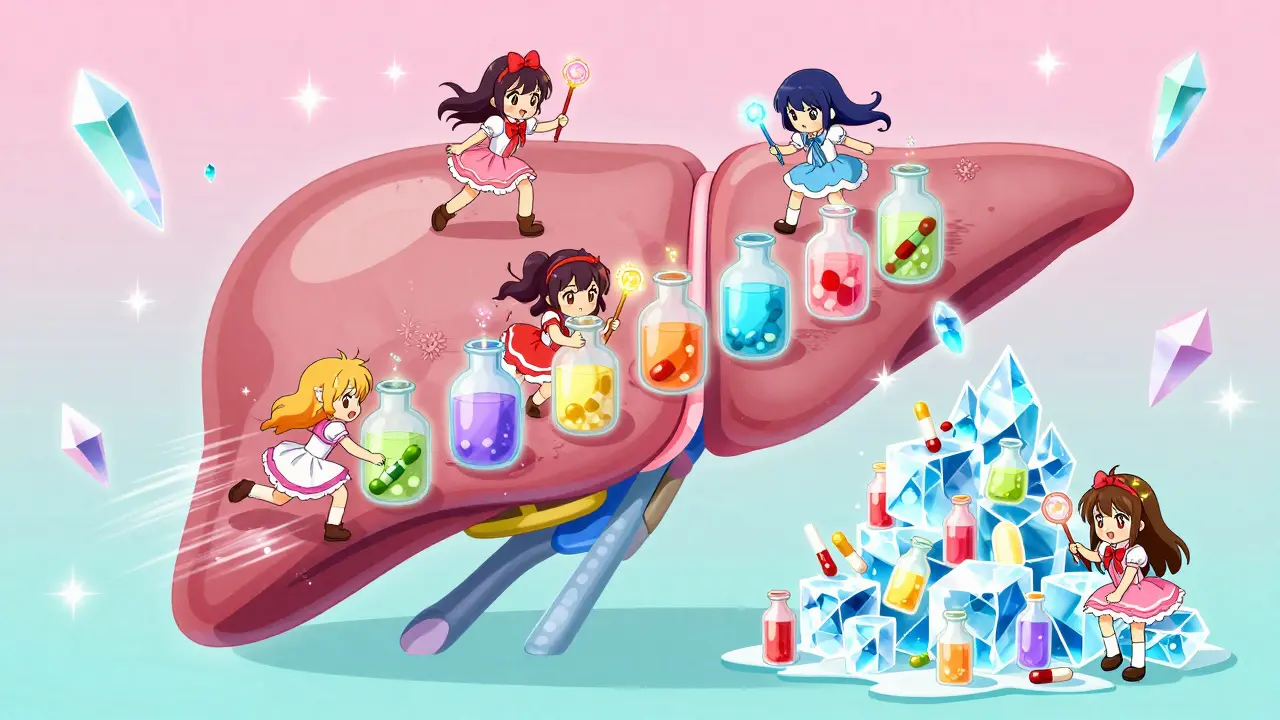
Most of the action happens in the liver, specifically with the Cytochrome P450 (CYP) enzyme family. These proteins are the primary tools your body uses to metabolize drugs. Two of the most important players are CYP2D6 and CYP2C19. These enzymes handle a huge variety of antidepressants, antipsychotics, and painkillers. If you have a genetic variant that makes these enzymes inactive, a standard dose of a drug could be effectively an overdose.
Beyond the liver, some interactions happen in the immune system. Take the HLA-B*15:02 allele. If a person carries this specific genetic marker and takes the seizure medication carbamazepine, they face a risk 50 to 100 times higher for developing Stevens-Johnson Syndrome, a severe and potentially fatal skin reaction. This isn't about how the drug is metabolized, but how the body's immune system reacts to it.
| Gene/Enzyme | Associated Medication | Genetic Variation | Potential Outcome |
|---|---|---|---|
| CYP2D6 | Codeine / Antidepressants | Poor Metabolizer | No pain relief or toxic buildup |
| TPMT | Azathioprine | Poor Metabolizer | Severe bone marrow suppression |
| VKORC1 / CYP2C9 | Warfarin | Variant alleles | Increased risk of major bleeding |
| HLA-B*15:02 | Carbamazepine | Positive marker | Severe skin reactions (SJS) |
Why Traditional Drug Checkers Often Miss the Mark
If you've ever used a pharmacy app to check for drug interactions, you've used a traditional DDI (drug-drug interaction) checker. These are great for flagging that "Drug A" might clash with "Drug B," but they have a massive blind spot: they assume every human is biologically identical. They ignore the person taking the pills.
Research has shown that when you add genetic data into the mix, the number of potentially major interaction impacts jumps significantly. In one study of community pharmacy patients, considering genetic polymorphisms increased the estimated probability of an interaction impact by over 90%. Traditional databases like Lexicomp are useful, but they can't tell you if your specific pharmacogenetic variant makes a "minor" interaction a "major" one for you personally.
Real-World Success: From the Lab to the Clinic
This isn't just theoretical. Places like the Mayo Clinic have been using preemptive PGx testing since 2011. They found that nearly 89% of their patients had at least one genetic variant that could affect how they respond to medication. By using clinical decision support alerts-basically "digital red flags"-they reduced inappropriate prescribing by 45%.
Consider the case of warfarin, a common blood thinner. It's notoriously hard to dose because the window between "not enough to stop a clot" and "too much and you start bleeding" is tiny. By looking at two different genes-CYP2C9 (which handles metabolism) and VKORC1 (which affects the drug's target)-doctors can reduce major bleeding events by 31% compared to just guessing and checking with blood tests.

The Roadblocks to Universal Adoption
If this is so effective, why isn't every doctor doing it? There are three big hurdles: money, education, and data. First, the cost. Implementing these systems can cost a healthcare network over a million dollars. While there are CPT codes for reimbursement, they don't always cover the full cost of the test and the expert time needed to interpret the results.
Second is the knowledge gap. A survey of 1,200 pharmacists revealed that only 28% felt comfortable interpreting PGx results. It's a steep learning curve; most clinicians need 15 to 20 hours of dedicated training just to get a handle on how to use these reports in a real patient encounter.
Finally, there's a diversity problem. Most of the research has been done on populations of European descent. Only about 2% of PGx research participants represent African ancestry. This means the guidelines might not be as accurate for everyone, which could accidentally widen health disparities if we rush to implement them without more diverse data.
What's Next for Personalized Medicine?
We are moving toward a world where your genetic profile is a permanent part of your electronic health record. The next big leap is Artificial Intelligence. Recent studies have shown that AI models incorporating PGx data can improve the accuracy of complex drug dosing by up to 37%. Instead of a doctor looking at a chart, an AI could analyze your genes, your current meds, and your kidney function in milliseconds to suggest the perfect dose.
The Clinical Pharmacogenetics Implementation Consortium (CPIC) continues to expand its guidelines, now covering over 100 drug-gene pairs. As these guidelines become the standard of care, the "trial and error" method of prescribing will slowly disappear, replaced by a system that knows exactly how you'll react before the pill even touches your tongue.
What is the difference between pharmacogenetics and pharmacogenomics?
While people use them interchangeably, pharmacogenetics usually looks at how a single gene affects a drug response. Pharmacogenomics is a broader term that looks at the entire genome-all your genes-to understand complex drug responses.
Do I need a PGx test before starting any new medication?
Not necessarily. The FDA doesn't require a test for every drug. However, for high-risk medications like certain blood thinners, chemotherapy agents, or antidepressants, a test can prevent severe adverse reactions and help you find the right dose faster.
Can my diet or lifestyle override my genetic drug response?
Yes, to an extent. This is related to "phenoconversion." For example, certain foods or other medications can inhibit or induce the same enzymes your genes control, effectively changing your biological response regardless of your DNA.
How accurate are these genetic tests for drug interactions?
They are very accurate at identifying your genotype, but the "clinical utility" varies. For some drugs, like TPMT and thiopurines, the link is incredibly strong. For others, genes are only one piece of the puzzle, and factors like age and kidney function also play a role.
Will my insurance cover pharmacogenomic testing?
Coverage varies wildly. Some insurance plans cover it if the doctor can prove it's medically necessary for a specific high-risk drug. Others don't cover it at all, leaving patients to pay between $250 and $400 out of pocket.


Comments
Nicole Antunes
April 24, 2026 AT 02:00 AMIt is truly heartening to see the medical community moving toward such a personalized approach. :)
Ajinkya Joshi
April 25, 2026 AT 08:10 AMOh wow, so we've finally figured out that humans aren't identical clones. Groundbreaking stuff. I'm sure the $30 billion waste is totally an accident and not just the result of a system that loves charging for a 'trial and error' phase. Absolute genius move to wait until now to prioritize the genetic side of things. Truly a marvel of modern efficiency.
Anastasios Kyriacou
April 26, 2026 AT 02:19 AMidk why ppl act like this is new... just more expcetions for insurance to deny
Saptatshi Biswas
April 27, 2026 AT 00:05 AMThe mention of the diversity problem is the only part of this text that carries any weight. It is an absolute disgrace that only 2% of research represents African ancestry, and frankly, it is a reflection of the systemic failures of Western medicine. We are essentially treating the rest of the global population as an afterthought while they collect data from Europeans. This is not just a 'roadblock,' it is a scientific crime that marginalizes billions of people in the name of progress!
Amy Fredericks
April 27, 2026 AT 22:22 PMI love how this empowers patients to have a real conversation with their doctors about why a medication might not be working. It's all about finding the right fit for each individual! 🌟
Mike Arrant
April 28, 2026 AT 19:17 PMYou're all missing the point. This is just a way for big pharma to sell you a $400 test before they sell you a $1000 drug. It's a racket. If you're actually paying for these tests out of pocket, you're just playing into their hands. Just listen to your body and stop trusting these corporate 'guidelines' blindly.
Dave Edwards
April 29, 2026 AT 01:21 AMTypical. Another 'breakthrough' that's actually just a way to gather more data on us for some AI master-brain. Who's to say these 'digital red flags' aren't just a way to keep certain people from getting specific meds for some hidden agenda? I'm not falling for the shiny future pitch. 🙄
Sarah Watters
April 29, 2026 AT 07:30 AMThe AI integration is where this gets really creepy. Once they have your genetic markers in a permanent record and feed it into an algorithm, they basically own your biological blueprint. It's not about dosing accuracy; it's about predictability and control. They want a database of who is 'resistant' to what so they can market the next hyper-expensive 'personalized' solution to the highest bidder. Just a convenient way to track our vulnerabilities under the guise of healthcare.
Emma Cozad
May 1, 2026 AT 02:24 AMTypical US healthcare, charging a million dollars for a system that shouldve been standard years ago. absolute joke. totaly useless if it only works for people from europe anyway lol
Mel Glick
May 1, 2026 AT 18:11 PMWe need to push for more diverse clinical trials immediately. It is unacceptable that we are basing these guidelines on a narrow demographic. If we want this to be actual progress, we need to integrate global genetic data now!
Sue Stoller
May 2, 2026 AT 02:37 AMKeep pushing for the change! It's so exciting to think that one day we can just skip the scary trial-and-error phase of antidepressants. Imagine the lives saved and the suffering reduced! ✨💖
vimal purwal
May 3, 2026 AT 07:33 AMI must express my sincere agreement with the necessity of increasing the training hours for pharmacists, as it is quite evident that the current knowledge gap is a significant barrier to patient safety. While the implementation costs are indeed substantial, the long-term reduction in adverse drug reactions-which cost billions-should justify the initial investment in a way that prioritizes the human element over short-term fiscal concerns. We must ensure that every clinician is not only comfortable but proficient in interpreting these complex reports to avoid the very toxicity the tests are meant to prevent.
Anantha Lakshmi
May 4, 2026 AT 11:08 AMThis is such a beautiful step toward a kinder, more precise world! 🌸 Let's hope the cost comes down so everyone can benefit regardless of where they live! 🌈✨