
Every year, over 90% of prescriptions in the U.S. are filled with generic drugs. They’re cheaper, just as effective for most people, and save the system billions. But sometimes, a doctor steps in and says: no generics. Not this time. This patient gets the brand-name drug - no exceptions. That’s called a prescriber override.
It’s not a loophole. It’s not abuse. It’s a legal tool built into pharmacy laws across all 50 states. But here’s the problem: most doctors don’t know how to use it right. And when they mess it up, patients pay the price - sometimes with hospital visits, unstable conditions, or bills that spike overnight.
Why Do Doctors Override Generic Substitution?
Generics aren’t magic. They’re copies. Same active ingredient. Same dose. Same way to take it. But they can have different fillers - dyes, binders, coatings. For most people, that doesn’t matter. But for some, it does.
Take levothyroxine, the drug for hypothyroidism. A patient has been stable on Synthroid for years. Then the pharmacy switches them to a generic. The body reacts. Heart races. Weight drops. Anxiety spikes. Why? Because even tiny differences in how the drug is absorbed can throw off thyroid levels in people who are super sensitive. The FDA says generics are bioequivalent. But for narrow therapeutic index drugs like this, the margin for error is razor-thin.
Same with warfarin. A blood thinner. A few milligrams off can mean a clot or a bleed. Phenytoin. An anti-seizure drug. A small change in absorption can trigger a seizure. These aren’t hypotheticals. The Institute for Safe Medication Practices tracked 27 serious adverse events between 2018 and 2022 linked to improper generic switches in these exact drugs.
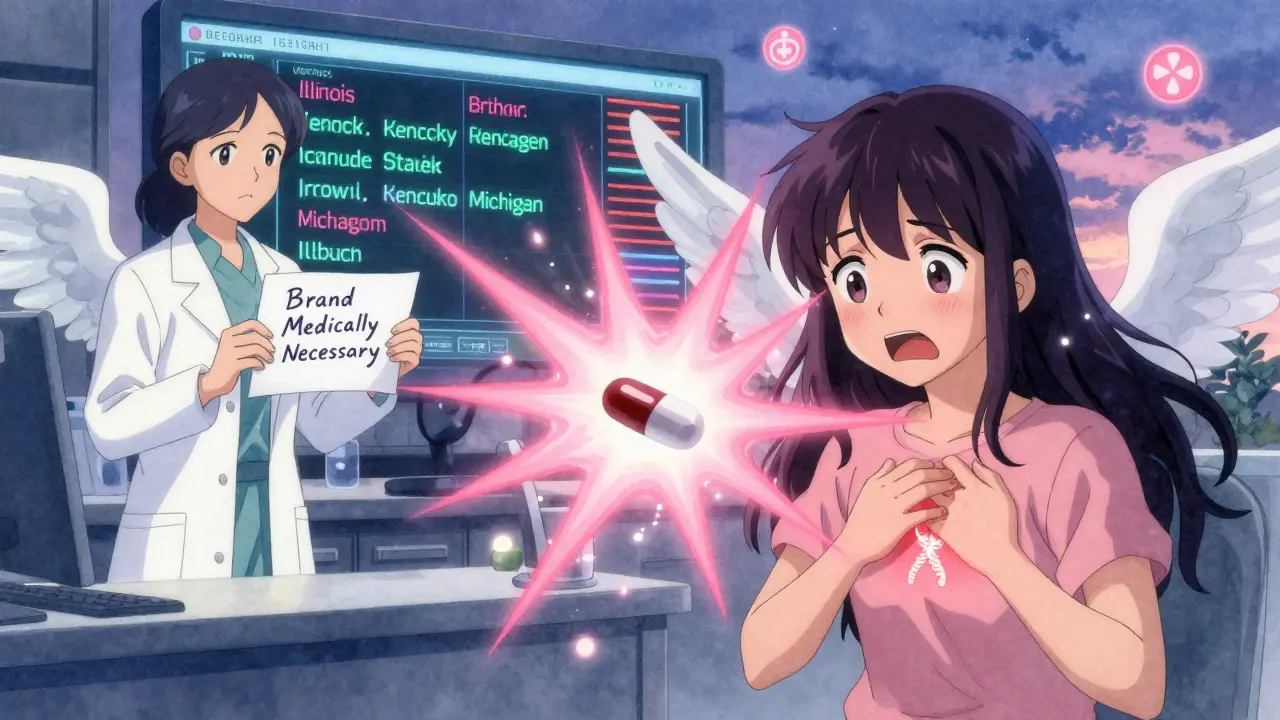
Some patients have allergies to dyes or fillers in generics. Others tried a generic and had a documented failure - their symptoms returned. That’s when a doctor writes: Dispense as Written. Or Brand Medically Necessary. Or DAW-1.
How the Override Actually Works
It’s not as simple as scribbling ‘no generics’ on the paper. There’s a system. The National Council for Prescription Drug Programs (NCPDP) created nine codes that tell pharmacies exactly what to do. The most important one? DAW-1. That’s the code that says: Substitution Not Allowed by Prescriber.
But here’s where things get messy. Every state has its own rules on how to write it.
- In Illinois, the prescriber must check a box labeled ‘May Not Substitute’ on the prescription form.
- In Kentucky, the doctor must handwrite ‘Brand Medically Necessary’ - and sign it.
- In Massachusetts, just writing ‘No Substitution’ works.
- In Michigan, you have to write ‘DAW’ or ‘Dispense as Written’ by hand.
- In Oregon, you can say it over the phone, type it in, or write it - but you can’t just pick a default option in your EHR.
If you don’t follow your state’s exact format, the pharmacy won’t honor it. And they’re not being difficult. They’re following state law. One doctor in Texas wrote ‘Do Not Substitute’ - and the pharmacy filled the generic anyway. The patient had a seizure. The doctor was sued.
Electronic prescriptions make this worse. Most EHR systems default to ‘Allow Substitution.’ If you don’t manually change it to DAW-1, the system sends a blank code - and the pharmacy assumes it’s okay to switch. A 2022 AMA survey found 52% of physicians said their EHR templates don’t match their state’s override rules.
Who Uses Overrides - And How Often?
Not everyone needs a brand. But some conditions absolutely do. Data from Avalere Health shows:
- Anticonvulsants: 14.8% of prescriptions have DAW-1
- Psychiatric meds: 12.3%
- Thyroid drugs: 10.1%
- Immunosuppressants: 9.7%
That’s not random. These are drugs where small changes in blood levels can cause big problems. The FDA’s Orange Book - the official list of approved drugs and their therapeutic equivalence ratings - helps pharmacists decide what’s substitutable. Only drugs with an ‘A’ rating are considered interchangeable. ‘B’ ratings mean they’re not. But even with that, doctors still override - because real patients don’t always behave like clinical trials.
Still, research shows many overrides are unnecessary. Dr. William Shrank from UnitedHealth Group found doctors often overestimate how different generics are from brands. A 2021 study in the Journal of Managed Care & Specialty Pharmacy found DAW-1 prescriptions cost 32.7% more on average. The American Pharmacists Association estimates $7.8 billion is spent every year on inappropriate overrides.
And it’s not just cost. It’s access. Medicare and private insurers treat DAW-1 as a red flag. They often require prior authorization. That means the doctor has to call, fax, or log into a portal - just to get a drug the patient already takes. It delays care. It frustrates patients. It burns out staff.
The Hidden Cost of Confusion
Doctors aren’t lazy. They’re overwhelmed. A 2022 survey on Sermo, a physician network, showed 63% of doctors struggled with state-specific override rules. Why? Because they change. Constantly.
One doctor practices in New York and sees patients in Connecticut. New York requires a handwritten note. Connecticut accepts electronic DAW-1. She doesn’t know which rule applies to which patient. So she writes it both ways. The pharmacy in Connecticut rejects it. The patient waits. The refill is late. The condition worsens.
Pharmacists aren’t blameless either. A report on AllNurses showed 68% of override-related claim rejections come from bad documentation - smudged handwriting, missing signatures, unclear codes. One Reddit user, ‘Dr_InternalMed,’ shared a story from June 2023: a patient on levothyroxine was switched to a generic despite a DAW-1. The pharmacy claimed the doctor’s note was ‘incomplete.’ The patient ended up in the ER with thyroid storm.
And here’s the kicker: only 58.3% of physicians in a national survey correctly understood their own state’s override requirements. That’s not incompetence. That’s a system designed without enough support.
How to Get It Right
If you’re a doctor and you need to override:
- Know your state’s exact rule. Check the National Association of Boards of Pharmacy’s interactive map - updated quarterly.
- Use your EHR’s override template - but verify it matches your state’s wording. Don’t assume.
- If you’re writing by hand, use the exact phrase your state requires. No shortcuts.
- For electronic prescriptions, manually select DAW-1. Don’t let defaults take over.
- Document the reason: ‘History of therapeutic failure with generic,’ ‘Allergy to dye in generic,’ or ‘Narrow therapeutic index.’
- When possible, use a standardized override form from your state pharmacy board. Clinics in Michigan that did this cut override errors by 42%.
And if you’re not sure? Ask your pharmacist. They know the rules. They see the rejections. They can tell you what works.

The Future: Standardization Is Coming
There’s movement to fix this mess. In 2023, Congress introduced the Standardized Prescriber Override Protocol Act. It would create one national format for DAW-1 requests. No more state-by-state confusion.
The NCPDP is also updating its e-prescribing standard (SCRIPT 201905) to build override rules directly into the system. By late 2024, EHRs should auto-populate the correct code based on the prescriber’s state - no manual guesswork.
The FDA is modernizing the Orange Book too. Version 4.0, released in January 2023, now includes biosimilars - meaning override rules will soon apply to expensive biologic drugs like Humira and Enbrel.
But until then? The system is broken. And patients are paying for it.
What You Need to Remember
Prescriber override isn’t about choosing brand over generic. It’s about choosing the right drug for the right patient. Sometimes, that’s the brand. Sometimes, it’s the generic. The system should make that call easy - not confusing.
Doctors: Know your state’s rule. Use the right code. Document the reason. Don’t let your EHR make the decision for you.
Pharmacists: Honor the override. If the note is unclear, call the prescriber. Don’t guess.
Patients: If you’re switched to a generic and you feel worse - speak up. Ask if your doctor intended to override. You have the right to know.
The goal isn’t to stop generics. It’s to make sure they’re used where they work - and not where they don’t.
Can a pharmacist refuse to fill a DAW-1 override?
No. If a prescriber properly documents DAW-1 according to state law, the pharmacist is legally required to dispense the brand-name drug. Refusing to do so is a violation of state pharmacy regulations. However, if the documentation is incomplete, unclear, or doesn’t follow state-specific format rules, the pharmacist may contact the prescriber for clarification - but cannot substitute without permission.
Do I need to override for every refill?
Yes. Each prescription is treated as a separate order. Even if you wrote DAW-1 on the last refill, the next one must be documented again. EHR systems don’t auto-apply overrides across refills. If you don’t re-enter the code, the pharmacy will default to substitution.
Can a patient request a brand-name drug even if the doctor didn’t override?
Yes. That’s DAW-2. If a patient wants the brand and the doctor didn’t specify otherwise, the patient can ask the pharmacist to dispense it. However, the patient will likely pay the full brand price unless their insurance covers it. Some insurers require prior authorization even for patient-requested brands.
Are there drugs that can’t be substituted at all?
Yes. The FDA’s Orange Book lists drugs with ‘B’ ratings - meaning they are not considered therapeutically equivalent. These include some extended-release formulations, complex generics, or drugs where bioequivalence data is insufficient. Pharmacists cannot substitute these, even if no override is written. But many prescribers still override them out of caution, even when not required.
Why do insurance companies deny DAW-1 claims?
Many insurers treat DAW-1 as a trigger for prior authorization, especially for high-cost drugs. Even if the override is valid, the payer may require documentation proving medical necessity - like lab results showing therapeutic failure. If the doctor doesn’t provide that, the claim gets denied. This isn’t about rejecting the override - it’s about controlling costs.
Can I override for a drug that’s not on the Orange Book?
Yes. The Orange Book only lists FDA-approved drugs with therapeutic equivalence ratings. If a drug is new, off-label, or not yet evaluated, there may be no rating. In those cases, the prescriber’s judgment is final. But you must still use the correct DAW code and document the reason clearly. Pharmacies may still contact you for confirmation.
What happens if I accidentally override when I shouldn’t have?
There’s no penalty for an honest mistake - but it increases costs and may trigger insurance audits. If you realize you overrode unnecessarily, you can call the pharmacy to cancel the next refill and update the prescription to allow substitution. Going forward, review your override patterns. Are you using DAW-1 for conditions where generics are proven safe? If so, adjust your practice.





Comments
Stacey Marsengill
January 19, 2026 AT 08:32 AMThis system is a nightmare. I had a patient go into thyroid storm because the pharmacy switched her levothyroxine and the doctor didn't know the state required a handwritten note. She ended up in the ER. Again. And now the insurance is denying her next refill because they think it's 'unnecessary.' We're not playing chess with people's lives here - we're trying to keep them alive.
Max Sinclair
January 19, 2026 AT 16:24 PMThis is one of those rare cases where the system actually makes sense - if everyone follows the rules. The problem isn’t generics. It’s inconsistent documentation. I’ve seen pharmacists reject perfectly valid DAW-1 requests because the EHR auto-filled ‘Allow Substitution’ and the doctor never noticed. It’s not malice - it’s a design flaw. Standardization is long overdue.
christian Espinola
January 20, 2026 AT 09:56 AMLet’s be real. This whole ‘prescriber override’ thing is just Big Pharma’s way of keeping the gravy train rolling. 90% of generics work fine. The rest? Patients are being manipulated into thinking they’re special. The FDA says they’re equivalent. The studies say they’re equivalent. But doctors, scared of lawsuits or lazy about learning the rules, keep hitting DAW-1 like it’s a magic button. $7.8 billion wasted. That’s not medicine - that’s greed dressed in white coats.
Wendy Claughton
January 21, 2026 AT 14:41 PMEvery time I see a patient panic because their generic was switched… I feel it in my bones. 🥺 I’ve had people cry because they lost weight, couldn’t sleep, felt like they were ‘dying inside’ - all because a pill looked different. It’s not ‘in their head.’ It’s biochemistry. And the system? It’s like a broken thermostat in a freezer. We keep adjusting the dial but never fix the wiring. We need national standards. Not next year. Now.
Selina Warren
January 22, 2026 AT 22:33 PMStop pretending this is about patient care. It’s about power. Doctors want control. Pharmacists want to avoid liability. Insurers want to save money. And patients? They’re the ones getting bounced between systems like a ping-pong ball. If you’re a doctor who doesn’t know your state’s override rules, you shouldn’t be prescribing. Period. No more excuses. This isn’t ‘confusion’ - it’s negligence dressed in jargon.
Robert Davis
January 23, 2026 AT 15:24 PMI read this whole thing. Twice. And I still don’t know if I’m supposed to write ‘DAW-1’ or ‘Dispense as Written’ or check a box or… what? I’m a busy internist. I don’t have time to memorize 50 different state laws. My EHR says ‘Allow Substitution’ by default. I click ‘Save.’ That’s it. Now I’m supposed to be a legal expert? Someone’s gonna get sued. And it won’t be the pharmacy.
Eric Gebeke
January 25, 2026 AT 02:24 AMThey say ‘patients pay the price.’ But who’s really paying? The ones who can’t afford the brand? Or the ones who can’t get their meds because the pharmacy won’t fill it? I’ve seen both. And guess what? The system doesn’t care. It’s not broken - it’s designed this way. The real question: who benefits from this chaos? Hint: it’s not the patient. It’s not the doctor. It’s not the pharmacist. It’s the middlemen. Always the middlemen.
Jake Moore
January 26, 2026 AT 15:52 PMHere’s a practical tip: if you’re a provider, bookmark the NABP’s interactive map. It’s updated quarterly and free. I made a cheat sheet for my clinic - one page, color-coded by state. We print it and tape it next to the EHR. Error rate dropped 60%. Also - always document the reason. ‘History of therapeutic failure’ is better than ‘patient prefers brand.’ It’s not about preference. It’s about safety. And if you’re unsure? Call the pharmacy. They’re usually happy to help. Seriously. They’ve seen it all.
Joni O
January 28, 2026 AT 15:30 PMi just had a patient switch to a generic and her anxiety went through the roof... she called me crying at 2am. i had to call the pharmacy and beg them to switch back. i forgot to write 'daw-1' on the script. my bad. but why is this so hard??