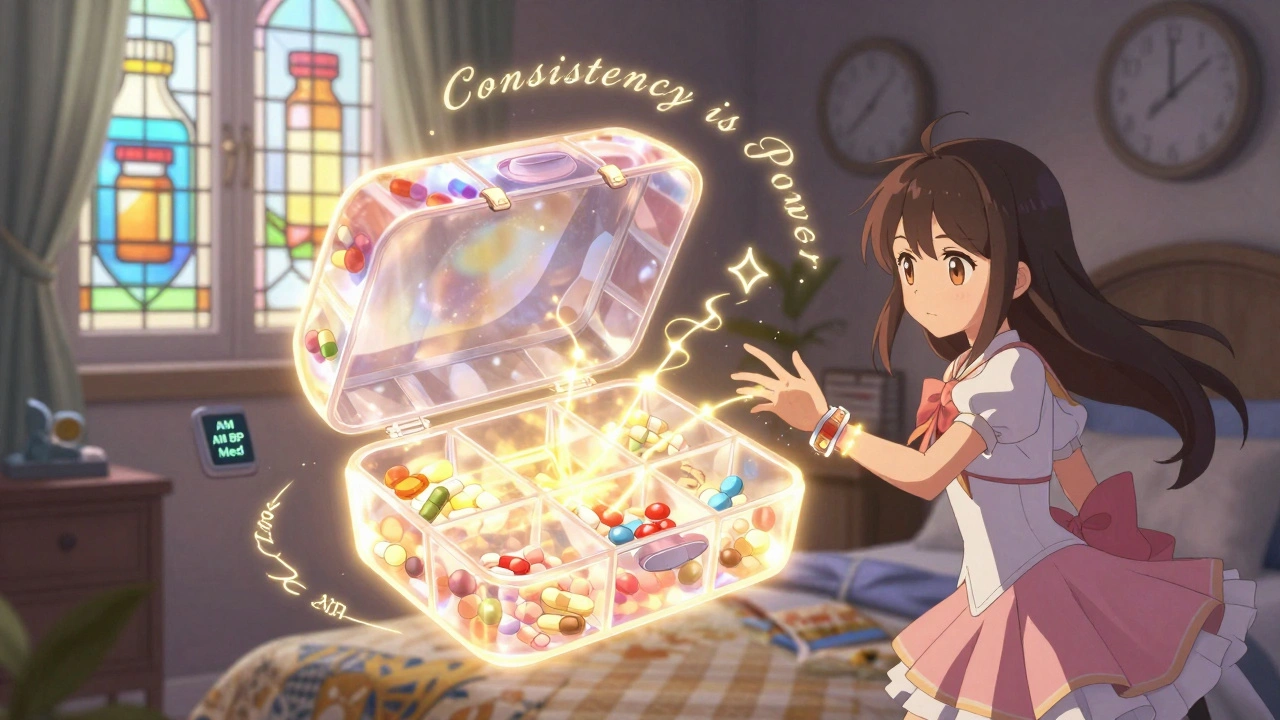
Skipping a pill because you’re running late, feeling fine, or just forgetting-it seems harmless. But for many prescription medications, missing even one dose can undo weeks of progress. It’s not about being perfect. It’s about keeping your body in the right chemical balance so your treatment actually works.
Why Timing Matters More Than You Think
Your body doesn’t work on a "when I feel like it" schedule. Medications are designed to stay at a steady level in your bloodstream. Too little, and the drug can’t do its job. Too much, and you risk side effects or toxicity. For some drugs, the window between effective and dangerous is razor-thin. Take antibiotics, for example. If you stop taking them after three days because your sore throat feels better, you’re not curing the infection-you’re training the bacteria to survive. The strongest bugs live, multiply, and come back stronger. That’s how antibiotic resistance starts. The CDC says you must finish the full course, even if you feel fine. Seven days? Ten days? Twenty? It’s not a suggestion. It’s science. The same goes for blood pressure meds. High blood pressure doesn’t give you warning signs. You won’t feel dizzy or have a headache when it’s high. But it’s silently damaging your heart, kidneys, and arteries every hour you skip a dose. Studies show that people who take their hypertension meds inconsistently are far more likely to have a stroke or heart attack. The American Heart Association says consistent dosing cuts that risk by half. Then there’s warfarin, a blood thinner. One day you take it at 8 a.m., the next at 10 p.m., and your INR levels swing wildly. Too high? You could bleed internally. Too low? You could get a clot. This isn’t guesswork. It’s precision medicine.What Happens When You Skip Doses
The consequences aren’t theoretical. They show up in hospital emergency rooms and in obituaries. - People with diabetes who skip insulin or metformin risk diabetic ketoacidosis-a life-threatening condition that can land them in intensive care. - Transplant patients who miss immunosuppressants can reject their new organ within days. - People with epilepsy who skip antiseizure meds can have a seizure while driving, bathing, or sleeping. - Those on antidepressants or antipsychotics often experience withdrawal symptoms or a sudden return of symptoms, sometimes worse than before. A study in the Annals of Internal Medicine found that for every extra pill you’re asked to take each day, your chance of forgetting increases by about 16%. So if you’re on five meds, taken three times a day, you’re doing 15 doses weekly. That’s a lot to remember. And here’s the truth: most people don’t mean to skip. They forget. They get confused. They’re scared of side effects. Or they think, "I feel fine now, so I don’t need it." That’s the trap. Many conditions-like high cholesterol, thyroid disease, or atrial fibrillation-don’t have obvious symptoms when they’re under control. The medicine is working because you can’t feel the problem.How to Actually Remember Your Doses
Forgetfulness isn’t a character flaw. It’s human. But you can outsmart it. Start with a pill organizer. Not the fancy ones with alarms. Just a simple seven-day box with morning, afternoon, evening, and night slots. Fill it once a week. If you see an empty compartment, you know you missed it. No guesswork. Pair your meds with habits you already do. Take your morning pill right after brushing your teeth. Take your evening one with your dinner. Linking it to something automatic makes it stick. Set alarms on your phone. Not one. Two. One at the exact time, one 15 minutes later. Label them: "AM BP Med," "Evening Insulin." Don’t just say "Medicine." Be specific. If you’re on five or more meds, ask your pharmacist for a medication review. They’ll check for timing conflicts, duplicate drugs, or unnecessary pills. Many pharmacies offer free medication therapy management-especially if you’re on Medicare Part D. They’ll even mail you a pillbox and refill reminders.
When You Don’t Understand the Instructions
One of the biggest reasons people skip doses? They don’t know what they’re supposed to do. "Take on an empty stomach" means no food for two hours before and after. That’s not the same as "take before breakfast." If you eat toast with your pill, the drug might not absorb. That’s not your fault-it’s unclear labeling. "Take with food" protects your stomach, but also helps your body absorb the medicine. Some antibiotics won’t work if taken on an empty stomach. Others cause nausea if taken after eating. Never assume. Always ask. When your doctor writes a script, say: "Can you explain how and when I take this?" Then, repeat it back to them. "So I take this at 7 a.m. with water, no food, and I don’t skip it even if I feel fine?" That’s called the teach-back method. It’s used in hospitals because it cuts errors by up to 40%.What to Do When You Miss a Dose
You missed it. Don’t panic. Don’t double up. Don’t wait until tomorrow. Check the label. Most meds have instructions: "If you miss a dose, take it as soon as you remember. If it’s almost time for the next dose, skip the missed one." But not all meds follow that rule. - For blood thinners like warfarin: Call your doctor. Don’t guess. - For insulin: Check your blood sugar. If it’s high, you may need a correction dose-but never just inject extra without guidance. - For birth control pills: The rules change depending on the type and when you missed it. Follow the package insert or call your clinic. - For antibiotics: If you miss one by less than four hours, take it. If it’s been longer, skip it. Resume your normal schedule. Never double up. When in doubt, call your pharmacist. They’re trained for this. They’ll tell you exactly what to do-no judgment, no rush.
It’s Not About Being Perfect. It’s About Being Consistent.
You don’t need to be flawless. You just need to be regular. One missed dose here and there doesn’t mean your treatment failed. But a pattern of skipping? That’s when things start to unravel. Think of it like charging a phone. If you plug it in for two hours, then leave it unplugged for 12, it won’t last. You need steady, predictable input. Your body works the same way. The goal isn’t to stress about every minute. It’s to build a system so your meds become part of your life-not something you fight against. Use your phone. Use your pillbox. Ask questions. Talk to your pharmacist. If you’re overwhelmed, tell your doctor. There are tools. There are programs. There are people who want to help you stay healthy. Your health isn’t something you manage on your own. It’s something you build-with every pill you take, on time, every time.What happens if I skip a dose of my blood pressure medication?
Skipping even one dose of your blood pressure medicine can cause your pressure to spike unpredictably. This increases your risk of stroke, heart attack, or kidney damage over time. High blood pressure often has no symptoms, so you won’t feel the danger. That’s why taking it daily-even when you feel fine-is critical.
Can I stop taking antibiotics once I feel better?
No. Stopping antibiotics early lets the strongest bacteria survive and multiply. This leads to antibiotic-resistant infections that are harder-and sometimes impossible-to treat. Always finish the full course, even if your symptoms disappear after a few days.
Why do some pills need to be taken with food and others on an empty stomach?
Food can change how your body absorbs medicine. Some drugs need an empty stomach to be absorbed properly-like certain antibiotics or thyroid meds. Others need food to reduce stomach upset or help absorption-like statins or some diabetes pills. Always follow the label instructions exactly.
How do I know if I’m taking my meds correctly?
Ask your pharmacist for a medication review. They’ll check your list for timing conflicts, duplicates, or unnecessary pills. You can also use the teach-back method: repeat your dosing schedule out loud to your doctor or pharmacist. If you can explain it clearly, you’re likely doing it right.
Are there tools to help me remember my doses?
Yes. Simple weekly pill organizers, phone alarms labeled with your med names, and medication reminder apps can help. Many pharmacies offer free pillboxes and refill reminders. Some smart pill bottles even send alerts to your phone or your caregiver if you miss a dose.
What if I can’t afford my medication?
Talk to your pharmacist or doctor. Many drug manufacturers offer patient assistance programs. Some pharmacies have discount cards or generic alternatives. Never skip doses because of cost-there are solutions. Skipping can lead to hospitalization, which costs far more.
Can I switch the time I take my meds?
For some meds, yes. For others, no. Blood pressure pills taken at night may work better for some people. Antibiotics often need to be spaced evenly. Never change timing without checking with your doctor or pharmacist. Even small shifts can affect how well the drug works.
How long does it take for medication timing to start working?
It varies. Blood pressure meds may take weeks to show full effect. Antibiotics start working in hours but need days to fully clear infection. Insulin works within minutes. The key is consistency-not speed. Taking your meds at the same time every day helps your body adapt and respond properly.




Comments
Genesis Rubi
December 2, 2025 AT 17:50 PMlol at people who think skipping a pill is 'harmless' 🤡 my grandma took her blood pressure meds like clockwork even when she was half-dead from cancer. you skip? you're not 'busy' you're just dumb. this isn't a suggestion it's your body not turning into a science experiment.
Doug Hawk
December 2, 2025 AT 23:22 PMthe pharmacokinetics here are spot on but i think the real issue is polypharmacy fatigue. when you're on 7 meds with 3 different dosing windows and 4 different food interactions, it's not forgetfulness-it's cognitive overload. the system is broken, not the patient. we need better interfaces, not guilt trips.
John Morrow
December 3, 2025 AT 22:55 PMthe notion that consistency equals efficacy is a reductive fallacy rooted in linear pharmacodynamics. biological systems are nonlinear, circadian, and hormetic. the idea that a 15-minute variance in warfarin dosing is catastrophic ignores interindividual variability in CYP2C9 metabolism, vitamin K intake, and gut microbiome modulation. you're not 'training bacteria'-you're applying a blunt instrument to a precision ecosystem. the CDC's one-size-fits-all guidelines are relics of 20th century medicine.
Kristen Yates
December 4, 2025 AT 18:31 PMi used to forget my thyroid meds every other day. then i started putting them next to my toothbrush. now i don’t even think about it. simple stuff works. no apps, no alarms, just habit stacking.
Saurabh Tiwari
December 5, 2025 AT 01:01 AMbro this is so true 🙏 i was skipping my bp meds in india because i thought i felt fine. then i had a dizzy spell at the bus stop. now i keep my pills in my chai cup. no more accidents. life is better when you don't fight your body 😌
Michael Campbell
December 5, 2025 AT 11:33 AMpharma wants you addicted to pills. they don't want you to heal. they want you to keep buying. they told you to finish antibiotics? that's how they make you resistant so they can sell you the next drug. wake up.
Victoria Graci
December 5, 2025 AT 13:41 PMmedication isn't just chemistry-it's ritual. it's the quiet act of choosing yourself every morning before the world wakes up. it's the invisible thread tying your future self to your present act. skipping a pill isn't laziness-it's a whisper of self-betrayal. and over time? whispers become screams. your body remembers every time you chose convenience over care. don't let your future self pay for today's forgetfulness.
Saravanan Sathyanandha
December 5, 2025 AT 19:50 PMin many cultures, including mine, medication adherence is deeply tied to familial duty and personal discipline. my father, a diabetic for 32 years, never missed a dose-not because he was afraid of complications, but because he believed his health was a gift he owed to his children. this isn't just medical advice-it's intergenerational responsibility. we must honor that.
alaa ismail
December 6, 2025 AT 22:14 PMmy cousin took her antidepressants wrong for 3 years and thought she was 'getting better.' turned out she was just in a fog. once she fixed the timing? she cried for no reason for a week. then she started laughing again. weird how the brain needs structure to feel free.
ruiqing Jane
December 7, 2025 AT 02:50 AMyou don't need to be perfect. you just need to be present. set two alarms. use the pillbox. ask your pharmacist. your life is worth the two minutes it takes to do it right. you're not failing-you're learning. and that's enough.