When you take a pill for high blood pressure, diabetes, or an infection, there’s a good chance the active ingredient inside came from a factory in China. Around 80% of the world’s active pharmaceutical ingredients (APIs) are made there. That’s not a small number-it’s the backbone of nearly every generic drug you’ve ever bought. But behind that scale lies a deep and growing concern: quality. For years, Chinese manufacturers have dominated global drug production by being cheap and fast. Now, the system is showing cracks. And the people who pay the price aren’t CEOs or regulators-they’re patients.
Why China Rules the API Market
China didn’t become the world’s API powerhouse by accident. After joining the WTO in 2001, the government poured billions into building chemical plants, training workers, and cutting red tape. By 2023, Chinese companies produced over 1.5 million metric tons of APIs annually. Some factories, like those run by Sinopharm or Shijiazhuang Pharma Group, churn out 500 to 2,000 tons of a single drug ingredient per year. That’s more than most Western facilities can make in a decade. The secret? Vertical integration. Chinese manufacturers control nearly 70% of the production chain-from raw chemicals to final API. They buy precursors cheaply, use outdated but cost-effective batch processing, and operate in regions with lax environmental rules. This lets them sell APIs for $50-$150 per kilogram, while Western equivalents cost $200-$400. For drug companies trying to keep prices low, it’s hard to say no. But here’s the catch: making cheap drugs doesn’t mean making safe ones.The Quality Gap That Won’t Go Away
The U.S. Food and Drug Administration (FDA) inspects over 2,000 foreign drug facilities each year. Nearly 30% of those are in China. And in 2022-2023, 78% of FDA warning letters to Chinese plants cited one thing: inadequate lab controls. That means testing equipment wasn’t calibrated, data was altered, or results were ignored. In one 2023 case, Huahai Pharmaceutical shipped metformin API with inconsistent potency. The result? A recall of 1.2 million blood pressure pills in the U.S. Another company, Zydus, had to scrap batches because API samples failed purity tests. According to FDA data, 12.7% of Chinese API samples failed quality checks-more than five times the failure rate of European APIs. It’s not just about purity. Data integrity is a massive issue. In 52% of inspections, FDA inspectors found falsified records-logs altered after the fact, test results deleted, or batches approved without proper validation. One U.S. quality assurance specialist on Reddit reported having to retest 37% of Chinese-sourced metformin batches, compared to just 8% from Indian suppliers. That’s not a glitch. It’s a pattern.Why the System Keeps Failing
China’s pharmaceutical industry is caught between two worlds. On one side, it’s a global supplier with massive scale. On the other, it’s still run by many small, underfunded factories that treat compliance as an afterthought. The 2016 Generic Consistency Evaluation (GCE) program was supposed to fix this. It required Chinese generics to prove they worked the same as brand-name drugs. But as of 2024, only 35% of approved generics had completed the process. The rest? Still on the market, with no real proof they’re equivalent. Even worse, China’s regulatory agency, the NMPA, still doesn’t have the resources to match the FDA’s scrutiny. Former FDA Commissioner Dr. Margaret Hamburg told Congress in 2024 that inspections in China happen at “one-tenth the rate” of U.S. facilities. That’s not oversight-it’s a blind spot. And then there’s the technology gap. While U.S. and European plants are shifting to continuous manufacturing-where drugs are made in a steady, controlled flow-65% of Chinese API production still uses old-school batch methods. That means more variability, more contamination risk, and more human error.
Who’s Really in Control?
Here’s something most people don’t realize: China doesn’t make most finished pills. It makes the raw ingredients. India buys 65% of its APIs from China, then turns them into tablets and capsules. So when you buy a generic drug from India, it’s likely Chinese-made inside. That creates a dangerous chain. If one Chinese factory has a quality failure, it can ripple across dozens of countries. The Atlantic Council calls it a “single point of failure” for 90% of essential medicines. A trade dispute, a factory shutdown, or even a natural disaster in China could leave hospitals without critical drugs. The U.S. and EU are trying to fix this. The CHIPS and Science Act in the U.S. allocated $500 million to rebuild domestic API production. The EU’s 2024 Pharmaceutical Strategy aims to cut reliance on China from 80% to 40% by 2030. But rebuilding a supply chain takes years. And right now, there’s no cheap alternative.Cost vs. Risk: The Hard Choice for Buyers
For pharmaceutical companies, the choice is brutal. Pay more for Indian or European APIs? That means higher drug prices-and pushback from insurers and governments. Stick with China? Risk recalls, lawsuits, and patient harm. A 2023 survey by PhRMA found 68% of U.S. generic manufacturers had experienced quality issues with Chinese suppliers. Forty-two percent reported inconsistent purity. Thirty-seven percent said documentation was falsified. Yet, 42% still kept buying because the savings were too big. One procurement manager told a Gartner survey team: “Switching to Chinese API for amoxicillin saved us $4.2 million a year-even with a 15% rejection rate.” That’s a business decision. But when those rejected batches make it to patients, it’s no longer just a cost problem. It’s a health crisis.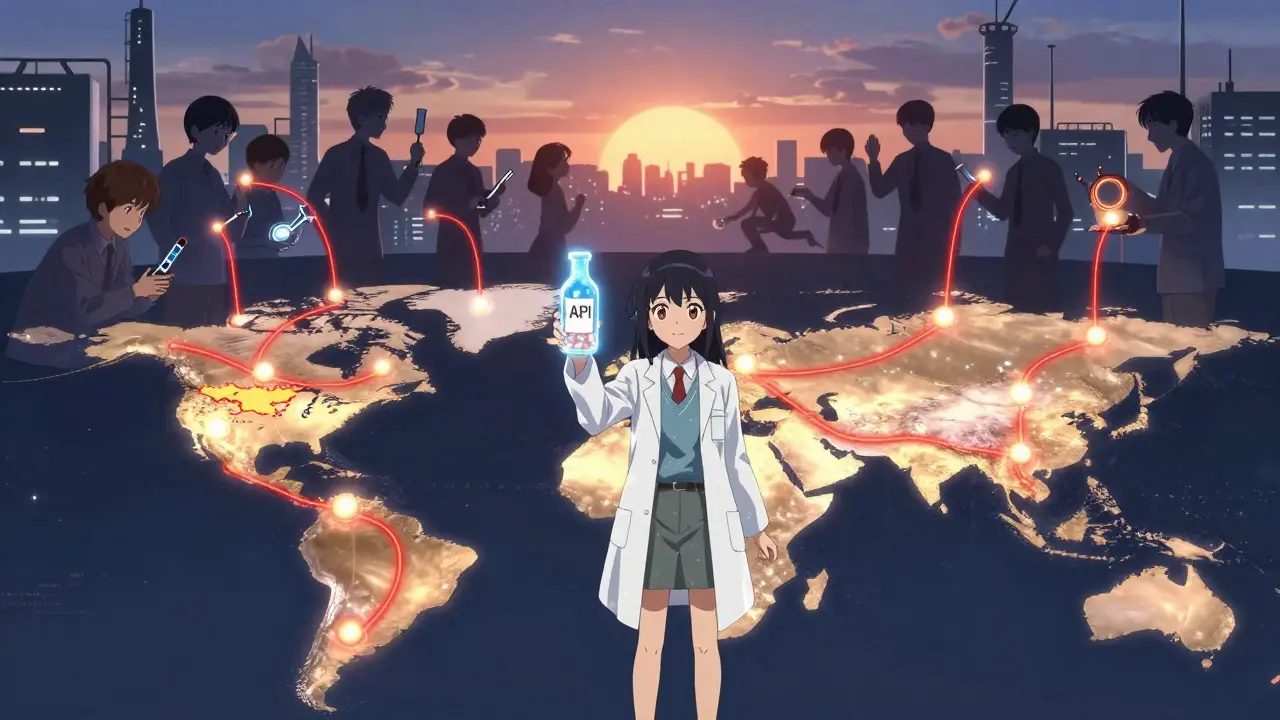




Comments
John Tran
January 14, 2026 AT 20:11 PMso like... we're all just sitting here swallowing tiny chemical ghosts from a country that doesn't even have real FDA oversight, and we call this progress? i mean, think about it-your blood pressure med might be 80% active ingredient and 20% wishful thinking. the whole system's built on trust, and trust is just a word people use when they're too scared to check the receipts. we're outsourcing our health to a factory floor where the quality control guy is probably napping under a fan while his kid draws stick figures on the lab reports. it's not capitalism-it's a horror movie where the monster is a spreadsheet.
mike swinchoski
January 15, 2026 AT 20:06 PMyou people are insane. if you don't like chinese drugs, don't take them. stop crying. people in india and africa take these pills and live. you want expensive american drugs? go live in a mansion and pay $500 for a pill that does the same thing. this is just rich people panic.
Trevor Whipple
January 16, 2026 AT 19:29 PMlol okay so the FDA finds falsified data in 52% of inspections but we're still buying? that's like hiring a guy to fix your car who's been caught lying about the oil change 37 times and saying 'eh, he's cheap'. also, did you know that the chinese govt shut down 8,000 bad factories? that sounds like a lot until you realize they had 7,000 to begin with. so now there's 2,500 left-still more than enough to poison half the planet. and don't get me started on how india's just a middleman. your 'made in india' pill? it's a chinese ghost in an indian costume. the real scandal? no one's问责 anyone. just more 'we're working on it' while your grandma's metformin turns into sugar water.
Lance Nickie
January 16, 2026 AT 19:35 PMwe've been buying chinese meds for 20 years and no one's died. chill.
Damario Brown
January 17, 2026 AT 18:13 PMthe data is clear: 12.7% failure rate on chinese apis vs 2.4% in eu. that's not a risk-it's a statistical inevitability of systemic corruption. add in the 37% retest rate for metformin and the fact that 42% of u.s. manufacturers still buy it because it saves $4.2m/year? this isn't supply chain-it's a Ponzi scheme where the payout is your liver. and the auditors? they're paid by the same companies they inspect. that's like letting the fox audit the henhouse while holding a bribe envelope. we're not just outsourcing manufacturing-we're outsourcing morality.
John Pope
January 18, 2026 AT 07:08 AMyou know what’s wild? we treat pharmaceuticals like they’re magic beans from the sky, but we don’t treat them like the life-or-death chemistry they are. we want the pill to work, sure-but we also want it to be cheap, fast, and guilt-free. we’ve created a market where profit is the only god, and the altar is built on lab notebooks that got ‘accidentally’ erased. and now we’re shocked when the gods get angry? please. the real tragedy isn’t the falsified data-it’s that we’ve normalized it. we don’t scream when the insulin batch is 12% off. we just say ‘oh well, maybe it’s just me’. that’s not ignorance. that’s collective surrender.
Clay .Haeber
January 19, 2026 AT 21:09 PMoh wow, so china makes the stuff, india makes the pills, and america makes the outrage? brilliant. we built an empire on outsourcing and now we’re surprised the outsourced stuff isn’t perfect? i mean, if you want a drug that’s 100% pure, 100% traceable, and 100% expensive, go buy a branded pill from a pharma exec’s yacht. otherwise, stop pretending you’re a patient-you’re a consumer who wanted a bargain and now you’re mad the bargain came with side effects. also, ‘pharma 2035’? cute. they’re still using 1980s tech and calling it innovation. the future is here-it’s just badly documented.
Priyanka Kumari
January 21, 2026 AT 20:08 PMas someone from india who works in pharma, i see this every day. yes, most of our apis come from china-and yes, some batches are bad. but we’ve also seen huge improvements in the last 5 years. we test everything, we reject more than we used to, and we’re training more quality staff. it’s not perfect, but it’s getting better. instead of blaming china, let’s support global standards, fund better inspections, and help factories upgrade. we’re all in this together-patients, manufacturers, regulators. blame doesn’t heal. collaboration does.
Robin Williams
January 22, 2026 AT 23:27 PMit’s funny how we treat medicine like it’s just another product. but it’s not. it’s the difference between life and death. we’ve turned healthcare into a spreadsheet, and now we’re surprised when the numbers don’t add up. maybe the real problem isn’t china-it’s us. we built a system that rewards speed over safety, profit over people. and now we’re all just waiting for the next recall to hit our name. maybe it’s time to stop asking where the pill came from… and start asking who we’ve become to let this happen.