
The skin around your eyes is the thinnest on your entire body-just 0.55 millimeters thick. That’s why even the mildest product can trigger a reaction. If you’ve been dealing with red, itchy, swollen eyelids that won’t go away, you’re not alone. About 74% of eyelid dermatitis cases are caused by allergic contact dermatitis (ACD), not just dryness or tired eyes. And the culprit? It’s often something you apply daily-makeup, shampoo, nail polish, or even hand cream.
Why Your Eyelids Are So Sensitive
Your eyelids don’t have the same protective barrier as the rest of your skin. They’re exposed to more products, more friction, and more environmental triggers. Every time you touch your face, you transfer chemicals from your hands. If you just got a manicure, applied mascara, or washed your hair with a new shampoo, those substances can drift onto your eyelids. Even airborne particles from hair dye or nail salon fumes can settle there. The reaction doesn’t happen right away. Symptoms like redness, swelling, flaking, or tiny blisters usually show up 24 to 48 hours after contact. That’s why most people blame their latest makeup or lack of sleep-not the real trigger. By the time the rash appears, they’ve already reapplied the product three times.The Top 7 Allergens Behind Eyelid Dermatitis
Not all allergens are obvious. Here are the most common ones, based on a 2021 NIH study of 215 patients:- Nickel (28.7%) - Found in cheap eyeglass frames, eyelash curlers, and even magnetic eyelash systems
- Shellac (21.4%) - The UV-cured gel polish used in nail salons; it can transfer from fingers to eyelids
- Preservatives (18.9%) - Especially methylisothiazolinone, parabens, and formaldehyde releasers in creams and serums
- Topical antibiotics (15.3%) - Neomycin and bacitracin in eye drops or ointments
- Fragrances (14.6%) - Even ‘natural’ or ‘unscented’ products can contain hidden fragrance compounds
- Acrylates (12.1%) - Used in long-wear mascaras, waterproof liners, and lash glues
- Surfactants (9.8%) - Sodium lauryl sulfate and similar detergents in cleansers and makeup removers
What’s surprising? Fragrances and preservatives rank lower on eyelids than on other body parts. Nickel and shellac dominate here because they’re directly transferred from hands or tools. And here’s the kicker: 42% of patients didn’t realize their nail polish was the cause. They thought they were only using eye products.
Why Patch Testing Is Non-Negotiable
Doctors who aren’t dermatologists often mistake eyelid dermatitis for blepharitis, eczema, or even an infection. But clinical history alone only identifies the trigger in 37% of cases. That’s why patch testing is the gold standard. Patch testing involves placing tiny amounts of 60-100 common allergens on your back or upper arm. The patches stay on for 48 hours. Then, a dermatologist checks for reactions at 72 and 96 hours. This catches delayed reactions that creams or eye drops won’t reveal. The American Academy of Dermatology recommends using the TRUE Test plus extra panels for eye-specific allergens. Studies show this approach has 89% accuracy. Without it, you’re guessing. And guessing means the rash keeps coming back.What Not to Do: The Steroid Trap
It’s tempting to grab a hydrocortisone cream from the medicine cabinet. But applying regular steroid ointments to your eyelids is dangerous. High-potency steroids can cause irreversible skin thinning in as few as 7-10 uses. Worse, they can seep into your eye and raise eye pressure, leading to glaucoma or cataracts. The FDA approved Eysuvis 0.25% in December 2022-the first steroid ointment specifically designed for eyelid use. It’s formulated to minimize absorption into the eye and has shown 89% symptom relief in 14 days. But even this should only be used under supervision. If your dermatologist prescribes a steroid, make sure it’s low-potency (like hydrocortisone 1%) and only for short-term use. Never use over-the-counter steroid creams without checking the label for eye safety.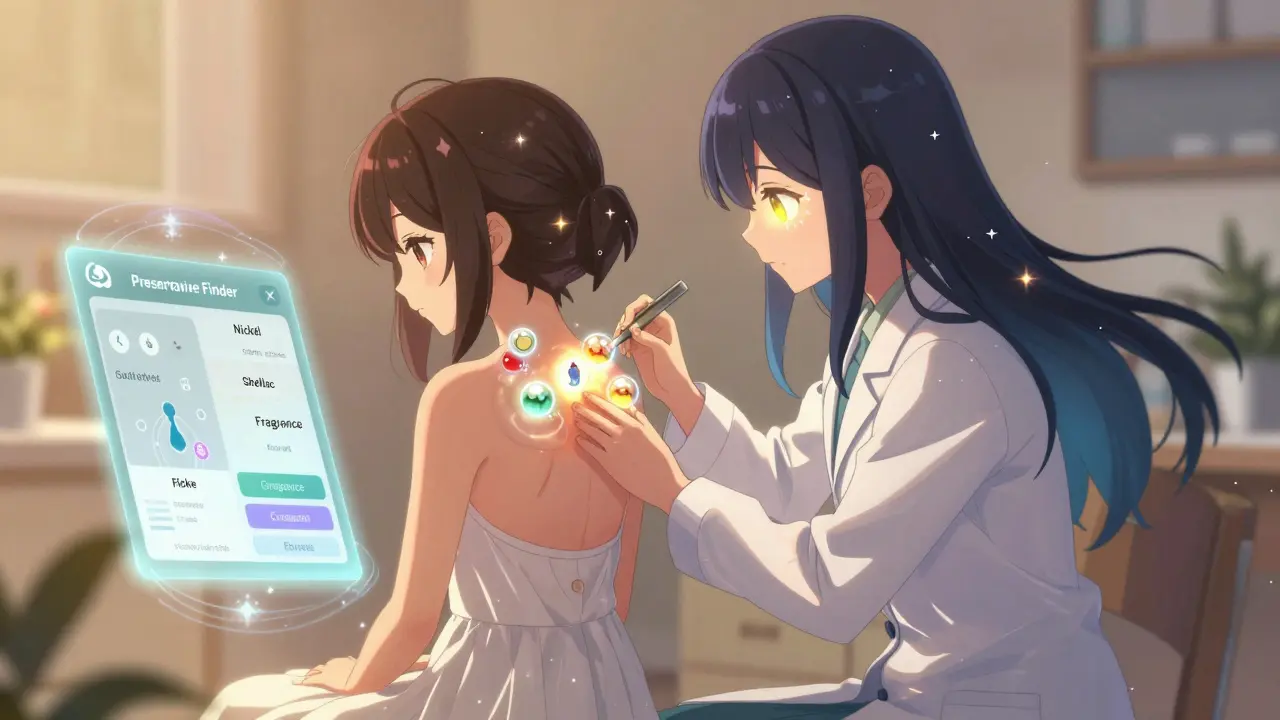
How to Break the Cycle: A 3-Phase Recovery Plan
Successful recovery isn’t about avoiding ‘cosmetics.’ It’s about avoiding specific chemicals. Here’s what works:- Phase 1: Stop Everything (Days 1-3) - Remove all eye makeup, face creams, and hair products. Wash your face with plain water. Use cool compresses to soothe swelling. Don’t touch your eyes unless your hands are clean.
- Phase 2: Protect and Wait (Days 4-14) - Apply pure petroleum jelly (like Vaseline) to keep the skin moist. Avoid anything with water, fragrance, or preservatives. This is when you schedule your patch test.
- Phase 3: Targeted Avoidance (Day 15+) - Once your patch test results come back, you’ll know exactly what to avoid. Use the Contact Allergen Replacement Database (CARD) to find safe alternatives. It lists over 12,800 verified products, updated monthly.
Patients who follow this full protocol have a 68% success rate. Those who just try to ‘use less makeup’? Only 32% get relief.
Hidden Sources You’re Probably Missing
Most people think they’re only exposed through eye products. But here’s what’s really happening:- You wash your hair with shampoo containing fragrance, then rub your eyes.
- You apply nail polish, touch your phone, then rest your hand on your cheek.
- You use a ‘clean’ face wash with chamomile or calendula-both from the Compositae family, which triggers reactions in 33% of ‘natural’ product users.
- You wear eyelash extensions glued with acrylate-based adhesives.
71% of nail-related cases involve women who started wearing gel polish regularly. Their eyelids reacted, but they didn’t connect the dots. Use the ‘Preservative Finder’ app (downloaded over 147,000 times) to scan product labels. It flags 37 common irritants in seconds.
What’s Changing in the Cosmetic Industry
The EU now requires clearer labeling of fragrance allergens on cosmetic products. The American Academy of Dermatology expects this to cut misdiagnosis rates by 15-20% in the next three years. But new problems are emerging. ‘Clean beauty’ brands often use plant extracts like tea tree oil, lavender, or chamomile. These are natural-but they’re also common allergens. A 2023 JAMA Dermatology study found that one-third of ‘natural’ eye products contained unlisted botanicals that triggered reactions. And then there’s magnetic eyelashes. They contain nickel alloys. Nickel is the #1 allergen for eyelid dermatitis. These trendy lashes aren’t just risky-they’re a direct trigger.
Real Stories: How People Finally Found Relief
On Reddit, user ‘MakeupLover87’ spent three years trying every eye cream, steroid, and ‘gentle’ brand. Nothing worked. Then she got patch tested. Turns out, she was allergic to toluene sulfonamide formaldehyde resin-a preservative in her nail polish. Once she stopped wearing gel nails, her eyelids cleared in 48 hours. Another patient, a 36-year-old teacher, thought her itchy lids were from stress. Her dermatologist found she was reacting to methylisothiazolinone in her ‘hypoallergenic’ cleanser. She switched to a simple oil-based cleanser and used only petroleum jelly for two weeks. The rash vanished. The pattern is always the same: years of frustration, then one test, one change, and relief.When to See a Dermatologist
If your eyelid rash lasts more than two weeks, keeps coming back, or spreads to your cheeks or neck, see a board-certified dermatologist. Don’t wait. The longer you’re exposed to the allergen, the more your skin sensitizes-and the harder it becomes to treat. Also, if you’ve had reactions to more than one product, or if you have eczema elsewhere on your body, you’re at higher risk. Studies show 63% of eyelid dermatitis patients have sensitivities in other areas. Your eyelids might be the first warning sign.Final Advice: Less Is More
Your eyelids don’t need serums, primers, or ‘anti-aging’ creams. They need protection from unnecessary chemicals. Stick to:- Pure petroleum jelly for moisture
- Mineral-based, fragrance-free makeup (if you must wear it)
- Soap-free, preservative-free cleansers
- Washing your hands before touching your face
- Removing nail polish if you have recurring flare-ups
And if you’re unsure? Get tested. Eyelid dermatitis isn’t something you live with. It’s something you can fix-with the right information.
Can eyelid dermatitis be caused by makeup?
Yes, makeup is one of the most common causes. Ingredients like nickel (in eyelash curlers), shellac (in gel polish), acrylates (in waterproof mascara), and preservatives (in creams) can trigger allergic reactions. Even ‘hypoallergenic’ or ‘natural’ makeup can contain hidden allergens.
Is eyelid dermatitis the same as eczema?
Not always. Atopic dermatitis (eczema) is genetic and often affects multiple body areas like the arms and knees. Eyelid dermatitis is usually allergic contact dermatitis, triggered by external chemicals. You can have both, but they require different treatments.
Can I use hydrocortisone cream on my eyelids?
Only low-potency hydrocortisone 1% for a few days, and only if approved by a dermatologist. Regular steroid creams can cause skin thinning or eye damage. Never use over-the-counter steroids on your eyelids without professional advice.
How long does eyelid dermatitis last?
With strict allergen avoidance, most people see improvement in 1-2 weeks. But if you keep using the trigger, it can last months or become chronic. Patch testing and precise avoidance are key to long-term relief.
Can nail polish cause eyelid dermatitis?
Yes. Nail polish, especially gel polish containing shellac or acrylates, is a major cause. Allergens transfer from fingers to eyelids when you touch your face. In 71% of nail-related cases, patients didn’t realize their nails were the source.
What’s the best way to find out what’s causing my eyelid rash?
Patch testing by a board-certified dermatologist is the only reliable method. Clinical history alone misses the trigger in 63% of cases. Testing identifies specific allergens with 95% accuracy, so you know exactly what to avoid.
Are ‘clean beauty’ products safer for sensitive eyelids?
Not necessarily. A 2023 study found 33% of ‘natural’ eye products contain unlisted botanical allergens like chamomile or tea tree oil, which can trigger reactions. ‘Clean’ doesn’t mean ‘allergen-free.’ Always check ingredients and consider patch testing.
Can eyelid dermatitis lead to eye damage?
The dermatitis itself doesn’t damage the eye. But improper use of steroid creams can raise eye pressure, leading to glaucoma or cataracts. Always use eye-safe products and follow dermatologist guidance.
If you’ve been struggling with eyelid irritation, remember: this isn’t normal. It’s not just dry skin. It’s an allergic reaction-and it can be solved. Start by stopping everything, then get tested. Your eyelids will thank you.





Comments
Gary Hartung
December 26, 2025 AT 01:54 AMLet me just say-this is the most comprehensive, meticulously researched, and frankly, *necessary* piece of dermatological journalism I’ve read since the Great Retinoid Rebellion of 2019. The way you broke down shellac transfer from nails to eyelids? Genius. I’ve spent three years in dermatological purgatory because I thought ‘hypoallergenic’ meant ‘safe.’ Spoiler: it doesn’t. And the fact that 42% of patients didn’t connect their gel manicures to their eyelids? That’s not ignorance-it’s systemic deception by the beauty industry. I’m sending this to my esthetician. She’s going to cry.
Ben Harris
December 27, 2025 AT 11:34 AMI dont care what the study says i used neomycin for 12 years and never had a problem so your science is fake and your fearmongering is weak
Zabihullah Saleh
December 28, 2025 AT 15:11 PMYou know, this reminds me of the Japanese concept of 'wabi-sabi'-finding beauty in imperfection, in the transient, in the quietly broken. Our eyelids, so delicate, so exposed-they’re not failing us. They’re screaming. In a world that tells us to layer, to cover, to enhance, the skin around our eyes is the one part that still remembers how to say no. It doesn’t want serums. It doesn’t want glitter. It just wants to breathe. Maybe the real cure isn’t in patch tests or databases… but in learning to stop touching our faces like they’re canvases. We’ve forgotten how to be gentle.
Lindsay Hensel
December 29, 2025 AT 05:52 AMThank you for this exceptionally well-structured and evidence-based exposition. The distinction between allergic contact dermatitis and atopic eczema is critically undercommunicated in public health discourse. I will be sharing this with my entire skincare advisory board. The recommendation to use petroleum jelly as a protective barrier, paired with the CARD database, represents a paradigm shift in patient-centered care. I am deeply appreciative of the clarity and rigor demonstrated here.
Sophie Stallkind
December 29, 2025 AT 07:58 AMThis is an outstanding clinical summary. The inclusion of the TRUE Test protocol and the specific mention of Eysuvis 0.25% as an FDA-approved option for eyelid use is both timely and invaluable. The three-phase recovery plan is clinically sound and mirrors best practices in allergen avoidance therapy. I will be incorporating this into my patient education materials immediately. Thank you for your dedication to precision in dermatological communication.
Katherine Blumhardt
December 30, 2025 AT 05:00 AMi got my eyelids messed up after using a new mascara and i thought it was just dryness so i kept using it and then i cried in the shower for 20 mins because my eyes felt like sandpaper and then i found this post and now im gonna stop wearing makeup forever and live in a cave
Michael Dillon
December 30, 2025 AT 21:09 PMOkay but let’s be real-nickel in eyelash curlers? That’s like blaming your toaster for your coffee burn. If you’re touching your eyes after handling metal objects, you’re doing life wrong. And shellac from nail polish? That’s a hygiene issue, not an allergy epidemic. I’ve worn gel nails for five years and never had a problem. This feels like fear-mongering dressed up as science. Maybe the real issue is people who overthink everything? Also-petroleum jelly? Really? That’s your miracle cure? I’ve got a $200 serum that does better than Vaseline. Just saying.
Winni Victor
December 31, 2025 AT 15:05 PMOh my god. I’m 36, I’ve had this for 8 years, I’ve spent $4,000 on ‘gentle’ skincare, I’ve cried into my pillow every night thinking I was ugly, and now you’re telling me it was my goddamn gel nails? I just threw out my entire nail polish collection. I’m not even mad. I’m… free. I didn’t know my eyelids could feel this calm. I’m going to go stare at a tree for an hour. I think I’m healing.