
When your child has a fever, the last thing you want is to guess which medicine is safe-or worse, give too much. Acetaminophen and ibuprofen are the two go-to options, but they’re not the same. One works faster. The other lasts longer. One might be linked to asthma risk. The other could stress the kidneys. And if you’re dosing by age instead of weight, you’re putting your child at risk.
What’s the Difference Between Acetaminophen and Ibuprofen?
Acetaminophen (sold as Tylenol, Panadol, and generics) has been around since the 1950s. It reduces fever and eases pain, but it doesn’t fight inflammation. That’s why it’s often the first choice for teething or mild discomfort. It hits peak levels in the blood in about 30 to 60 minutes, and its effects last 4 to 6 hours.
Ibuprofen (sold as Motrin, Advil, and generics) came later, approved in the 1970s. It’s an NSAID, which means it reduces fever, pain, and inflammation. That makes it better for ear infections, sprains, or swollen gums. It takes 1 to 2 hours to peak, but it lasts 6 to 8 hours. In multiple studies, it’s been shown to bring down fever more effectively than acetaminophen.
A 2021 meta-analysis of 85 studies found that at the 4-hour mark, kids treated with ibuprofen were nearly twice as likely to be fever-free compared to those given acetaminophen. The number needed to treat (NNT) was just 6-meaning for every 6 kids you give ibuprofen instead of acetaminophen, one extra child will be fever-free within hours.
Which One Is Safer for Infants Under Two?
The American Academy of Pediatrics (AAP) says acetaminophen is okay for infants 3 months and older. For babies under 3 months, don’t use it unless a doctor says so. Why? Because their livers are still developing, and even small overdoses can cause serious harm.
Ibuprofen is not recommended for babies under 6 months unless a pediatrician approves it. This isn’t because it’s dangerous-it’s because there’s not enough data on how their tiny kidneys handle it. But for infants 6 months and up, ibuprofen is just as safe as acetaminophen, and often more effective.
A 2014 review of 20 studies found no significant difference in side effects between the two. No more kidney injuries. No more liver damage. Just two safe, well-studied options. The real danger? Giving the wrong dose.
Dosing by Weight, Not Age
Every pediatrician will tell you: never dose by age. A 12-pound 4-month-old and a 12-pound 11-month-old need the same amount-even if they’re 7 months apart in age.
For acetaminophen, the standard dose is 7 to 15 mg per kilogram of body weight, every 4 to 6 hours. Maximum daily dose: 75 mg/kg.
For ibuprofen, it’s 4 to 10 mg per kilogram, every 6 to 8 hours. Maximum daily dose: 40 mg/kg.
Here’s a quick reference:
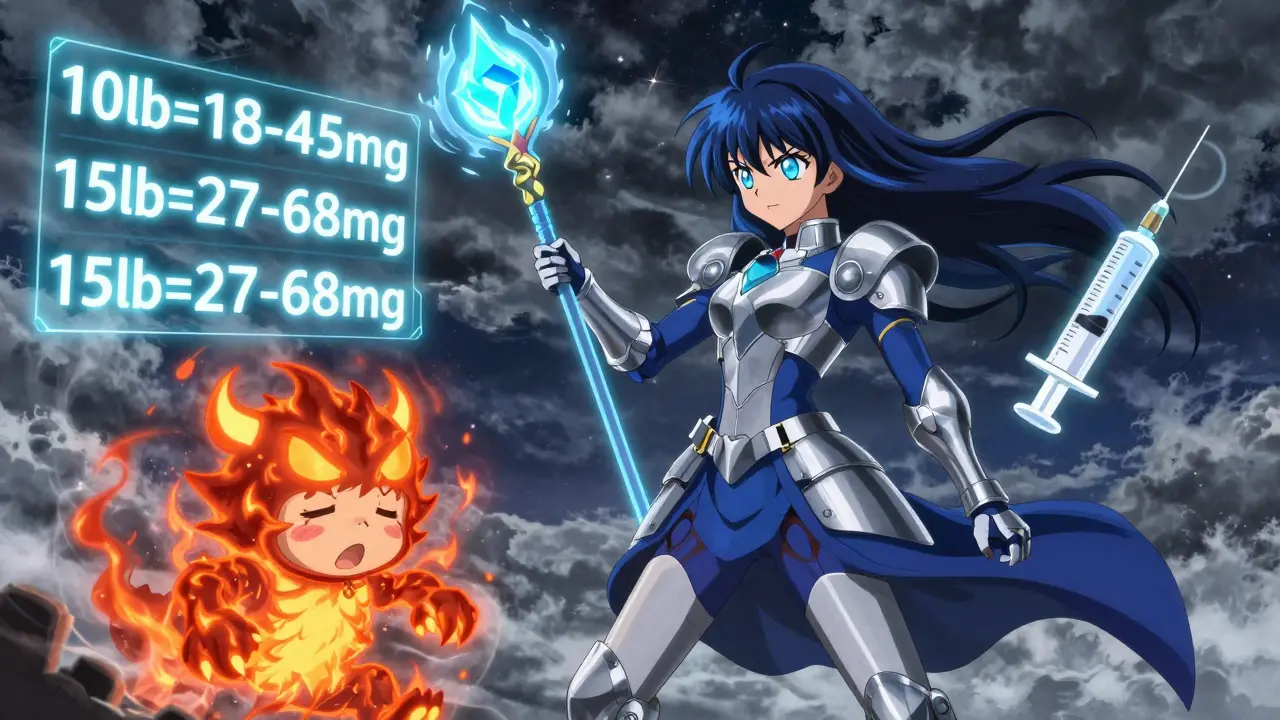
- 10 lb (4.5 kg): Acetaminophen = 32-68 mg; Ibuprofen = 18-45 mg
- 15 lb (6.8 kg): Acetaminophen = 48-102 mg; Ibuprofen = 27-68 mg
- 20 lb (9.1 kg): Acetaminophen = 64-136 mg; Ibuprofen = 36-91 mg
These are per dose amounts. Always check your product’s concentration. Since 2011, infant acetaminophen has been standardized to 160 mg per 5 mL. But older bottles or liquid drops might still say 80 mg per 0.8 mL. Mixing them up is how overdoses happen.
Why Dosing Errors Are So Common
A 2021 audit from a children’s hospital found that 68% of dosing mistakes happened because parents used age-based charts instead of weight. Another 22% of adverse events came from using the wrong tool-like a kitchen spoon or a syringe from a different bottle.
The FDA required all pediatric liquid meds to come with a dosing device since 2020. But many parents still use the old cup that came with the bottle-or worse, guess. Always use the syringe or cup that came with the bottle. Never reuse a syringe from another medicine.
Also, never use adult medicine. A single teaspoon of adult ibuprofen (200 mg) is more than a 20-pound toddler’s entire daily dose. According to the American Association of Poison Control Centers, 17% of pediatric poisonings from fever meds come from accidental ingestion of adult formulations.
Alternating Medications? Don’t Do It Without a Doctor
Many parents alternate acetaminophen and ibuprofen to keep a fever down longer. It sounds smart. But it’s risky.
A 2023 AAP study found that alternating can reduce fever faster-but only if you get the timing and doses exactly right. Most parents don’t. One study showed that 41% of parents who alternated gave doses too close together, increasing overdose risk.
The BabyCenter 2022 survey found 63% of parents alternate. But the AAP doesn’t recommend it unless a doctor is guiding you. If your child’s fever won’t budge after two doses of one medicine, call your pediatrician. Don’t just reach for the other bottle.
Safety Risks You Might Not Know
Acetaminophen is linked to a higher risk of childhood asthma. A 2022 meta-analysis in the European Respiratory Journal found that infants given acetaminophen in their first year had a 1.6 times higher risk of developing asthma by age 3. The reason isn’t clear, but it’s a pattern seen across multiple studies.
Ibuprofen carries a small risk of kidney stress, especially if the child is dehydrated or has an infection. That’s why it’s not recommended for babies under 6 months-those kidneys are still learning how to handle drugs.
But here’s the key: both are safe when used correctly. The risks are real, but they’re tied to misuse-not the medicine itself. The biggest threat isn’t the drug. It’s the wrong dose, the wrong tool, or the wrong timing.
What to Look for on the Label
Check three things before giving any medicine:
- Active ingredient-Is it acetaminophen or ibuprofen? Don’t assume because it’s “children’s” or “infant.”
- Concentration-Is it 160 mg/5 mL? Or 80 mg/0.8 mL? Older bottles are still in homes. Mixing them can cause overdose.
- Dosing device-Did it come with a syringe or cup? If not, don’t use it.
Generic brands are just as effective as brand names. Children’s Tylenol and Children’s Motrin cost about $8-$9 for a 4 oz bottle. But generics, which make up 76% of sales, cost half as much. Save your money-your child won’t know the difference.
When to Call the Doctor
Call your pediatrician if:
- Your child is under 3 months and has a fever of 100.4°F or higher
- Fever lasts more than 72 hours, even with medicine
- Your child is lethargic, won’t drink, or has a rash
- You’ve given the maximum daily dose and the fever won’t break
- You’re unsure how much to give
Don’t wait. Fever is a symptom, not the enemy. It’s your child’s body fighting something. Medicine helps them feel better-it doesn’t cure the cause.
What’s Changing in 2025?
The AAP is updating its fever guidelines in January 2025. They’ll include new data on acetaminophen and asthma risk, and possibly adjust the age cutoff for ibuprofen use in infants. A major clinical trial called PAIN-RELIEF is still underway, testing weight-based dosing in 1,200 children under 2. Early results suggest precise dosing cuts errors by more than half.
For now, stick with the facts: ibuprofen works better for fever, acetaminophen is gentler on the stomach, and both are safe if you dose by weight. The rest is noise.
Bottom Line
For a child over 6 months with a fever, ibuprofen is often the better choice. It lasts longer and works harder. For babies 3-6 months, acetaminophen is the default-unless your doctor says otherwise. For any child under 3 months, call your pediatrician before giving anything.
Always use a dosing syringe. Always measure by weight. Never mix with other meds. And never, ever use adult bottles.
Medicine isn’t magic. It’s science. And when you use it right, it keeps your child safe-and you sane.




Comments
Christina Widodo
January 12, 2026 AT 09:28 AMI used to alternate meds like it was a science experiment until my kid got a stomach bug and I accidentally doubled the ibuprofen dose. Holy hell. ER trip. Now I stick to one at a time and always weigh first. No more guessing.
Also, that 160 mg/5mL standardization? Lifesaver. My mom still has old 80 mg drops lying around. Don’t let that happen to you.
Prachi Chauhan
January 12, 2026 AT 14:26 PMWhy do we even need medicine for fever? Fever is not the enemy. It’s the body’s way of cooking the virus. In my village, we use wet cloths and coconut water. No drugs. Kids recover faster. Why are we so scared of heat? We medicate everything now. Even joy.
Katherine Carlock
January 12, 2026 AT 18:45 PMThank you for this. I’m a new mom and I was terrified of dosing. I printed out the weight chart and taped it to the fridge next to the syringes.
Also, I didn’t know generics were just as good. I’ve been buying Tylenol because I thought it was ‘stronger.’ Nope. Saved $15 this week. Win.
Sona Chandra
January 14, 2026 AT 07:59 AMACETAMINOPHEN CAUSES ASTHMA?? AND YOU’RE JUST TELLING US NOW??
My son got asthma at 2. He got Tylenol for every single cold since he was 2 months old. I’m furious. Who’s responsible for this? Pharma? AAP? My pediatrician? Someone needs to answer for this. I’m filing a complaint. This is negligence.
Jennifer Phelps
January 14, 2026 AT 11:32 AMI always use the syringe that came with the bottle but sometimes I forget to check the concentration and just eyeball it like a moron
Also I did alternate once because my kid was burning up and I thought I was being smart turns out I gave the second dose 3 hours after the first not 6 and now I’m scared to even look at the medicine cabinet
beth cordell
January 15, 2026 AT 03:09 AMTHIS IS SO HELPFUL 🙏🏽 I just saved this to my phone. Also can we talk about how the dosing syringes are the only thing keeping us alive? I used to use a teaspoon and now I’m obsessed with the syringe.
Also I just realized my sister gave her kid adult Motrin once 😱 I had to scream at her over Zoom. WE NEED A PUBLIC SERVICE ANNOUNCEMENT.
Lauren Warner
January 15, 2026 AT 13:58 PMLet’s be real. The AAP doesn’t care about your kid. They’re funded by pharmaceutical lobbyists. The asthma link? Ignored. The kidney risk? Downplayed. The real issue? They want you to keep buying their drugs.
You think this guide is safety advice? It’s marketing. The real solution? Don’t give anything unless the fever is over 104 and even then, sponge baths. Let the immune system do its job.
Craig Wright
January 15, 2026 AT 15:54 PMIt is regrettable that American parenting has become so reliant on pharmaceutical intervention. In the United Kingdom, we are taught that fever is a natural defense mechanism. To medicate prematurely is to undermine the child's own physiology. The emphasis on weight-based dosing is commendable, yet the cultural obsession with rapid symptom suppression is both medically unsound and socially corrosive.
Lelia Battle
January 16, 2026 AT 07:52 AMI appreciate the thorough breakdown. I’ve been using ibuprofen for my 8-month-old since he turned 6 months, and I always double-check the weight.
One thing I wish was emphasized more: hydration. Fever meds help, but if they’re not drinking, nothing else matters. I keep a little cup of water and Pedialyte next to the medicine. Simple, but it’s made all the difference.
Rinky Tandon
January 18, 2026 AT 06:33 AMAcetaminophen is a silent killer disguised as a baby-safe solution. The asthma data is irrefutable. And you’re telling parents to use it for teething? That’s not care, that’s chemical negligence.
Ibuprofen? Fine for 6+ months. But if your kid is under 6 months and you’re giving them ANYTHING besides a cold washcloth, you’re playing Russian roulette with their kidneys.
Stop trusting Big Pharma. Stop trusting AAP. Start reading the studies. I’ve read every single one. And I’m not letting my next child touch either.