Getting the right dose of liquid medicine isn’t just about following the label-it’s about understanding exactly what it says. A single mistake can lead to underdosing, overdosing, or serious side effects. In the U.S., about 1.3 million injuries each year come from medication errors, and nearly half of those involve liquid prescriptions. The good news? The system has changed to make it easier. But you still need to know how to read it right.
What You’ll See on the Label
Every liquid prescription label has three key pieces of information you need to spot right away:- Total container volume - This is how much medicine is in the bottle. Common sizes are 118 mL, 150 mL, or 237 mL. This number tells you how much is inside, not how much to take.
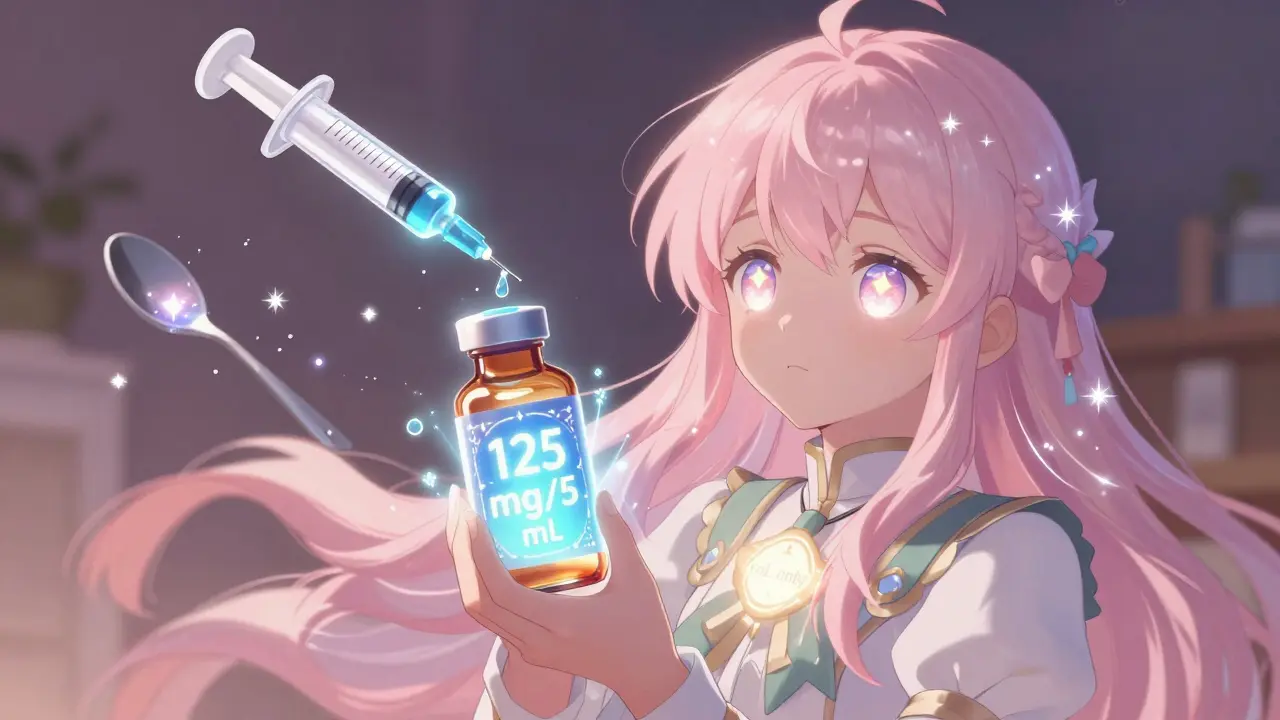
- Concentration - This is the most important part. It looks like this: 125 mg/5 mL. That means every 5 milliliters of liquid contains 125 milligrams of the drug. If your dose is 250 mg, you need two of those 5 mL portions.
- Dosage instructions - This tells you how much to take and how often. It might say: Take 10 mL twice daily. That’s 10 milliliters, two times a day.
Don’t confuse the total volume with the dose. A bottle labeled 150 mL doesn’t mean you take 150 mL. It just means the bottle holds 150 mL total. The dose is always tied to the concentration.
Why Milliliters (mL) Are the Only Unit That Matters
You might still see teaspoons (tsp) or tablespoons (tbsp) on older labels or in your head from past experiences. But those are gone from modern prescriptions. Here’s why:- A teaspoon isn’t always 5 mL. Household spoons vary wildly-from 2.5 mL to over 7 mL. A 2018 study found some tablespoons held as little as 5 mL or as much as 20 mL.
- Milliliters are exact. One mL is always one mL. No guesswork.
- The FDA and the National Council for Prescription Drug Programs (NCPDP) banned non-metric units on prescriptions in 2016. Pharmacies must now use only mL.
Studies show using mL cuts dosing errors by over 50%. A 2017 review in the Journal of Patient Safety found parents using mL measurements were far less likely to give too much or too little. Even small mistakes matter-especially for kids. A child’s body can’t handle even a 2 mL overdose.
How to Read the Numbers: Leading Zeros and No Trailing Zeros
The way numbers are written on the label isn’t random. It’s designed to prevent deadly mistakes.- Always use a leading zero: Write 0.5 mL, never .5 mL. That tiny zero keeps someone from misreading it as 5 mL.
- No trailing zeros: Write 5 mL, never 5.0 mL. A decimal point with a zero after it can make someone think the dose is more precise than it is-and lead to doubling up.
A 2018 Johns Hopkins study found that following these rules reduced 10-fold dosing errors by 47%. That’s nearly half of the most dangerous mistakes. If you see .5 mL or 5.0 mL, double-check with the pharmacist. That label doesn’t meet current standards.
Spacing Matters: 5 mL, Not 5mL
It’s easy to miss, but spacing on the label is intentional. Look for space between the number and the unit: 5 mL, not 5mL.Why? Because without space, people misread it. A 2021 study found that when labels showed 5mL, 12% of caregivers thought it meant 50 mL. That’s a tenfold error. The NCPDP standard requires clear spacing so the number and unit are visually separated. Always check for that space.
Understanding Concentration: The Hidden Key
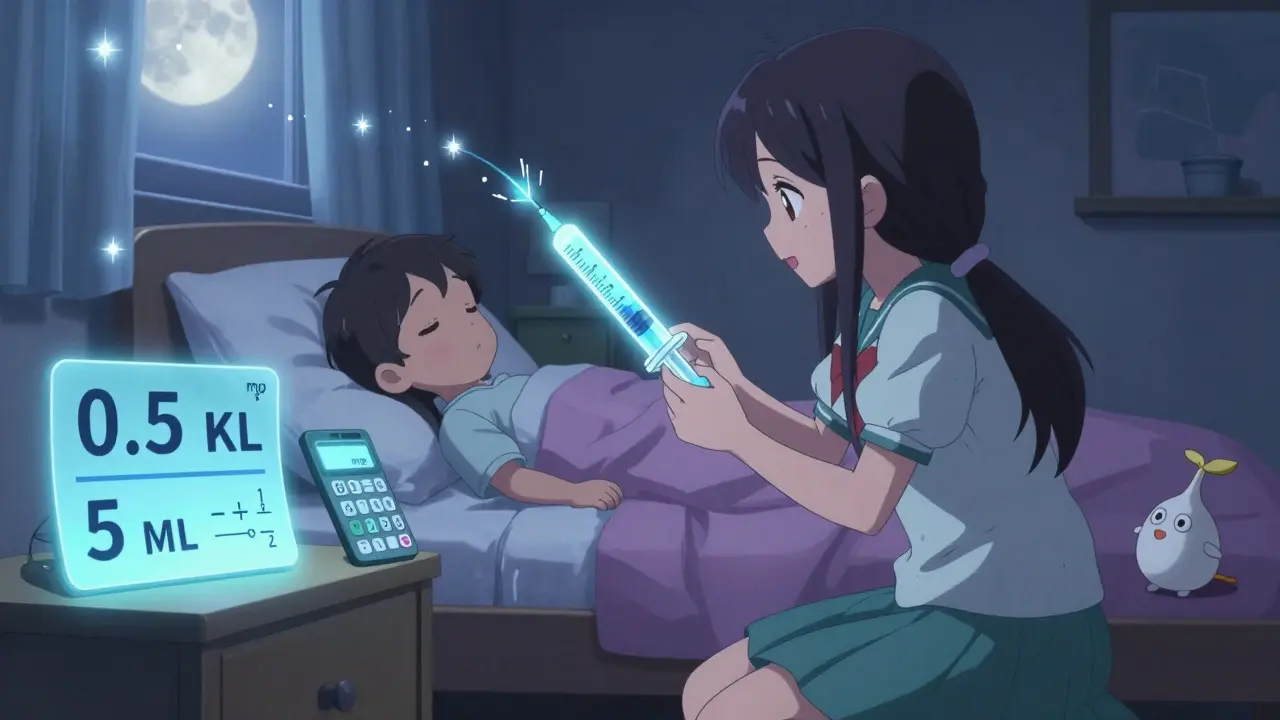
This is where most mistakes happen. You see 240 mg/5 mL and think, “I need 240 mg, so I’ll give 5 mL.” But what if the doctor ordered 120 mg? Then you need half of that 5 mL-so 2.5 mL.Here’s how to calculate it:
- Find the concentration: 120 mg/5 mL
- Find your dose: 60 mg
- Divide: 60 mg is half of 120 mg, so you need half of 5 mL = 2.5 mL
Another example: 160 mg/5 mL, and the dose is 80 mg. You need half of 5 mL = 2.5 mL. If the dose is 240 mg? That’s 1.5 times 160 mg, so 1.5 × 5 mL = 7.5 mL.
Many parents get this wrong. Reddit threads from 2022 show over 1,200 stories of people giving the wrong amount because they didn’t understand concentration. One parent wrote: “I gave my baby 5 mL because the label said 240 mg/5 mL-and didn’t realize the dose was only 120 mg.” That’s a dangerous mistake.
Use the Right Measuring Tool
Never use a kitchen spoon. Even if the label says “1 tsp,” don’t use it. Those spoons aren’t accurate. Instead:- Use the dosing cup, syringe, or dropper that came with the medicine.
- Look for clear markings in mL. Some tools show both mL and tsp-but rely on the mL numbers.
- Oral syringes are best for small doses (under 5 mL). They’re precise and hard to mess up.
- For doses under 1 mL, always use a syringe. A 0.8 mL dose with a cup? Almost impossible to get right.
A 2022 study from Nationwide Children’s Hospital found that parents who got hands-on training with the measuring device made zero errors. Those who didn’t? 39.4% got it wrong.
What If the Label Doesn’t Match the Tool?
Sometimes the label says “Take 7.5 mL,” but the syringe only goes up to 5 mL. Or the cup doesn’t have a 7.5 mL mark. That’s a problem.Here’s what to do:
- Go back to the pharmacy. Ask them to give you a syringe that can measure 7.5 mL.
- They should provide one for free. It’s part of their responsibility under CMS rules.
- If they say no, ask for a second opinion. You have the right to safe dosing tools.
Pharmacies are required to provide measuring devices that match the label. If they don’t, they’re not following FDA and NCPDP guidelines.
Check the Expiration Date and Storage
Liquid medicine doesn’t last forever. Most last 14-30 days after opening. Some need refrigeration. The label should say.- Check the expiration date on the bottle.
- Look for “Discard after” dates.
- Store as directed-some meds lose strength if left at room temperature.
Using expired or improperly stored medicine can mean the dose is too weak. That’s just as dangerous as taking too much.
What If You’re Still Confused?
You’re not alone. Only 12% of U.S. adults have proficient health literacy, according to the National Assessment of Adult Literacy. That means most people struggle with medical terms.Here’s what to do:
- Ask the pharmacist: “Can you show me how to measure this?”
- Use the teach-back method: Repeat the dose back to them. “So, I take 2.5 mL twice a day, right?”
- Take a photo of the label and the measuring tool. Review it later.
- Call the pharmacy if you’re unsure. No question is too small.
A 2021 study from Memorial Sloan Kettering found that using teach-back reduced dosing errors by 63%. It’s simple, free, and saves lives.
What’s Changing in 2026?
The system keeps improving. In January 2023, NCPDP updated its standards:- Labels must use high-contrast printing (black on white).
- Font size must be at least 10-point for all critical info.
- By 2025, CMS may penalize pharmacies with non-compliant labels.
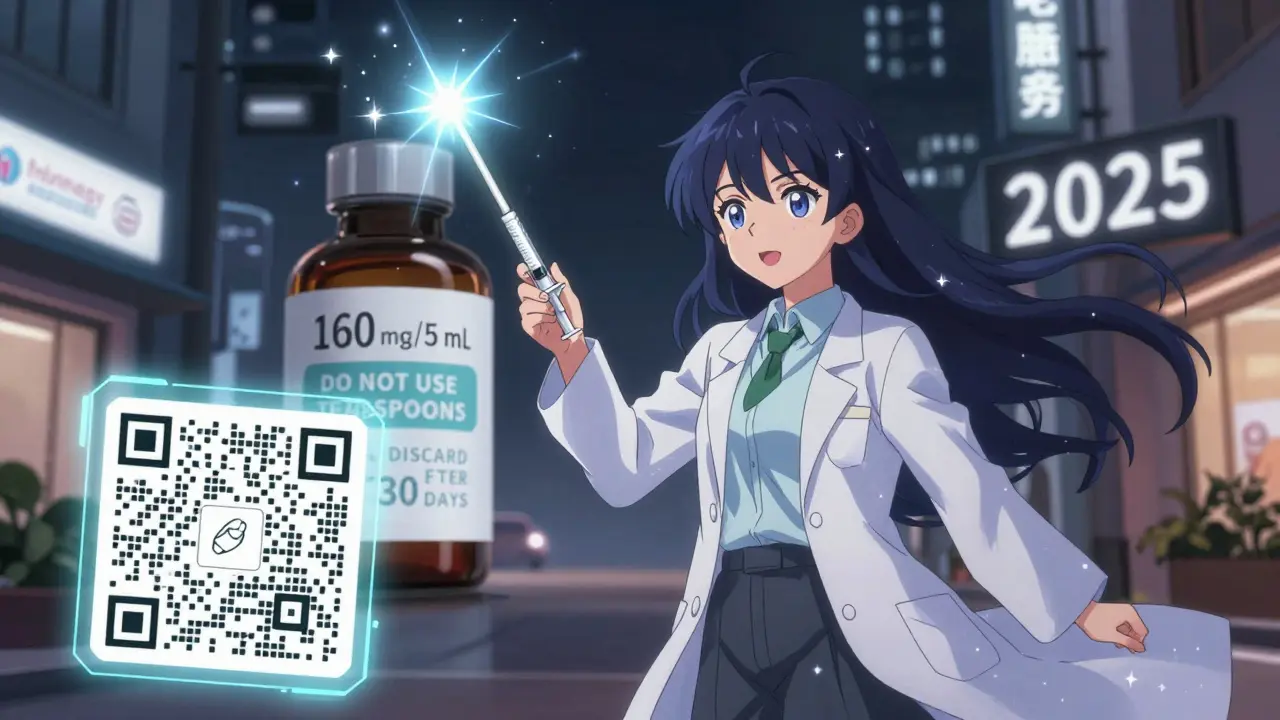
Some pharmacies are testing QR codes on labels. Scan it, and you’ll see a short video showing how to measure the dose. Amazon Pharmacy already uses this-and reports 28% fewer error-related calls.
The American Academy of Pediatrics is rolling out a 2024 program to teach parents how to read labels during routine checkups. That’s a big step forward.
Bottom line: You don’t need to be a doctor to read these labels. You just need to know what to look for-and never guess.



Comments
Joanne Tan
February 12, 2026 AT 07:09 AMomg i just realized i’ve been using a kitchen spoon for my kid’s antibiotics 😅 turns out my ‘tsp’ was closer to 7ml… no wonder she kept getting sick. thanks for this!!
Carla McKinney
February 14, 2026 AT 02:21 AMIt’s not just about reading the label. It’s about the systemic failure of pharmacies to enforce compliance. The FDA’s 2016 rule? Half of the pharmacies I’ve been to still print ‘tsp’ in tiny letters under the mL. It’s a loophole they exploit because they don’t want to buy new printers. This isn’t education-it’s negligence.
And don’t get me started on the ‘teach-back’ method. It’s a performative gesture. Nurses don’t care if you repeat it back-they just want you to leave so they can move on to the next patient. Real change requires audits, not pamphlets.
alex clo
February 15, 2026 AT 06:26 AMWhile the article provides accurate and well-researched guidance, I would like to emphasize the importance of pharmacist-patient communication as a critical safeguard. In clinical practice, even when labels are compliant, miscommunication during dispensing remains a leading cause of error. A structured verbal confirmation, documented in the patient’s record, significantly reduces risk. This should be standardized across all community pharmacies.
Additionally, the mention of QR codes is promising. However, their effectiveness depends on digital literacy and device access-factors that disproportionately affect elderly and low-income populations. A multilingual, audio-assisted version should be mandatory for equity.
Ojus Save
February 16, 2026 AT 01:35 AMhmm so 5ml not 5ml? wait no its 5 mL right? lol i think i got it… but my phone autocorrects mL to ml and now im confused
Jack Havard
February 16, 2026 AT 22:20 PMLet’s be real-this whole system is a distraction. The real issue is that we’re giving children liquid drugs at all. Solid dosage forms are safer, more stable, and easier to dose. Why are we still using syrups? Because Big Pharma makes more profit from them. They’re cheaper to produce, have longer shelf lives, and parents are too scared to ask for pills. This isn’t about milliliters-it’s about corporate greed disguised as safety.
And the ‘leading zero’ rule? That’s a band-aid. If the dose is 0.5 mL, why not just make a 0.5 mL tablet? Simple solution. But they won’t do it because it cuts margins.
Stacie Willhite
February 18, 2026 AT 10:59 AMI’m a nurse and I’ve seen too many parents panic because the syringe didn’t have a 3.75 mL mark. I always carry spare syringes in my bag. If you’re unsure, don’t guess-call the pharmacy. We’ve all been there. You’re not alone. And if you’re reading this and feeling overwhelmed? That’s okay. You’re doing better than you think.
Jason Pascoe
February 19, 2026 AT 07:58 AMInteresting read. As someone from Australia, I can confirm that our pharmacy standards are very similar-strict mL use, no tsp, clear spacing. But I’ve noticed a cultural difference: here, pharmacists routinely sit down with parents and demonstrate dosing. No rush. No paperwork. Just a quiet 5 minutes with a syringe. Maybe that’s the real innovation-not the label, but the human interaction.
Annie Joyce
February 21, 2026 AT 03:49 AMMy kid’s med was 120mg/5mL and the doc said 60mg. I thought ‘half of 5 is 2.5’-so I pulled out the syringe and… froze. My hands were shaking. I ended up calling the pharmacy three times. Turns out, I wasn’t dumb-I was terrified. That’s the real problem. We’re not teaching people how to measure. We’re teaching them how to panic.
Now I use a sticky note on the fridge: ‘Dose = 2.5 mL. Twice a day. Syringe = red cap.’ Simple. Visual. Calming. If you’re scared, write it down. You deserve to feel safe.
Rob Turner
February 23, 2026 AT 02:13 AMInteresting how we’ve turned medicine into a puzzle. We’ve removed teaspoons, added leading zeros, mandated spacing-yet still, people make errors. Perhaps we’re over-engineering the solution. The human brain isn’t built for decimal precision under stress. Maybe what we need isn’t more rules-but more trust. Trust in the pharmacist. Trust in the process. Trust that you’re not alone in not knowing.
Also, I’ve never seen a QR code on a prescription. Is that even real? Or just wishful thinking? 😅
Luke Trouten
February 23, 2026 AT 10:41 AMThe underlying philosophy here is commendable: precision as a form of care. But we must also acknowledge the emotional labor involved. Reading a label correctly isn’t just cognitive-it’s emotional. Fear, fatigue, grief, or anxiety can distort perception. The ideal system doesn’t just require accurate labels-it requires emotional support structures. We measure doses in milliliters, but we heal in human moments.
Gabriella Adams
February 25, 2026 AT 04:43 AMAs a pediatric pharmacist, I can confirm: the most dangerous errors occur when caregivers rely on memory instead of the written label. One mother told me she ‘remembered’ the dose as 5 mL because ‘that’s what we always did.’ The label said 2.5 mL. The child nearly died. This isn’t about literacy-it’s about habit. The cure? Repetition. Visualization. Routine. Don’t rely on your brain. Let the label do the thinking for you.
Kristin Jarecki
February 25, 2026 AT 04:49 AMWhile the technical details are sound, I would urge all readers to consider the broader context of health equity. Not everyone has access to calibrated syringes. Not everyone can visit a pharmacy in person. Not everyone speaks English as a first language. The burden of compliance falls disproportionately on marginalized communities. Systemic change requires not just better labels-but better access, better translation, and better advocacy.
Rachidi Toupé GAGNON
February 25, 2026 AT 13:46 PMBoom. 2.5 mL. Syringe in hand. Kid’s fine. 🙌