
Most people don’t realize how much their prescription drug costs can change - even if they stay with the same insurance plan. One year you pay $15 for your blood pressure med. The next, you’re handed a bill for $120. No warning. No explanation. Just a pharmacy counter and a shocked face. That’s not a mistake. It’s a gap in understanding your coverage.
Is your medication even on the list?
Every insurance plan has a formulary - a list of drugs it covers. But not all formularies are created equal. Some cover hundreds of generics. Others barely list the brand-name drugs you’ve been taking for years. The first question you need to ask: "Is my exact medication on the formulary?" Don’t assume. Don’t guess. Check. Even if your plan says it covers "all prescription drugs," it doesn’t mean yours. Some plans exclude newer drugs, off-label uses, or medications deemed "non-essential." Others put your drug in a higher tier just to make you pay more. If you take insulin, antidepressants, or a specialty drug for arthritis or MS, this isn’t optional. It’s critical.What tier is your drug on?
Formularies are split into tiers. Each tier has a different price. Here’s how it usually breaks down:- Tier 1: Generic drugs - usually $10-$20 copay
- Tier 2: Preferred brand-name drugs - $30-$50 copay
- Tier 3: Non-preferred brand-name drugs - $75-$125 copay
- Tier 4: Specialty drugs - 25%-33% coinsurance, often $500+ per prescription
How much do you pay before coverage starts?
Many plans have a deductible for prescriptions. That means you pay 100% of your drug costs until you hit that number. For Bronze Marketplace plans, that deductible can be $6,000. For Gold plans, it’s often under $150. If you take multiple medications, a high deductible could mean you’re paying $800 in the first month just to get your pills. Ask: "Is there a separate prescription deductible?" Some plans bundle it with medical costs. Others keep it separate. If your plan has a $1,000 drug deductible and you need three prescriptions a month, you’re looking at $3,000 before your insurance kicks in. That’s not affordable for most people.Do you have to try cheaper drugs first?
This is called step therapy. Your plan might require you to try a cheaper drug before they’ll pay for the one your doctor prescribed. For example: you need a biologic for rheumatoid arthritis, but your plan says you must try methotrexate first. Even if you’ve tried it for years and it didn’t work. Even if your doctor says it’s unsafe. Step therapy is used in 37% of specialty drug cases. It delays treatment. It causes frustration. And it can make your condition worse. Ask: "Does this plan require step therapy for my medications?" And if yes: "How do I request an exception?"
Do you need prior authorization?
Prior authorization means your doctor has to get approval from your insurer before you can fill the prescription. It can take days. Sometimes weeks. For drugs like cancer treatments, mental health meds, or rare disease therapies, delays can be dangerous. 28% of Medicare Part D prescriptions require prior authorization. That’s almost one in three. And if your doctor forgets to submit the paperwork? You get turned away at the pharmacy. Ask: "Which of my medications need prior authorization?" Then ask: "How long does it usually take to get approved?"Where can you fill your prescriptions?
Your plan might only cover drugs from certain pharmacies. This is called a network. If you use an out-of-network pharmacy, you could pay 37% more - or the plan might not cover it at all. Some plans only work with CVS, Walgreens, or Walmart. Others limit you to mail-order for maintenance drugs. If you live in a rural area or rely on a local pharmacy, this matters. Ask: "Which pharmacies are in-network?" And: "Can I use my local pharmacy, or do I have to switch to mail-order?"What’s the monthly cost?
Premiums are only part of the story. You also pay copays, coinsurance, and deductibles. A low-premium plan might look great - until you realize you’re paying $1,200 a month for your specialty drug. That’s why you need to calculate your total annual cost. For example: if you take 12 medications a year, a Bronze plan might save you $200 in premiums - but cost you $1,842 more in out-of-pocket drug expenses than a Gold plan. That’s a net loss. Ask: "What will I pay annually for my medications, including premiums, copays, and deductibles?" Use the plan’s online tool. Enter your exact drugs and pharmacy. Don’t trust estimates.What happens if you hit the coverage gap?
If you’re on Medicare Part D, you might hit the "donut hole." That’s when your out-of-pocket costs jump after you spend $5,030 on drugs in 2024. You pay 25% of the cost until you hit $8,000. Then catastrophic coverage kicks in. But starting in 2025, that gap disappears. And insulin will cost no more than $35 a month. Still, if you’re on a high-cost drug now, you need to know how your plan handles the gap. Ask: "How does this plan handle the coverage gap?" And: "Will I qualify for any discounts before 2025?"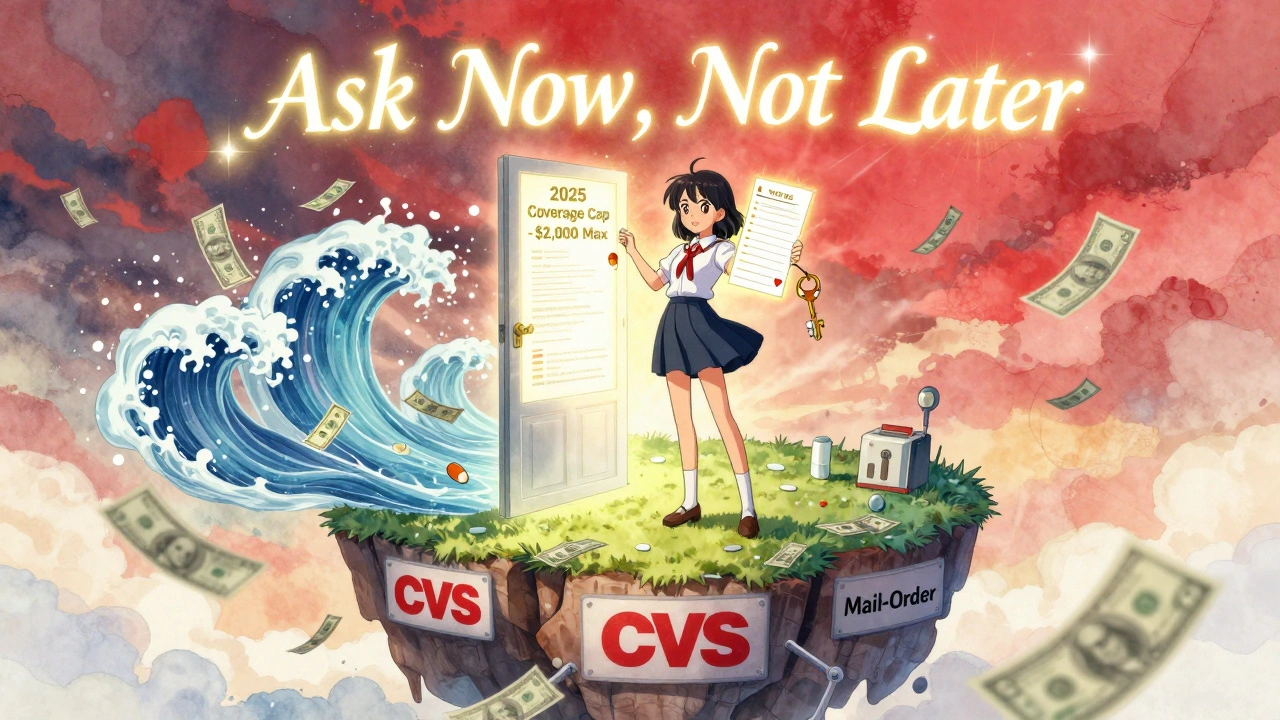
Can you switch plans if your coverage changes?
You can’t switch your plan just because your drug got dropped or your copay went up. You’re stuck until the next enrollment period. Marketplace plans: Open enrollment runs from November 1 to January 15. Medicare Part D: Annual Election Period is October 15 to December 7. If your drug is removed from the formulary in March, you wait until next fall to switch. That’s why checking now matters. Ask: "Can I change plans mid-year if my medications are no longer covered?" The answer is almost always no - unless you qualify for a special enrollment period. That’s rare. Don’t count on it.What’s changing in 2025?
New rules are coming. Starting in 2025, Medicare Part D will cap your out-of-pocket drug costs at $2,000 a year. That’s a huge shift. But private plans aren’t required to follow it. So if you’re on an employer plan or a Marketplace plan, you’re not protected. Also, Medicare will start negotiating prices for 20 high-cost drugs. That could lower premiums. But it won’t help you until 2026 or later. For now, focus on what you can control: your current plan, your medications, and your pharmacy.What to do next
Here’s your checklist:- Make a list of every medication you take - including dosage and frequency
- Go to your plan’s website and enter those drugs into their formulary checker
- Check your pharmacy network - do you use an in-network location?
- Calculate your total annual cost: premiums + copays + deductibles
- Call customer service and ask: "Is my drug on the formulary? What tier? Any prior auth or step therapy?"
- Write down the answers. Keep them in your wallet.
People don’t realize it, but 63% of shoppers in 2022 didn’t check their drug coverage until after they enrolled. Then they got stuck. One man in Ohio paid $3,700 for a single prescription because his Silver plan had a $500 copay cap - and his drug was priced at $4,200. He didn’t know. He didn’t ask. He just assumed.
You don’t have to be that person.
Does every insurance plan cover prescription drugs?
Yes, all Marketplace plans under the Affordable Care Act must include prescription drug coverage. Medicare Part D also covers drugs. Employer plans usually do too - about 85% include it. But coverage doesn’t mean your specific drugs are included. Always check the formulary.
What if my drug isn’t on the formulary?
You can ask for an exception. Your doctor needs to submit a letter explaining why the covered alternatives won’t work for you. This is called a "formulary exception request." Approval isn’t guaranteed, but it’s your only option if you need that drug. Don’t assume it’s denied - ask.
Can I switch plans mid-year if my medication is dropped?
Almost never. You’re locked in until the next open enrollment period - unless you qualify for a special enrollment event like losing other coverage, moving, or gaining Medicare eligibility. If your drug is removed, you may have to pay full price or switch to a cheaper alternative - even if your doctor disagrees.
Are generic drugs always cheaper?
Usually, yes. Generics are the same active ingredient as brand-name drugs but cost much less. But sometimes, the brand-name drug is on Tier 2 while the generic is on Tier 3 - meaning you pay more for the generic. Always check the tier, not just the name.
Why does my copay change every year?
Plans update formularies annually. A drug might move from Tier 1 to Tier 2. A new generic might replace your brand-name drug. Or the plan might raise copays to control costs. Always review your plan’s formulary changes during open enrollment - even if you’re happy with your current plan.
How do I know if I’m in the Medicare Part D coverage gap?
You’re in the gap when your total drug costs (what you pay + what your plan pays) reach $5,030 in 2024. You’ll get a notice from your plan, and your pharmacy will tell you at checkout. After $8,000, catastrophic coverage starts. Starting in 2025, the gap disappears entirely.
Should I choose a higher-premium plan if I take a lot of medications?
Yes. If you take 10+ prescriptions a year, a Gold or Platinum plan often saves you money. Higher premiums mean lower copays and lower deductibles. One person saved $1,842 a year by switching from a Bronze to a Gold plan - even though the premium went up $200. Total cost dropped by $1,642.
Can I use a discount card instead of insurance?
Sometimes. Discount cards like GoodRx can be cheaper than your insurance copay - especially for generics. But they don’t count toward your deductible or out-of-pocket maximum. If you’re trying to reach catastrophic coverage, use your insurance. If you’re just paying out of pocket, compare the card price with your insurance price first.
What to do if you’re confused
If you’re overwhelmed, call your plan’s customer service. Have your drug list ready. Ask for a formulary document. Ask for a summary of your costs. Don’t let them hang up on you. If you’re on Medicare, contact your State Health Insurance Assistance Program (SHIP) - they offer free, unbiased help.Prescription drug coverage isn’t just about price. It’s about access, timing, and predictability. The difference between paying $20 and $1,000 for a pill isn’t luck. It’s knowing the right questions to ask - before you fill your prescription.





Comments
Kelly Essenpreis
December 2, 2025 AT 10:33 AMWhy do we even bother with insurance? My last script cost more than my rent. Just pay cash or rob a bank.
Suzanne Mollaneda Padin
December 3, 2025 AT 01:08 AMThis is exactly why I keep a printed formulary sheet in my wallet. I learned the hard way when my insulin jumped from $30 to $280 overnight. Always check the tier, not just the name. It’s not laziness-it’s survival.
Erin Nemo
December 3, 2025 AT 03:36 AMI just checked my plan and my antidepressant moved to tier 3. I’m done. Going to GoodRx tomorrow.
Rachel Stanton
December 5, 2025 AT 00:47 AMStep therapy is a nightmare. My doctor prescribed a biologic for my RA, but my plan forced me to try three generics first. Two of them gave me hives. I had to appeal, submit medical records, and wait six weeks. By then, my joints were screaming. Don’t wait-file the exception request the day you get the denial letter.
Lauryn Smith
December 6, 2025 AT 07:06 AMI used to think premiums were the only thing that mattered. Then I switched from bronze to gold because I take 7 meds. My out-of-pocket dropped from $2,100 to $300. The premium went up $150. I saved $1,650. It’s not a luxury-it’s math.
Kenny Leow
December 7, 2025 AT 00:03 AMI’m from Singapore, and I’ve seen how their drug pricing works. Here, you pay what the market says. There, they negotiate bulk. It’s not magic-it’s policy. We need that here. 🙏
Edward Hyde
December 8, 2025 AT 13:12 PMInsurance companies are just glorified loan sharks with a formulary. They don’t care if you live or die-they care if you hit your deductible before Christmas. And if you don’t? They’ll just raise your copay next year. It’s a pyramid scheme with pills.
Alexander Williams
December 9, 2025 AT 16:32 PMThe formulary tier structure is a classic example of price discrimination based on pharmaceutical R&D amortization models. However, the lack of transparency in tier reclassification violates the principle of consumer informed consent. The FDA doesn’t regulate this. CMS doesn’t audit it. And the PBMs? They’re the real villains.
Charlotte Collins
December 10, 2025 AT 15:35 PMYou all think this is bad? Try being on Medicaid in a state that didn’t expand. I had to wait 11 months for my MS med because the state wouldn’t approve prior auth. Meanwhile, my neurologist kept saying, 'I’m sorry, but your plan says no.' No one’s accountable. No one’s punished. Just patients dying quietly.
Bonnie Youn
December 11, 2025 AT 09:05 AMDO NOT WAIT UNTIL YOU’RE AT THE PHARMACY. I did. My husband’s chemo med was dropped. We had to pay $9,000 out of pocket. We cried. We sold his guitar. We’re still paying it off. Check your plan. TODAY. You can’t unring this bell
ariel nicholas
December 12, 2025 AT 02:38 AMYou people are so obsessed with 'formularies' and 'tiers'... but have you considered that the entire system is a capitalist hallucination? The real problem is that we let corporations decide who gets to live. Your $35 insulin cap? A PR stunt. The real fix is single-payer. Or revolution. Pick one.
Margaret Stearns
December 13, 2025 AT 18:16 PMI just called my plan and asked about my meds. The rep said 'I can't give you that info over the phone.' I said 'then what good are you?' She hung up. So I emailed them. Got a response in 3 days. Took me 2 hours to find the formulary PDF on their site. It's like they want you to fail.
Amber-Lynn Quinata
December 14, 2025 AT 13:45 PMI’m so tired of people acting like this is normal. You’re not 'just lucky' if you can afford your meds. You’re privileged. And if you’re not checking your formulary? You’re part of the problem. 🤦♀️
Scotia Corley
December 16, 2025 AT 04:58 AMThe failure of American pharmaceutical policy is not a matter of individual negligence, but a systemic collapse of fiduciary responsibility. The absence of federal price controls constitutes a violation of the social contract. One must question the moral legitimacy of a system wherein life-saving pharmaceuticals are subject to quarterly earnings reports.
amit kuamr
December 17, 2025 AT 03:02 AMIn India we pay 10 dollars for same drug. Here you pay 1000. Why? Because you let them. You dont fight. You just pay. You think this is fair? No. You are weak